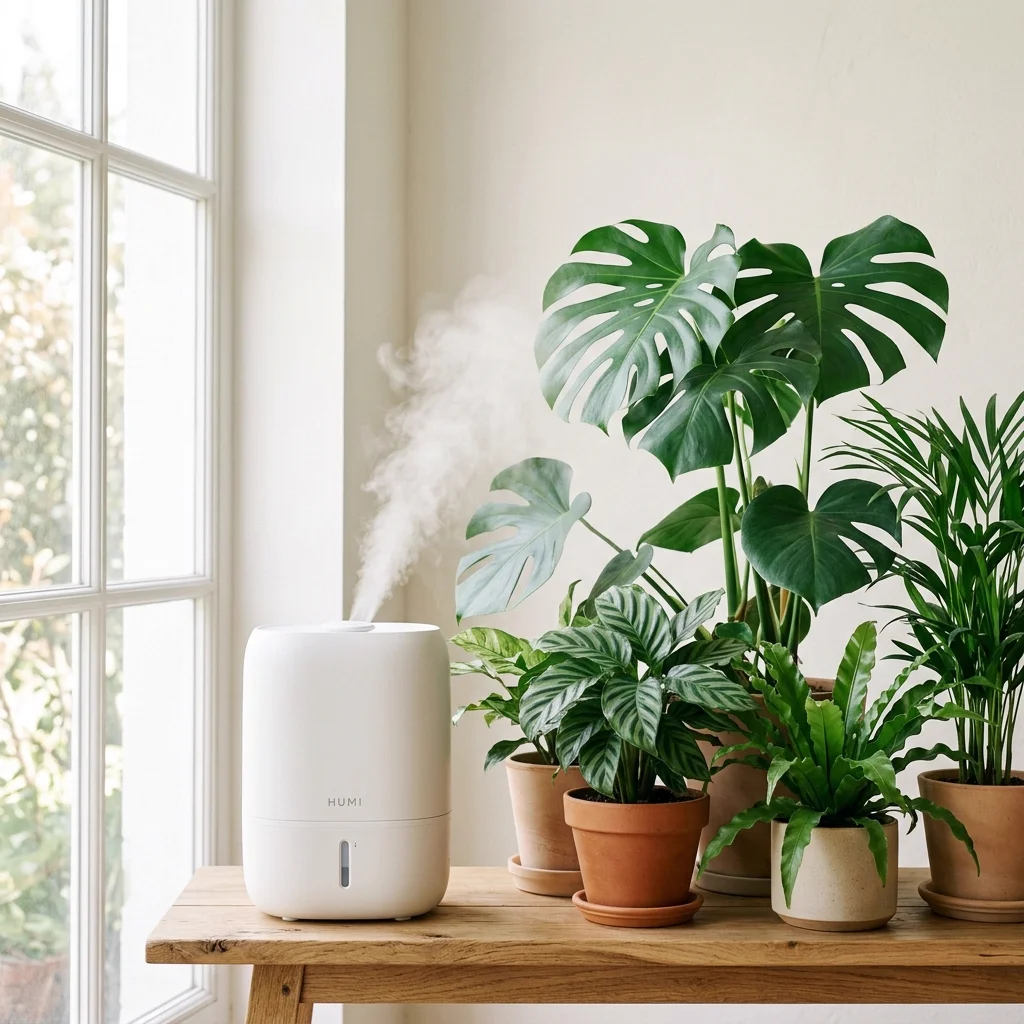
Dry winter air is a real problem for some houseplants, and a humidifier can help. It is also a water appliance that needs daily attention. This guide helps you decide whether your plants need one and which type to choose. We have not compared or ranked individual models, so there are no product picks here.
Do your plants need more humidity?
Iowa State Extension says many houseplants prefer 40 to 50 percent relative humidity. In winter, many homes fall to 10 to 20 percent. Iowa State lists the results of low humidity as slow growth, dried-up flower buds, and brown leaf tips and edges. The RHS explains why: in dry air, plants lose water through their leaves quickly and can wilt if roots cannot keep up.
Brown tips have other causes too, including salts and uneven watering. Measure first. Our guide to houseplant humidity and measurement shows how to log readings at the plant.
University of Maryland Extension says that, apart from cacti and succulents, all indoor plants benefit from extra humidity nearby. Some need it far more than others.
| Plant | Humidity guidance | Source |
|---|---|---|
| Bird’s nest fern | 60% or higher; a humidifier nearby in winter, or a pebble tray | RHS; Clemson HGIC |
| Stromanthe ‘Triostar’ | 60% or higher | RHS |
| Variegated monstera | 60–80% | RHS |
| Philodendron melanochrysum | 60–80% | RHS |
| Anthurium andraeanum | 60–80% | NC State |
| Anthurium crystallinum | Around 70% or higher | RHS |
| Moth orchid | High humidity | NC State |
| African violet | 40–60% | University of Minnesota |
| Foliage begonias | A humid environment | Clemson HGIC |
Plants that cope with ordinary indoor air include cacti and succulents (Maryland), and several Iowa State lists as tolerating low humidity: ZZ plant, ponytail palm, peperomia and cast iron plant. The RHS says syngonium and kentia palm adapt to average household humidity.
The misting myth
Misting looks like it should help. Iowa State is direct: “misting does not raise humidity levels for more than a few minutes,” which makes it “an impractical and ineffective way to raise humidity.” Foliage dries quickly, so you would have to mist several times a day. Iowa State adds that misting “can also easily promote and help spread certain diseases.”
University of Maryland Extension calls it “questionable” whether misting increases humidity. If you do mist, use tepid water early in the day so leaves dry by evening. Do not mist fuzzy-leaved plants such as African violets. Iowa State notes rex begonias “are not fond of water on their foliage,” and Clemson says misting is not recommended for foliage begonias.
Misting does have one use: Iowa State says it can clean dust off leaves.
Cheaper fixes to try first
All of these appear in Iowa State, Maryland, Minnesota or RHS guidance:
- Group plants together. Water evaporating from potting mix and leaves raises humidity around the group.
- Use a pebble tray. Stand pots on gravel or clay pellets in a tray of water. Keep the pot base above the waterline, or the mix stays wet and roots rot (Iowa State).
- Use a terrarium for small plants. Iowa State calls it an excellent way to hold moisture around them.
- Choose the room. The RHS suggests a steamy bathroom for many tropicals, given enough light.
These raise humidity locally, which matters for the next section.
Humidifier types compared
The US EPA groups home humidifiers by how they put water into the air:
| Type | How it works | What the EPA says to watch |
|---|---|---|
| Ultrasonic | Ultrasonic vibrations create a cool mist | Among the greatest dispersal of minerals and microorganisms from the tank |
| Impeller (“cool mist”) | A fast-spinning disc creates a cool mist | Among the greatest dispersal of minerals and microorganisms |
| Evaporative | A fan blows air through a wet wick, belt or filter | Not expected to disperse substantial minerals; a tank of standing water can still grow microbes |
| Steam vaporizer and “warm mist” | An element heats water to steam; warm mist cools the steam before release | Not expected to disperse substantial minerals; steam and hot water can cause burns |
Units come as portable, floor-standing console, or central models built into heating systems.
White dust
The EPA says ultrasonic and impeller humidifiers are “very efficient at dispersing minerals in tap water into the air.” That can show up as white dust on surfaces. Minerals also build up as scale, which the EPA calls a breeding ground for microorganisms. Its advice:
- Use bottled water labelled distilled. Water labelled spring, artesian or mineral has not been demineralised.
- Demineralisation cartridges, cassettes or filters vary widely. White dust is a sign they are not working.
- In hard-water areas, distilled water may cost less than cartridges.
Our humidifier cleaning, water and white dust guide covers this in more detail.
Cleaning: the part that decides which unit you should buy
The EPA routine for portable units:
- Daily: unplug, empty the tank, wipe all surfaces dry and refill with fresh water.
- Every third day: unplug, empty and scrub away scale, deposits or film.
- Cleaning products: follow the maker’s instructions. Without them, the EPA suggests a 3% hydrogen peroxide solution, then several rinses so no chemicals are released into the air.
- End of season: clean, dry all parts and store dry.
The EPA advises stopping use and seeing a doctor if you have breathing symptoms you link to the humidifier. Before buying, check that you can reach every surface that touches water.
How humid is too humid?
The EPA says not to humidify a home above 50 percent relative humidity, because higher levels may encourage mould and dust mites. Some tropicals in the table above want 60 percent or more. Do not push a whole room past 50 percent for them. Use a humidifier to lift dry winter air toward 40–50 percent, and grow the most demanding plants in a group, on a pebble tray or in a terrarium.
Use a separate hygrometer. The EPA says that if water condenses on windows, walls or pictures, you should move the humidifier, lower its setting or run it less. Keep carpets, curtains and nearby surfaces dry. For distances and room sizing, see where to put a plant humidifier.
A short buying checklist
- Type: decide between mineral dispersal (ultrasonic, impeller) and burn risk (steam).
- Output control: a humidistat or adjustable output, so you can stay under 50 percent.
- Cleanability: a wide tank opening and parts you can reach and dry.
- Water: whether the maker allows tap water, distilled water or a cartridge.
- Consumables: availability of wicks, filters or cartridges.
- A hygrometer: bought separately, placed near the plants but out of the mist.
References
- US Environmental Protection Agency: Use and Care of Home Humidifiers
- Iowa State University Extension and Outreach: How to Care for Houseplants
- Iowa State University Extension and Outreach: How can I raise the relative humidity indoors for my houseplants?
- Iowa State University Extension and Outreach: The air in our home is extremely dry in winter. Should I mist the houseplants?
- Iowa State University Extension and Outreach: Would it be helpful to mist a rex begonia during the winter months?
- Iowa State University Extension and Outreach: Easy low-maintenance houseplants
- University of Maryland Extension: Temperature and Humidity for Indoor Plants
- University of Minnesota Extension: Growing African violets
- NC State Extension Gardener Plant Toolbox: Anthurium andraeanum and Phalaenopsis
- Clemson Cooperative Extension HGIC: How to Grow and Care for Bird’s Nest Fern
- Clemson Cooperative Extension HGIC 1552: Growing Begonias Indoors
- Royal Horticultural Society: How to grow houseplants
- Royal Horticultural Society: Care tips for thirsty houseplants