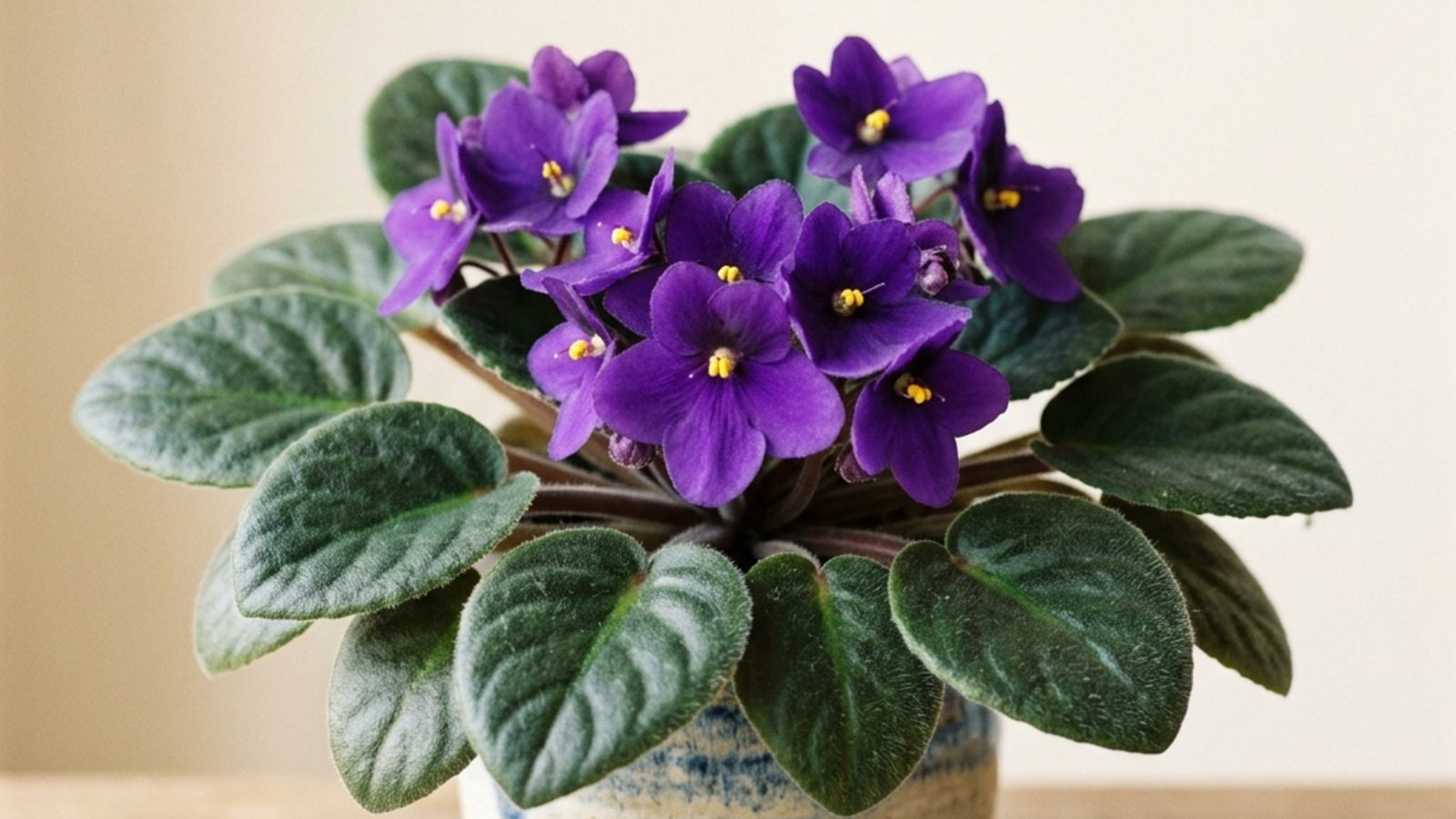
African violets can flower for most of the year indoors. Clemson Extension says they bloom 10 to 12 months a year in good conditions, with each flower cluster lasting three to six weeks. When they stop, the cause is usually light, and the fix is usually a move.
The African violet is now classified as Streptocarpus ionanthus, formerly Saintpaulia ionantha, in the gesneriad family (NC State Extension). It is native to Tanzania. Thousands of cultivars exist, in size classes from micro-miniature to large, with rosette or trailing habits.
African violet care at a glance
| Factor | Guidance |
|---|---|
| Window light | Bright, no direct afternoon sun; within 90 cm (3 ft) of a large south, east or west window (Clemson) |
| Grow lights | About 600 foot-candles for 15 hours a day under fluorescent tubes (Purdue, Colorado State) |
| Night temperature | 18–21 °C (65–70 °F) (Clemson, Purdue, Colorado State) |
| Day temperature | Up to 27–29 °C (80–85 °F) (Clemson); above 27 °C (80 °F), growth and flowering slow (Purdue) |
| Watering | When the top 2.5 cm (1 in) feels dry (Purdue); never bone dry or soggy (AVSA) |
| Humidity | High; 40–50% is ideal for buds (AVSA) |
| Mix | Light, porous: equal parts peat, perlite and vermiculite (AVSA) |
| Pot | About one-third the diameter of the plant (AVSA) |
| Pets | Non-toxic to dogs, cats and horses (ASPCA) |
Light: the key to reblooming
African violets need more light than most growers think, according to Purdue Extension. Read the leaves:
- Too little light: thin, dark green leaves on long stalks, and few flowers (Clemson, Purdue). The AVSA adds that leaves reach upward toward the light.
- Too much light: stunted plants with short stalks and small, crinkled, leathery leaves (Purdue). Colorado State adds pale or yellowish-green leaves.
At a window. Clemson suggests a spot within 90 cm (3 ft) of a large south, east or west window that gets no direct afternoon sun. The AVSA puts plants 30–45 cm (12–18 in) from the glass and calls east windows ideal. Purdue says north or east windows are usually best, especially in summer. University of Missouri Extension advises moving violets to a north window, or to the side of a large south window, from late spring to early autumn to prevent sunburn. Turn the plant occasionally for even growth (Purdue).
Under lights. Missouri Extension calls African violet one of the most satisfactory flowering plants for growing under lights. The sources differ on hours because fixtures differ:
- Purdue and Colorado State: about 600 foot-candles for 15 hours a day, from two 40-watt fluorescent tubes 30–38 cm (12–15 in) above the plants.
- Clemson: 15–30 cm (6–12 in) below two 40-watt tubes for 15–18 hours a day.
- The AVSA: lights 25–30 cm (10–12 in) above the leaves for 10–12 hours, noting that newer energy-efficient lights may need fewer hours.
Start in the middle of these and adjust by the leaf signs above. Our African violet grow light guide compares fixtures.
Watering without spots or rot
Clemson says excessive watering is one of the most common African violet problems, because the plants are very susceptible to crown and root rot. Underwatering harms them too: the AVSA notes buds dry off when a plant dries out completely.
How to water:
- Check first. Water when the top 2.5 cm (1 in) of mix feels dry (Purdue), or when the surface feels dry (Colorado State). Do not wait until the mix is hard or the plant wilts.
- Top or bottom. From the top, saturate the mix and let it drain. From the bottom, stand the pot in about 2.5 cm (1 in) of water until the surface is moist, then remove it and discard the excess (Clemson).
- Keep water off the leaves and crown. Clemson says cold water on the leaves causes white blotches and yellow or white ring patterns. Use room-temperature water.
- Never leave it standing in water for more than a few minutes (AVSA).
- Flush salts. If you bottom-water or use a wick, salts collect at the top of the mix. Purdue advises flushing with water from the top about once a month.
Temperature and humidity
Clemson, Purdue and Colorado State agree on night temperatures of 18–21 °C (65–70 °F). NC State warns that nights below 16 °C (60 °F) stunt the plant, with a long recovery. Purdue says chilled violets turn dark within 24 hours, become water-soaked, then wither. Keep leaves off cold glass in winter.
For humidity, the AVSA suggests 40–50%. Purdue and Colorado State suggest a tray of gravel or perlite with a shallow layer of water, with the pot sitting above the water, not in it.
Potting mix, pot size and repotting
African violets need a loose, porous mix. NC State suggests 2–3 parts sphagnum peat, 2 parts vermiculite and 1 part perlite, with lime to balance the peat’s acidity, or coir. The AVSA suggests equal parts peat, perlite and vermiculite, or a commercial violet mix cut half and half with perlite. Purdue gives a target pH of 6.0–6.5.
Pot size matters for flowering. The AVSA recommends a pot about one-third the diameter of the plant, usually no more than 5–8 cm (2–3 in) deep, because violets bloom when their roots are crowded. Always use drainage holes (Clemson).
Crown height. Plant with the crown above the mix surface (NC State). Clemson’s disease factsheet lists planting too deeply as a cause of crown rot. On clay pots, Purdue and Colorado State suggest tape or foil on the rim. Salts on the rim can rot leaf stalks that touch it.
Feeding
The AVSA notes that starving violets lack energy to bloom. It suggests a mild violet fertilizer weekly, at a quarter of the monthly label rate. Colorado State suggests every four to six weeks at the label rate. Both agree on the risk: Purdue and Colorado State say over-fertilizing is usually a bigger problem than under-fertilizing.
Signs it needs feeding: paler leaves and slower growth (Purdue), or fewer, smaller flowers (Colorado State). Purdue says winter feeding can be skipped unless the plants grow under lights.
Grooming and suckers
The AVSA recommends checking each plant every week or two and removing:
- faded flowers and their stalks;
- small, immature leaves at the bottom of the rosette;
- yellowing leaves;
- suckers, the side shoots that form a second crown and reduce flowering.
To tell a sucker from a bloom stalk, the AVSA says a shoot with two leaves may be a bloom stalk, while three or more leaves means a sucker. Remove suckers while small. They can be rooted as new plants.
Propagation. Purdue recommends rooting mature, not old, leaves with 2.5–4 cm (1–1.5 in) of stalk attached.
Pests and diseases
Clemson’s African violet disease factsheet highlights:
- Crown and root rot (Pythium, Phytophthora): soft, mushy crown and roots, drooping older leaves, and stunted or blackened centre leaves. Causes are overwatering, poor drainage and deep planting.
- Botrytis blight: grey, fuzzy growth on leaves and flowers. Remove dead material and keep foliage dry.
- Cyclamen mites: severely stunted, hairy, greyish centre leaves and buds that fail to open. Clemson recommends isolating infested plants and discarding badly infested ones. See our cyclamen mite identification guide.
- Mealybugs: cottony white masses in leaf axils. Remove light infestations with a swab dipped in rubbing alcohol.
Clemson also notes that flower buds can fail and drop in low temperatures, wet or poorly aerated soil, very dry air or exposure to cooking gas.
Pets
The ASPCA lists African violet as non-toxic to dogs, cats and horses.
References
- NC State Extension Gardener Plant Toolbox: Streptocarpus ionanthus
- Clemson Cooperative Extension HGIC 1550, N. Doubrava and R. F. Polomski: African Violet
- Clemson Cooperative Extension HGIC 2250 (2026): African Violet Diseases and Insect Pests
- Purdue Extension HO-10-W, B. R. Lerner and M. N. Dana: African Violet Care
- Colorado State University Extension, PlantTalk Colorado 1301: African Violet
- African Violet Society of America, K. and J. Stork: Secrets to blooming success
- African Violet Society of America, M. Schaeffer (2014): Groom, groom, groom
- University of Missouri Extension, D. H. Trinklein: Lighting Indoor Houseplants, G6515
- ASPCA Animal Poison Control Center: African Violet