Bromeliad
Bromeliaceae
Also known as: Guzmania, Neoregelia, blushing bromeliad, Aechmea fasciata, urn plant, silver vase plant, Vriesea, flaming sword, earth star
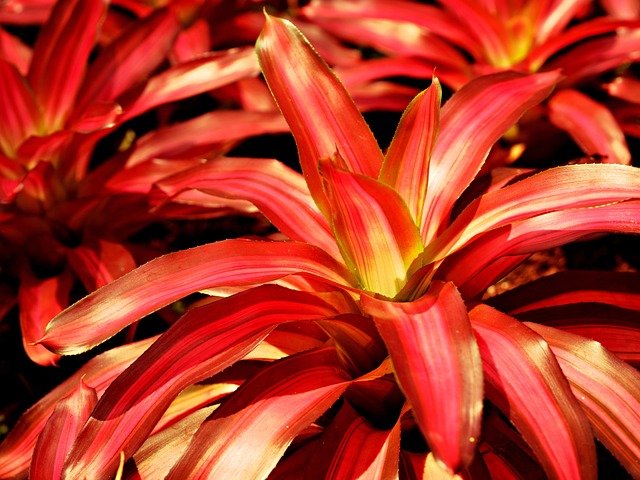
How do you care for a bromeliad?
Light: Bright, indirect light. Guzmania copes with lower light; Neoregelia needs strong light to keep its leaf colour. Water: Keep the central tank topped up and flush it regularly to stop stagnation and salt build-up. Let the potting mix dry between waterings; soggy mix causes root rot. It is non-toxic to cats and dogs.
About Bromeliad
Bromeliads make up the pineapple family (Bromeliaceae), about 2,500 species from tropical America; the usual houseplants are Guzmania, Neoregelia (blushing bromeliad), Aechmea (urn plant) and Vriesea (flaming sword). These are mostly epiphytes whose leaf rosettes form a central tank that holds water, and each rosette flowers once, then slowly dies while producing offsets, or pups. Extension services recommend bright, indirect light, an airy bark-based mix that dries between waterings, and a tank kept filled and flushed regularly; Clemson notes soggy potting mix causes root rot. The ASPCA lists blushing bromeliad, mosaic vase (a Guzmania) and earth star (Cryptanthus) as non-toxic to cats and dogs.
Bromeliad quick facts
- Botanical name
- Bromeliaceae
- Family
- Bromeliaceae (pineapple family)
- Native to
- Tropical and subtropical America, from Florida and the Caribbean to South America
- Light
- Bright, indirect light. Guzmania copes with lower light; Neoregelia needs strong light to keep its leaf colour.
- Water
- Keep the central tank topped up and flush it regularly to stop stagnation and salt build-up. Let the potting mix dry between waterings; soggy mix causes root rot.
- Temperature and humidity
- Ideally 21–32 °C (70–90 °F) by day and 10–18 °C (50–65 °F) at night, keeping nights at least 5.5 °C (10 °F) cooler than days. Relative humidity of 50–75%.
- Potting and feeding
- A fast-draining, bark-based (orchid) mix in a small pot. Feed sparingly; Wisconsin suggests ¼ to ⅛ strength; overfeeding dulls leaf colour.
- Flowering and pups
- Each rosette flowers once and then dies slowly. Separate pups when they are about a third the size of the parent. Sealing the plant in a clear bag with a ripe apple for 2–3 days can trigger flowering in 6–14 weeks.
- Common genera
- Guzmania (smooth leaves, long-lasting coloured bracts), Neoregelia (centre leaves blush red at flowering), Aechmea (spiny-edged leaves; A. fasciata is the silver vase or urn plant), Vriesea (flat, sword-shaped bracts) and Cryptanthus (earth star).
- Cats and dogs
- Non-toxic. The ASPCA lists blushing bromeliad (Neoregelia), mosaic vase (Guzmania musaica) and earth star (Cryptanthus) as non-toxic to dogs and cats. It has no entries for Aechmea or Vriesea, so this does not cover every bromeliad. Source: ASPCA
Sources: University of Wisconsin–Madison Extension: Bromeliads; Clemson Extension HGIC 1501: Bromeliads; NC State Extension: Guzmania; NC State Extension: Neoregelia; ASPCA: Blushing Bromeliad; ASPCA: Mosaic Vase; ASPCA: Earth Star
Bromeliad care at a glance
- Light
- Bright indirect. Wants bright, indirect light — sensitive to both extremes. Too much direct sun causes burns, too little causes stretching. Grow lights: Thrives under artificial grow lights (LED or fluorescent, 10-12 hours/day). A great option if your space lacks natural light.
- Watering
- Let the soil dry out significantly between waterings — this plant is very sensitive to overwatering. When in doubt, wait another day.
- Humidity
- Loves higher humidity (60%+). If your air is dry, group it with other plants, use a pebble tray, or run a humidifier nearby.
- Temperature
- Sensitive to cold — keep above 55°F (13°C). Avoid placing near drafty windows or exterior doors in winter.
- Soil
- Needs well-draining soil — add perlite or orchid bark to a standard potting mix. Good drainage is critical to prevent root rot.
- Pets
- The ASPCA lists blushing bromeliad (Neoregelia), mosaic vase (Guzmania musaica) and earth star (Cryptanthus) as non-toxic to dogs and cats. It has no entries for Aechmea or Vriesea, so this does not cover every bromeliad.
- Difficulty
- Moderate
Common bromeliad problems, answered
-
Bromeliad Central Cup Watering: How Much and How Often
Tank bromeliads such as Guzmania, Aechmea, Neoregelia and Vriesea hold water in a central cup formed by their leaves. Keep a little water in the cup, flush it regularly so it does not stagnate or build up salts, and let the potting mix dry between waterings.
-
Scale on Bromeliads: Spot the Insects, Spare the Leaf Scales
Raised, oval tan or brown bumps on bromeliad leaves, often near the leaf bases, along the leaf undersides or tucked into the overlapping leaf sheaths, are scale insects. Do not confuse them with the fine silvery scales that coat many bromeliad leaves naturally.
-
Repotting Bromeliads: When, Which Mix, and How to Pot Pups
Bromeliads rarely need repotting for root space: their roots are small and mostly anchor the plant. Repot to pot up pups once they reach about a third to half the parent's size, to replace a mix that stays soggy, or to rescue a plant from rot. Use a small pot and a coarse, fast-draining mix.
Questions about Bromeliad
Is bromeliad toxic to cats and dogs?
The ASPCA lists blushing bromeliad (Neoregelia), mosaic vase (Guzmania musaica) and earth star (Cryptanthus) as non-toxic to dogs and cats. It has no entries for Aechmea or Vriesea, so this does not cover every bromeliad.
Get the Plant Mortality Checklist
Check moisture, roots and recent care changes before choosing a treatment. A practical checklist to keep.
Your checklist is ready!
We also sent it to your inbox. Check your email for the full download.
Open the ChecklistFree. No spam. Unsubscribe anytime.