Croton
Codiaeum variegatum
Also known as: Joseph's coat, garden croton, fire croton
How do you care for a croton?
Light: Bright light with some direct sun. University of Missouri Extension notes crotons need high light for good colour and growth. Water: Water liberally while growing, with a resting period of reduced watering from fall to late winter. Use caution with cats and dogs.
About Croton
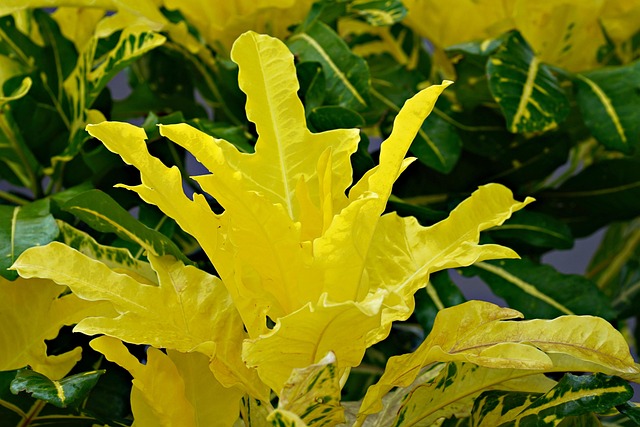
Croton (Codiaeum variegatum) is a shrub from Malaysia, the Pacific islands and northern Australia, grown for its leathery leaves in yellow, orange, red and green. Indoors it reaches about 90 cm (3 ft). NC State Extension notes it needs bright light with some direct sun for the best colour and may lose lower leaves in too much shade. Its milky sap can irritate skin.
Croton quick facts
- Botanical name
- Codiaeum variegatum
- Family
- Euphorbiaceae (spurge family)
- Native to
- Malaysia, the Pacific islands and northern Australia
- Light
- Bright light with some direct sun. University of Missouri Extension notes crotons need high light for good colour and growth.
- Water
- Water liberally while growing, with a resting period of reduced watering from fall to late winter.
- Temperature
- Bring indoors when temperatures reach 10 °C (50 °F).
- Size
- About 90 cm (3 ft) indoors.
- Cultivars
- 'Petra' is the most common; others include 'Gold Dust', 'Eleanor Roosevelt' and the twisted-leaf 'Spirale'.
- Cats and dogs
- Use caution. NC State Extension lists croton as poisonous to humans if large quantities are eaten (diterpene esters) and notes the sap can cause skin irritation. Keep it away from pets that chew plants. Source: NC State Extension
Sources: NC State Extension: Codiaeum variegatum; University of Missouri Extension: Lighting Indoor Houseplants (G6515)
Croton care at a glance
- Light
- Bright indirect. Wants bright, indirect light — sensitive to both extremes. Too much direct sun causes burns, too little causes stretching. Grow lights: Thrives under artificial grow lights (LED or fluorescent, 10-12 hours/day). A great option if your space lacks natural light.
- Watering
- Water when the top 1-2 inches of soil feel dry. Adjust with the seasons — less in winter, more in summer.
- Humidity
- Loves higher humidity (60%+). If your air is dry, group it with other plants, use a pebble tray, or run a humidifier nearby.
- Temperature
- Sensitive to cold — keep above 55°F (13°C). Avoid placing near drafty windows or exterior doors in winter.
- Soil
- Needs well-draining soil — add perlite or orchid bark to a standard potting mix. Good drainage is critical to prevent root rot.
- Pets
- NC State Extension lists croton as poisonous to humans if large quantities are eaten (diterpene esters) and notes the sap can cause skin irritation. Keep it away from pets that chew plants.
- Difficulty
- Intermediate
Common croton problems, answered
-
Croton Pests: Spider Mites, Mealybugs, Scale and Thrips
Spider mites are the pest most likely to trouble an indoor croton, especially in dry air. Mealybugs, scale insects and thrips are the other common ones. Each leaves a different sign, so identify the pest before you treat.
-
Croton Dropping Leaves: Moving, Light, Cold or Water?
Crotons drop leaves when their conditions change suddenly: a move from a bright greenhouse to a dim room, a cold draft, temperatures below about 15 °C (55 °F), or mix that stays too wet or too dry. Leaf drop right after you bring a croton home is a reaction to the move.
-
Overwatered Croton: Signs, Thirst Check and What to Do
An overwatered croton yellows or drops leaves while its mix is still damp, and may wilt in wet mix. Crotons want regular water in growth but a mix that dries at the surface between waterings, and much less water in winter. A pot standing in water, a pot that is too big or a dense mix keeps the roots wet and can lead to root rot.
-
Croton Brown Tips and Crispy Leaves: Causes and Fixes
Crispy brown tips and edges on a croton usually come from dry air, a mix allowed to dry out too far, salts from fertilizer or hard water, or hot sun through glass. Spider mites, which thrive in dry air, can add speckling and browning on top.
Questions about Croton
Is croton toxic to cats and dogs?
NC State Extension lists croton as poisonous to humans if large quantities are eaten (diterpene esters) and notes the sap can cause skin irritation. Keep it away from pets that chew plants.
Get the Plant Mortality Checklist
Check moisture, roots and recent care changes before choosing a treatment. A practical checklist to keep.
Your checklist is ready!
We also sent it to your inbox. Check your email for the full download.
Open the ChecklistFree. No spam. Unsubscribe anytime.