Dieffenbachia
Dieffenbachia seguine
Also known as: dumb cane, dumbcane, spotted dumb cane, gold dieffenbachia, variable dieffenbachia, Dieffenbachia maculata, Dieffenbachia amoena
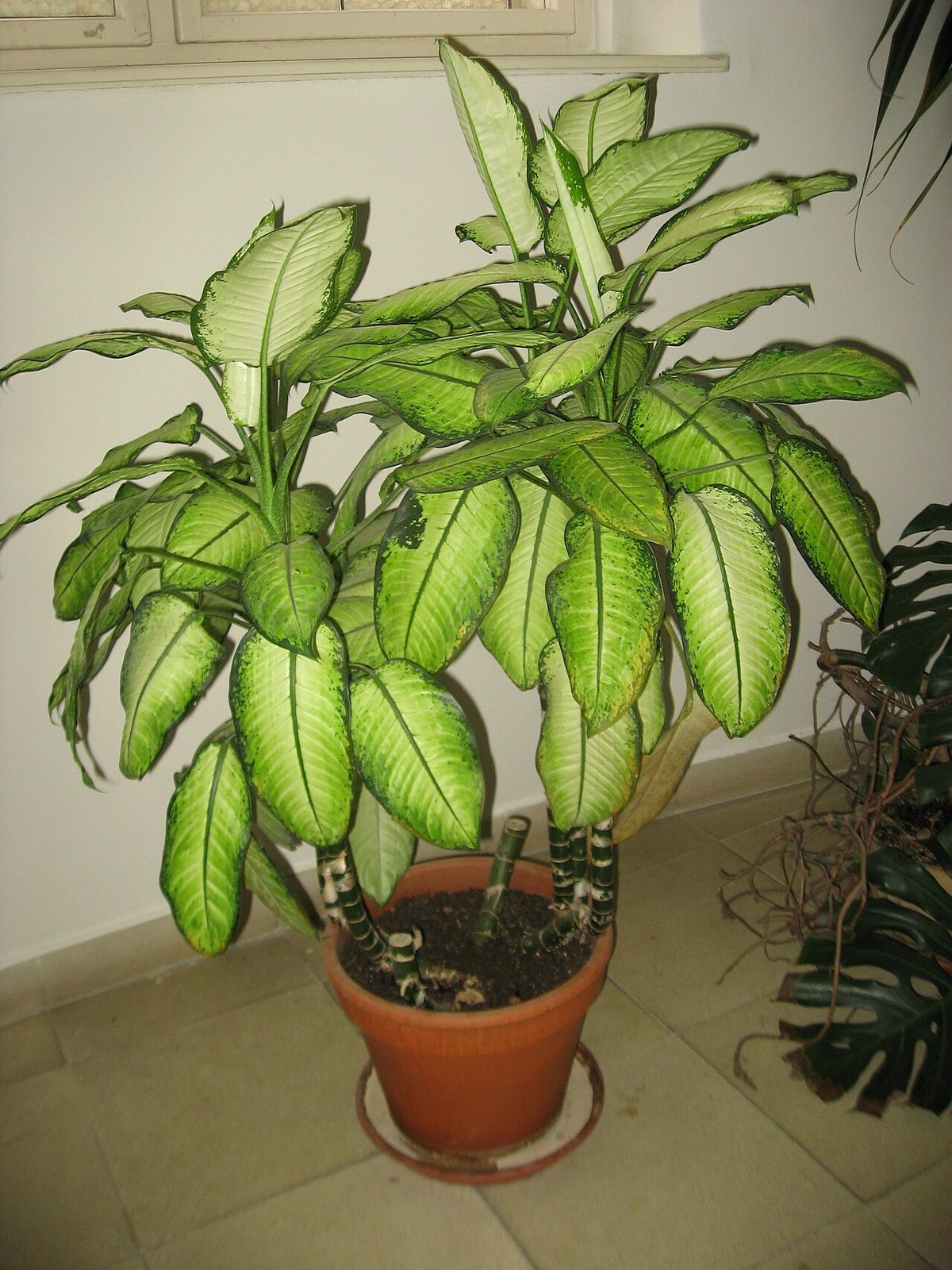

How do you care for a dieffenbachia?
Light: Bright, filtered light; Clemson allows some direct sun in winter only. It tolerates low light but grows slowly. Water: Water thoroughly, then let the top 2.5 cm (1 in) of mix dry before watering again to prevent root rot. It is toxic to cats and dogs, so keep it out of their reach.
About Dieffenbachia
Dieffenbachia, or dumb cane, is an upright aroid from the Caribbean and tropical South America, grown for large leaves splashed with cream, white or yellow; plants once sold as D. maculata, D. amoena and D. picta are now placed in D. seguine. Most grow 0.9–1.8 m (3–6 ft) tall and drop their lower leaves with age to show a cane-like stem. Clemson Extension recommends bright, filtered light, 16–24 °C (60–75 °F), and watering thoroughly once the top 2.5 cm (1 in) of mix is dry. All parts contain needle-like calcium oxalate crystals: the ASPCA lists it as toxic to cats and dogs, and NC State warns the sap irritates skin and can damage the eyes.
Dieffenbachia quick facts
- Botanical name
- Dieffenbachia seguine
- Family
- Araceae (arum family)
- Native to
- The Caribbean to tropical South America
- Light
- Bright, filtered light; Clemson allows some direct sun in winter only. It tolerates low light but grows slowly.
- Water
- Water thoroughly, then let the top 2.5 cm (1 in) of mix dry before watering again to prevent root rot.
- Temperature and humidity
- 16–24 °C (60–75 °F) with high humidity. Protect from cold drafts and sudden temperature changes.
- Size
- Most reach 0.9–1.8 m (3–6 ft) tall and 30–90 cm (1–3 ft) wide; leaves can be 46 cm (18 in) long and 30 cm (12 in) wide.
- Pruning and propagation
- Cut long, bare canes back to about 15 cm (6 in) and the plant regrows below the cut. Propagate by cane or tip cuttings, air layering or division.
- Telling it from Chinese evergreen
- Dieffenbachia leaves have more than 8 main side veins, usually 20–30; Aglaonema leaves have 5–8.
- Cats and dogs
- Toxic. The ASPCA lists dieffenbachia (dumbcane) as toxic to dogs and cats. It names insoluble calcium oxalates and a proteolytic enzyme, causing intense burning and irritation of the mouth, tongue and lips, heavy drooling, vomiting and difficulty swallowing. NC State rates the poison severity high: the sap irritates skin, can damage the cornea if it reaches the eyes, and may be fatal to pets and livestock. Wear gloves when pruning, and Clemson advises against it where children or pets are present. Source: ASPCA
Sources: NC State Extension: Dieffenbachia seguine; Clemson Extension HGIC 1503: Dieffenbachia; ASPCA: Dumbcane
Dieffenbachia care at a glance
- Light
- Bright indirect. Wants bright, indirect light — sensitive to both extremes. Too much direct sun causes burns, too little causes stretching. Grow lights: Thrives under artificial grow lights (LED or fluorescent, 10-12 hours/day). A great option if your space lacks natural light.
- Watering
- Let the soil dry out significantly between waterings — this plant is very sensitive to overwatering. When in doubt, wait another day.
- Humidity
- Loves higher humidity (60%+). If your air is dry, group it with other plants, use a pebble tray, or run a humidifier nearby.
- Temperature
- Prefers moderate temperatures (60-80°F). Keep away from radiators and intense afternoon sun windows.
- Soil
- Needs well-draining soil — add perlite or orchid bark to a standard potting mix. Good drainage is critical to prevent root rot.
- Pets
- The ASPCA lists dieffenbachia (dumbcane) as toxic to dogs and cats. It names insoluble calcium oxalates and a proteolytic enzyme, causing intense burning and irritation of the mouth, tongue and lips, heavy drooling, vomiting and difficulty swallowing. NC State rates the poison severity high: the sap irritates skin, can damage the cornea if it reaches the eyes, and may be fatal to pets and livestock. Wear gloves when pruning, and Clemson advises against it where children or pets are present.
- Difficulty
- Intermediate
Common dieffenbachia problems, answered
-
Dieffenbachia Propagation: Cuttings, Division and Sap Safety
Dieffenbachia (dumb cane) roots from a leafy tip cutting, from leafless cane sections that each carry at least two nodes, by division of a clumping plant, or by air layering. Every method means cutting tissue that releases irritating sap, so gloves and eye care come first.
-
Dieffenbachia Brown Tips: Watering, Salts or Dry Air?
Brown tips on Dieffenbachia (dumb cane) usually come from uneven watering, fertilizer salts building up in the mix, or hot, dry or drafty air. Very dark spots with a yellow halo that start at the leaf edge and spread are bacterial leaf spot, which needs different handling.
-
Dieffenbachia Root Rot: Check the Roots, Save the Cane
Dieffenbachia root rot shows as yellowing, wilting and a softening stem base while the mix is still wet. Clemson HGIC links it to slow-draining mix and watering too often. Roots turn brown to black and mushy, and in stem rots the base of the cane collapses.
-
Dieffenbachia Spider Mites: Spot, Wash and Treat
Spider mites on Dieffenbachia show first as fine pale speckling on the leaves and a faded look, then fine webbing on the undersides. Heavy feeding turns leaves yellow, bronze or tan. The mites are tiny, so the damage is usually noticed before the pest.
-
Dieffenbachia Overwatering: Dry It Out Before Rot Starts
An overwatered dieffenbachia has mix that is still damp below the surface, often with yellowing leaves, drooping in wet mix or water standing in the saucer. Dumb cane needs the top 2.5 cm (1 in) of mix to dry between waterings. Caught early, while the cane base is firm, it is a watering problem you can correct before rot sets in.
-
Dieffenbachia Leaves Curling Inwards: Water, Salts or Cold?
Dieffenbachia leaves that curl inwards are usually short of water, from a dry root ball or from roots damaged by wet mix. Curled leaves with brown edges point to too much fertilizer. Cold draughts, aphids and spider mites are the other causes to check.
Questions about Dieffenbachia
Is dieffenbachia toxic to cats and dogs?
The ASPCA lists dieffenbachia (dumbcane) as toxic to dogs and cats. It names insoluble calcium oxalates and a proteolytic enzyme, causing intense burning and irritation of the mouth, tongue and lips, heavy drooling, vomiting and difficulty swallowing. NC State rates the poison severity high: the sap irritates skin, can damage the cornea if it reaches the eyes, and may be fatal to pets and livestock. Wear gloves when pruning, and Clemson advises against it where children or pets are present.
Get the Plant Mortality Checklist
Check moisture, roots and recent care changes before choosing a treatment. A practical checklist to keep.
Your checklist is ready!
We also sent it to your inbox. Check your email for the full download.
Open the ChecklistFree. No spam. Unsubscribe anytime.