String of hearts
Ceropegia woodii
Also known as: Ceropegia woodii, rosary vine, chain of hearts, sweetheart vine

How do you care for a string of hearts?
Light: Bright, indirect light. Water: Let the mix dry out completely between waterings; reduce further in winter, when it is dormant. It is not listed as toxic to cats and dogs.
About String of hearts
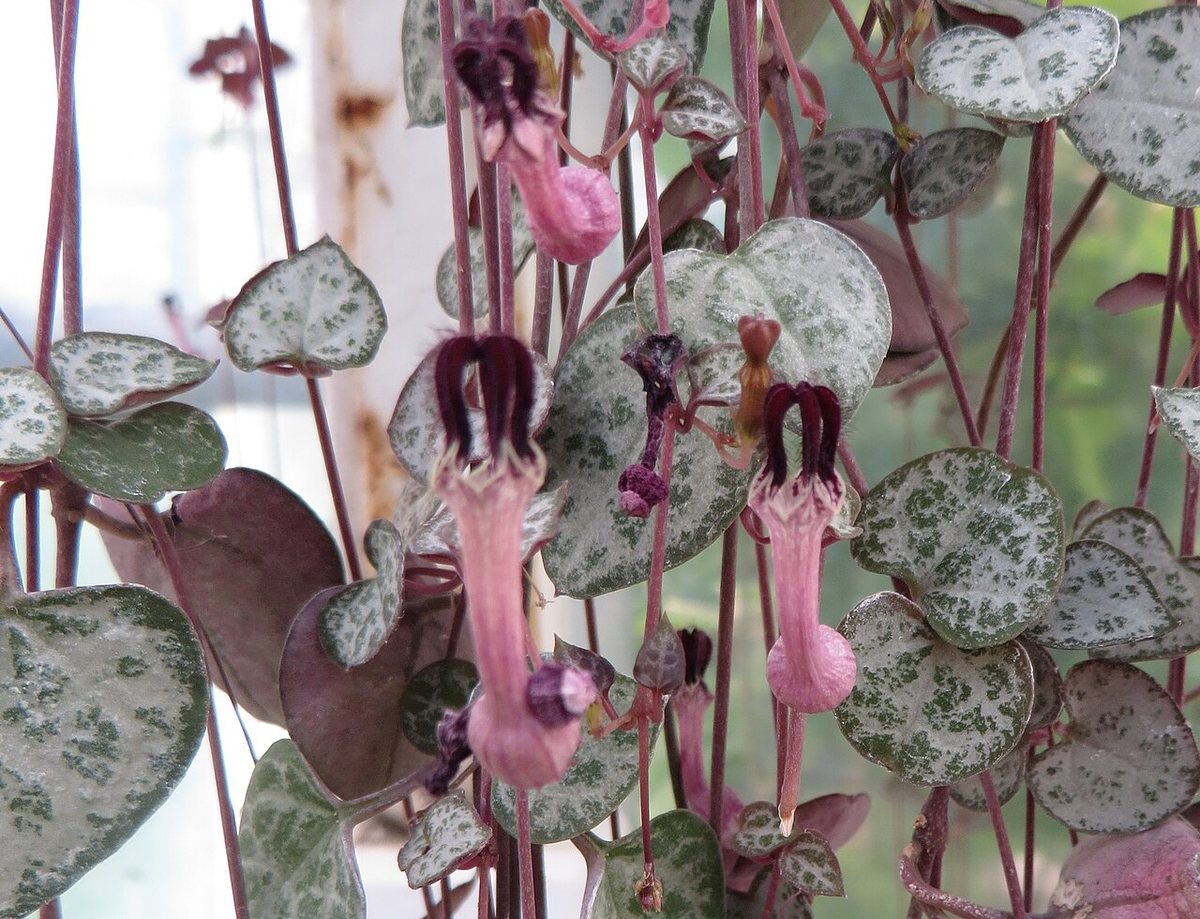
String of hearts (Ceropegia woodii) is a trailing succulent vine from southern Africa with small, silver-marked heart-shaped leaves and bead-like tubers along its stems. Indoors the stems hang about 90 cm (3 ft). NC State Extension recommends bright, indirect light, a well-drained sandy mix, and letting it dry out completely between waterings, watering even less during winter dormancy.
String of hearts quick facts
- Botanical name
- Ceropegia woodii
- Family
- Apocynaceae (dogbane family)
- Native to
- Southern Africa
- Light
- Bright, indirect light.
- Water
- Let the mix dry out completely between waterings; reduce further in winter, when it is dormant.
- Soil
- Well-drained, sandy potting mix.
- Size
- Stems hang about 90 cm (3 ft) indoors; up to 3.7 m (12 ft) in the wild.
- Repotting
- Likes to be crowded; repot only when necessary.
- Propagation
- The bead-like tubers root when they touch soil.
- Cats and dogs
- Not listed as toxic. NC State Extension lists no toxicity for string of hearts. The ASPCA has no entry for this species. Source: NC State Extension
Sources: NC State Extension: Ceropegia woodii; UW–Madison Extension: String of hearts; RHS: Ceropegia linearis subsp. woodii
String of hearts guides
String Of Hearts care at a glance
- Light
- Medium to bright indirect. Tolerates lower light but grows best in medium to bright indirect light. Can get leggy without enough light. Grow lights: Thrives under artificial grow lights (LED or fluorescent, 10-12 hours/day). A great option if your space lacks natural light.
- Watering
- Water when the top 1-2 inches of soil feel dry. Adjust with the seasons — less in winter, more in summer.
- Humidity
- Loves higher humidity (60%+). If your air is dry, group it with other plants, use a pebble tray, or run a humidifier nearby.
- Temperature
- Standard room temperature (60-80°F / 15-27°C) is perfect. Avoid cold drafts and sudden temperature swings.
- Soil
- Needs well-draining soil — add perlite or orchid bark to a standard potting mix. Good drainage is critical to prevent root rot.
- Pets
- NC State Extension lists no toxicity for string of hearts. The ASPCA has no entry for this species.
- Difficulty
- Moderate
Common string of hearts problems, answered
-
String of Hearts Yellow Leaves: Overwatering, Rot or Light?
Yellow leaves on string of hearts most often point to overwatering and root or basal rot, especially in winter when the plant is resting. Pale, washed-out leaves with long gaps between them point to low light instead.
-
String of Hearts Propagation: Tubers and Stem Cuttings
String of hearts is easy to propagate. The simplest method is to press one of the bead-like aerial tubers, still attached to its vine, onto the mix in another pot and cut it free once it roots. Stem cuttings also root, best with gentle bottom heat in early summer.
-
String of Hearts Dropping Leaves: Thirst, Rot, Cold or Light?
A string of hearts drops leaves when the root zone goes wrong in either direction: mix left bone dry long enough for leaves to shrivel, or mix kept wet until roots and tubers rot. Cold, a sudden move and low light also shed leaves, and low light leaves long, bare vines.
-
Leggy String of Hearts: More Light, Trim, Then Fill the Top
A leggy string of hearts, with long bare strands, wide gaps between leaf pairs and pale leaves, is short of light. Leaf pairs normally sit a few centimetres apart; large gaps on new growth mean the plant needs a brighter spot. A thin top is fixed by rooting strands back into the same pot.
Questions about String of hearts
Is string of hearts toxic to cats and dogs?
NC State Extension lists no toxicity for string of hearts. The ASPCA has no entry for this species.
Get the Plant Mortality Checklist
Check moisture, roots and recent care changes before choosing a treatment. A practical checklist to keep.
Your checklist is ready!
We also sent it to your inbox. Check your email for the full download.
Open the ChecklistFree. No spam. Unsubscribe anytime.