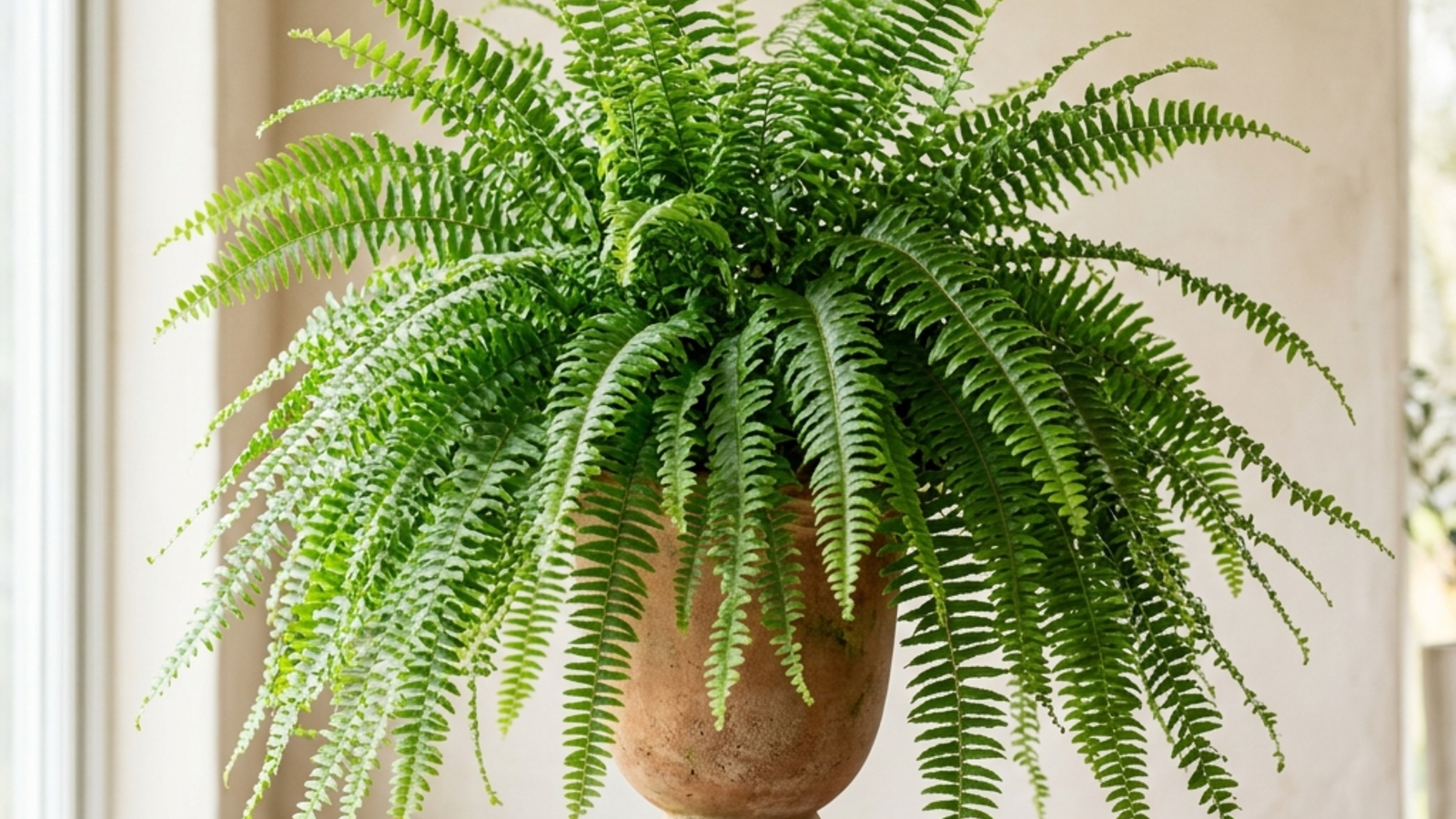
A Boston fern is not hard to grow. It is hard to grow in a warm, dry, heated room. NC State Extension says it needs high humidity and moist soil that is never allowed to dry out. Most brown, shedding ferns trace back to one of those two going wrong, or to a spot in direct sun.
The plant is Nephrolepis exaltata, a fern native to tropical and subtropical America (NC State). The classic indoor form is ‘Bostoniensis’, with broad, arching fronds (UF/IFAS). The RHS describes it growing to about 90 cm (3 ft) tall and wide, which is why it suits a hanging basket or a tall stand.
Boston fern care at a glance
| Factor | What the sources say |
|---|---|
| Light | Bright, indirect or filtered light (NC State, Clemson, RHS). No direct south or west sun (Clemson) |
| Water | Keep the mix barely moist at all times (Clemson); never let it dry out (NC State). Less in winter |
| Humidity | High (NC State, Clemson); moderate to high with good ventilation (RHS) |
| Temperature | 16–21 °C (60–70 °F) (NC State). Clemson: 20–22 °C (68–72 °F) by day, 10–13 °C (50–55 °F) at night |
| Mix | Porous, quick-draining, organic mix (Clemson); peat-free multi-purpose compost (RHS) |
| Feeding | Monthly at half strength from April to September; none in winter (Clemson, RHS) |
| Propagation | Division, or rooted runners (UF/IFAS, RHS, Illinois) |
| Pests | Spider mites, scale insects and mealybugs (Clemson) |
| Pets | Non-toxic to dogs and cats (ASPCA) |
Light: bright, filtered, never direct
NC State, Clemson and the RHS all recommend bright, indirect or filtered light. Clemson’s general fern guidance is to never put ferns directly in a south- or west-facing window, because direct sun damages the foliage.
University of Missouri Extension says Boston ferns tolerate low light but prefer a medium light level. It places medium-light plants within several feet of a west or south window, or in an east exposure. NC State notes that the cultivar ‘Dallas’ tolerates lower light and less humidity than most.
Watering: moist, not wet
This is the part that needs attention. NC State says the soil should never be allowed to dry out. Clemson says to keep it barely moist at all times. The RHS asks for moderate watering in the growing season, ideally with soft water.
Two limits sit on either side:
- Too dry. Clemson lists too little water among the main problems with indoor ferns, and warns never to let any fern dry out completely.
- Too wet. Clemson also warns not to let water stand in the pot, because it damages the roots. The RHS notes the plant can rot if fronds become too wet.
Winter changes the balance. NC State says to reduce watering in winter, when the plant is dormant and overwatering can lead to root rot. The RHS also says to water sparingly in winter.
Check the mix with a finger before each watering. If a fern in a hanging basket dries out between checks, our guide to Boston fern soil drying out covers pot size, mix and position.
Humidity: the usual weak point
NC State says Boston fern needs high humidity. It suggests placing it near kitchens and bathrooms, or setting it on a tray of wet pebbles. Clemson adds that indoor humidity is very low in winter, so ferns need extra attention then.
Clemson’s options for raising humidity:
- Double potting. Stand the growing pot inside a second container lined with moist sphagnum moss.
- A humid room. A bright bathroom suits delicate ferns.
- Light misting, occasionally.
The RHS pairs moderate to high humidity with good ventilation. For a bathroom setup, see why Boston ferns thrive in the bathroom. For measuring your room first, see our houseplant humidity guide.
Temperature
NC State gives 16–21 °C (60–70 °F). Clemson’s figures for Boston fern are 20–22 °C (68–72 °F) by day and 10–13 °C (50–55 °F) at night. Missouri Extension’s advice for ferns is short: keep them cool and moist. A cool, bright room suits it better than a spot by a radiator.
Mix, pot and repotting
Clemson recommends a porous potting mix that lets excess water drain quickly, with plenty of organic matter. For repotting, it suggests equal parts packaged houseplant potting mix and peat moss or leaf mold. The RHS recommends peat-free multi-purpose compost, or 1 part loam, 2 parts sharp sand and 3 parts leaf mould.
Repot overcrowded plants in early spring (Clemson). Use a pot with drainage holes.
Feeding
Ferns need light feeding. Clemson recommends fertilizing lightly once a month from April through September, with liquid houseplant fertilizer at about half the label rate. The RHS gives the same pattern: half-strength balanced liquid fertiliser monthly in the growing season.
Clemson adds three cautions:
- Too much fertilizer scorches fern leaves.
- Do not feed in winter.
- Do not feed new or repotted plants for six months.
UF/IFAS rates the soil salt tolerance of Nephrolepis exaltata as poor, which is another reason to feed lightly.
Propagation: division and runners
Clemson says division is the best method for most ferns. UF/IFAS says Boston fern propagates easily by dividing the clumps. The plant also spreads by thin green runners (UF/IFAS), and the RHS suggests separating rooted runners in late winter or early spring. University of Illinois Extension lists division and these specialized structures for Boston fern.
UF/IFAS notes that thick clumps can be renewed by severe pruning, with new fronds sprouting from the roots. Indoors, the RHS advice is simpler: remove dead fronds.
Problems and what to check
For step-by-step help, see our guides to brown fronds, shedding leaflets and fungus gnats. Start with this table.
| What you see | Likely cause | What to do |
|---|---|---|
| Brown, crisp leaflets, worse in winter | Low humidity (Clemson) | Raise humidity: pebble tray, double pot or a bathroom |
| Leaflets yellowing and dropping, dry mix | Too little water (Clemson) | Water thoroughly; check the mix more often |
| Yellowing fronds, wet mix, slow decline | Root rot from slow-draining mix or frequent watering (Clemson) | Check roots; see our root rot guide |
| Rows of brown or black dots under fronds | Spores, not pests (NC State) | No action needed |
| Fine webbing, speckled fronds | Spider mites (Clemson) | See our spider mite guide |
| Bumps or cottony tufts on stems | Scale insects or mealybugs (Clemson, UF/IFAS) | Remove by hand or a brisk water spray (Clemson) |
| Scorched, bleached fronds | Direct sun (Clemson) | Move out of direct south or west sun |
| Tip burn after feeding | Too much fertilizer (Clemson) | Feed less, at half strength, and not in winter |
| Broken, damaged fronds | Rough handling (Clemson) | Move it out of busy walkways |
A warning on sprays. Clemson says pesticide sprays injure many ferns. Read the label, test on a small area first, and watch for damage before treating the whole plant.
Is Boston fern safe for pets?
Yes. The ASPCA lists Boston fern as non-toxic to dogs and cats. That makes it a good option for a bright bathroom in a home with pets. See our pet-safe plants guide for others.
References
- NC State Extension Gardener Plant Toolbox: Nephrolepis exaltata
- Clemson Cooperative Extension HGIC 1505: Indoor Ferns
- UF/IFAS Extension, E. F. Gilman et al.: Nephrolepis exaltata, Boston Fern, Sword Fern (FPS427)
- Royal Horticultural Society: Nephrolepis exaltata
- Royal Horticultural Society: Nephrolepis exaltata ‘Bostoniensis’
- University of Missouri Extension, D. H. Trinklein: Lighting Indoor Houseplants, G6515
- University of Illinois Extension: Houseplants: Propagation
- ASPCA Animal Poison Control Center: Boston Fern