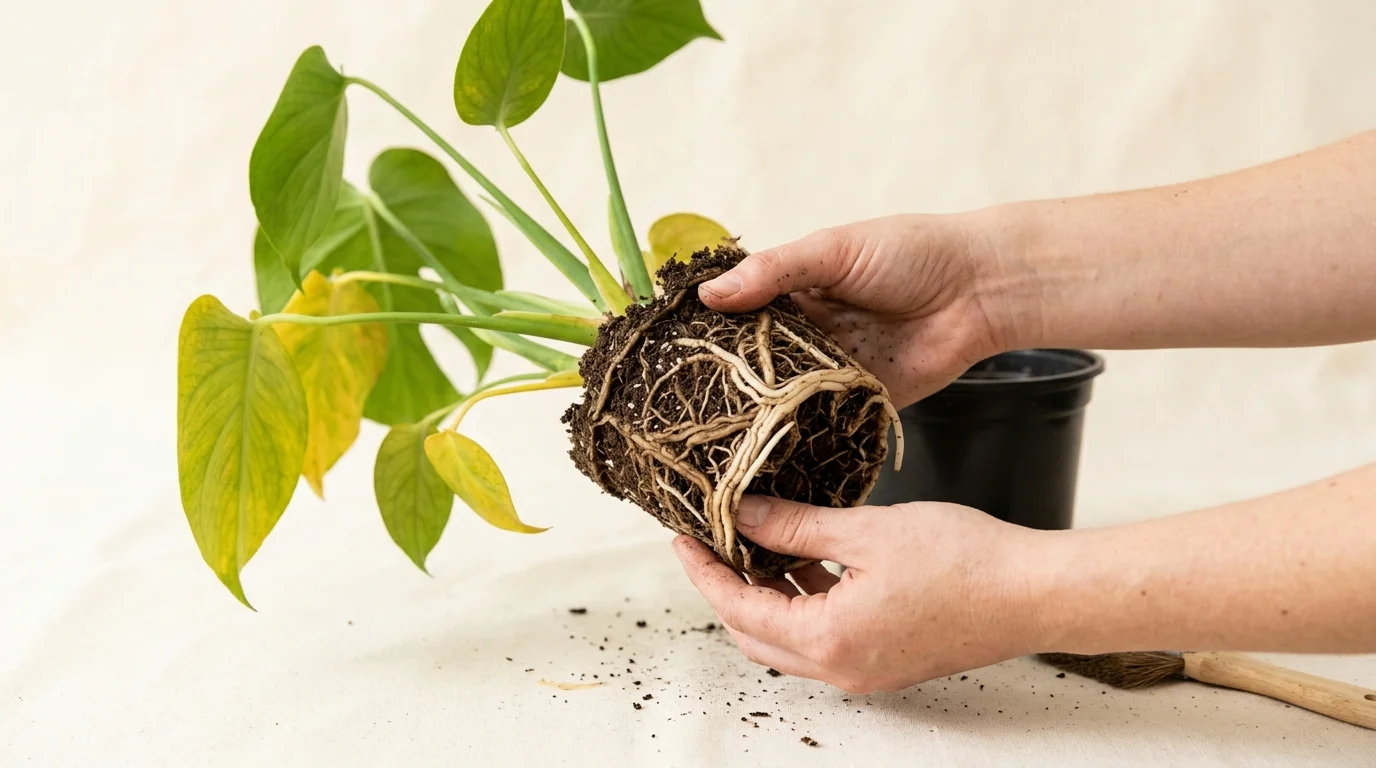
Root rot is a disease, not just a watering mistake. The UW–Madison Plant Disease Diagnostics Clinic defines it as any disease where a pathogen breaks down the root system. Wet potting mix is what lets those organisms win.
This page covers what causes root rot and how to stop it happening. If you already have a plant with soft roots, our root rot treatment guide walks through the rescue step by step.
The organisms behind root rot
UW–Madison lists Pythium, Phytophthora, Rhizoctonia solani and Fusarium as the most common causes. Clemson HGIC adds Botrytis, Alternaria and Sclerotinia to the list for houseplants.
| Organism | What it does to roots | Source |
|---|---|---|
| Pythium | Stunting, yellowing and wilting even when the mix is moist. Roots turn brown to black and mushy. The outer layer pulls away and leaves a fine, hair-like core | University of Maryland Extension |
| Phytophthora | Root tips turn dark brown, then soft and mushy. Can blacken the lower stem, so lower leaves yellow and drop | University of Maryland Extension |
| Rhizoctonia | Favoured by warm, moist conditions. Coarse reddish-brown threads, like spider web, grow over stems and roots, which brown and collapse | University of Maryland Extension |
| Fusarium | One of the most common root rot fungi, with a wide host range | UW–Madison |
UC IPM points out that Pythium and Phytophthora are not true fungi. They are “water molds”, with a swimming spore stage adapted to spread in water. That is why a waterlogged pot suits them so well.
Why wet potting mix is the trigger
Every source we checked ties root rot to excess water.
- Waterlogged roots lose oxygen. Clemson says overwatering cuts the oxygen available for root growth and favours root diseases.
- The pathogens like it wet. UW–Madison says most root rot fungi prefer wet soil, and grow and reproduce best there.
- Old mix drains worse. UC IPM notes that potting mix settles, loses air space and compacts at the bottom of the pot as it ages. A plant that drained well two years ago may not now.
- No drainage hole. Iowa State says that without one, the soil stays wet and roots rot and die.
- A gravel layer. Iowa State says gravel in the pot base creates a wetter zone near the roots and promotes root rot. UW–Madison adds that it can inhibit drainage.
- An oversized pot. Iowa State recommends moving up only one container size, maybe two, so the mix dries in a reasonable time. Penn State lists overpotting among the habits to avoid.
- Standing water. Iowa State says to empty the saucer or cachepot after about 30 to 45 minutes, because roots left in water rot.
UC IPM also links root rot to high salt levels in the mix. Periodic leaching with plain water helps prevent that.
How the pathogens get into the pot
Root rot organisms rarely appear from nowhere. The sources describe three routes in.
- On the plant you bought. UC IPM says houseplant diseases are usually introduced at the nursery. Check roots before you buy; reject plants with discoloured roots or stems.
- In soil and debris. UW–Madison says garden soils often carry root rot fungi, and that Pythium and Phytophthora spores survive for long periods in soil or plant debris.
- By reuse and splashing. UW–Madison warns against reusing old potting mix or drainage water. Clemson notes spores can spread by splashing water or by moving infested soil.
Signs that point to the roots
UW–Madison describes the classic clue: a plant that wilts even though the soil is wet. Infected plants are often stunted, and leaves may turn yellow or red, which looks like a nutrient problem. The RHS lists old and new leaves yellowing and dropping together, brown patches in the middle of leaves, stem rot and dark, mushy roots as signs of overwatering.
None of these leaf symptoms proves root rot. Penn State lists other causes of the same picture: over-fertilizing, too much or too little water, chilling of the roots, pesticide drenches and a pot-bound root ball. That is why the roots themselves are the evidence.
The root check in brief
Slide the plant out of its pot and look at the root tips.
- Healthy: UC IPM says healthy roots should be white, either all the way through or at least under their outer covering.
- Rotting: UC IPM describes off-coloured roots, brownish to black or dark yellowish, especially at the tips. UW–Madison adds that rotted roots are soft and may smell bad.
- The pull test: Penn State says rotted roots are limp, not crisp, and the outer layer strips off when pulled, leaving only the central strand.
Penn State notes that some plants have naturally dark roots, so judge texture and that stripping layer, not colour alone. Our treatment guide has a fuller comparison table.
Save it, propagate it or start again
The sources are frank about the odds. UW–Madison says throwing out a plant with root rot is often the best and most cost-effective option. Penn State explains why recovery is slow: dead roots do not recover, and new roots must grow.
| What you find | Reasonable next step | Source |
|---|---|---|
| A few infected roots, firm crown | Cut out the infected roots and repot in sterile mix | Clemson HGIC |
| Large part of the root system gone, healthy stems above | Take stem cuttings from healthy tissue only | University of Maryland Extension |
| Severe infection, soft crown or stem base | Throw the plant away | University of Maryland Extension, UW–Madison |
If you keep the plant, UW–Madison says the most important step is to reduce soil moisture. Give enough water to prevent drought stress, but no more. UW–Madison does not recommend fungicides for houseplant root rot, and Clemson says they will probably cost more than a new plant. Penn State’s fungicide guidance is written for commercial growers, and it starts with a lab diagnosis, because no single fungicide controls every root rot organism.
Prevention checklist
- Buy clean. Inspect roots before purchase and keep new plants apart until you are sure they are healthy (UC IPM, Maryland).
- Use pasteurized commercial potting mix, not garden soil (UW–Madison, Clemson).
- Use a pot with a drainage hole and no gravel layer (Iowa State, UW–Madison).
- Size the pot to the roots. Go up one size at a time (Iowa State).
- Water when the mix needs it, not by the calendar. Let excess drain and empty the saucer (Iowa State).
- Repot when the mix breaks down and starts holding water for too long (UC IPM).
- Do not reuse old mix or drainage water from a sick plant. Disinfest tools, surfaces and clay pots with a 10% bleach or detergent solution, or alcohol (UW–Madison).
- Leach salts periodically with plain water (UC IPM).
For day-to-day watering, see our watering guide and overwatered or underwatered checks.
Plant-specific root rot guides
Root structure changes how a rescue goes. We have written guides for pothos root rot, snake plant root rot, monstera root rot, begonia root rot, bird of paradise root rot and echeveria overwatering and root rot.
References
- UC Statewide IPM Program: Pest Notes: Houseplant Problems
- University of Maryland Extension: Root Rots of Indoor Plants
- UW–Madison Plant Disease Diagnostics Clinic, B. Hudelson and L. Jull: Root Rots on Houseplants
- Clemson Cooperative Extension HGIC 2251: Houseplant Diseases & Disorders
- Penn State Extension, G. W. Moorman: Fungal Root Rots and Chemical Fungicide Use
- Penn State Extension, S. Kapadia: Pest and Disease Problems of Indoor Plants
- Iowa State University Extension and Outreach: How to Care for Houseplants
- Royal Horticultural Society: How to help a poorly houseplant