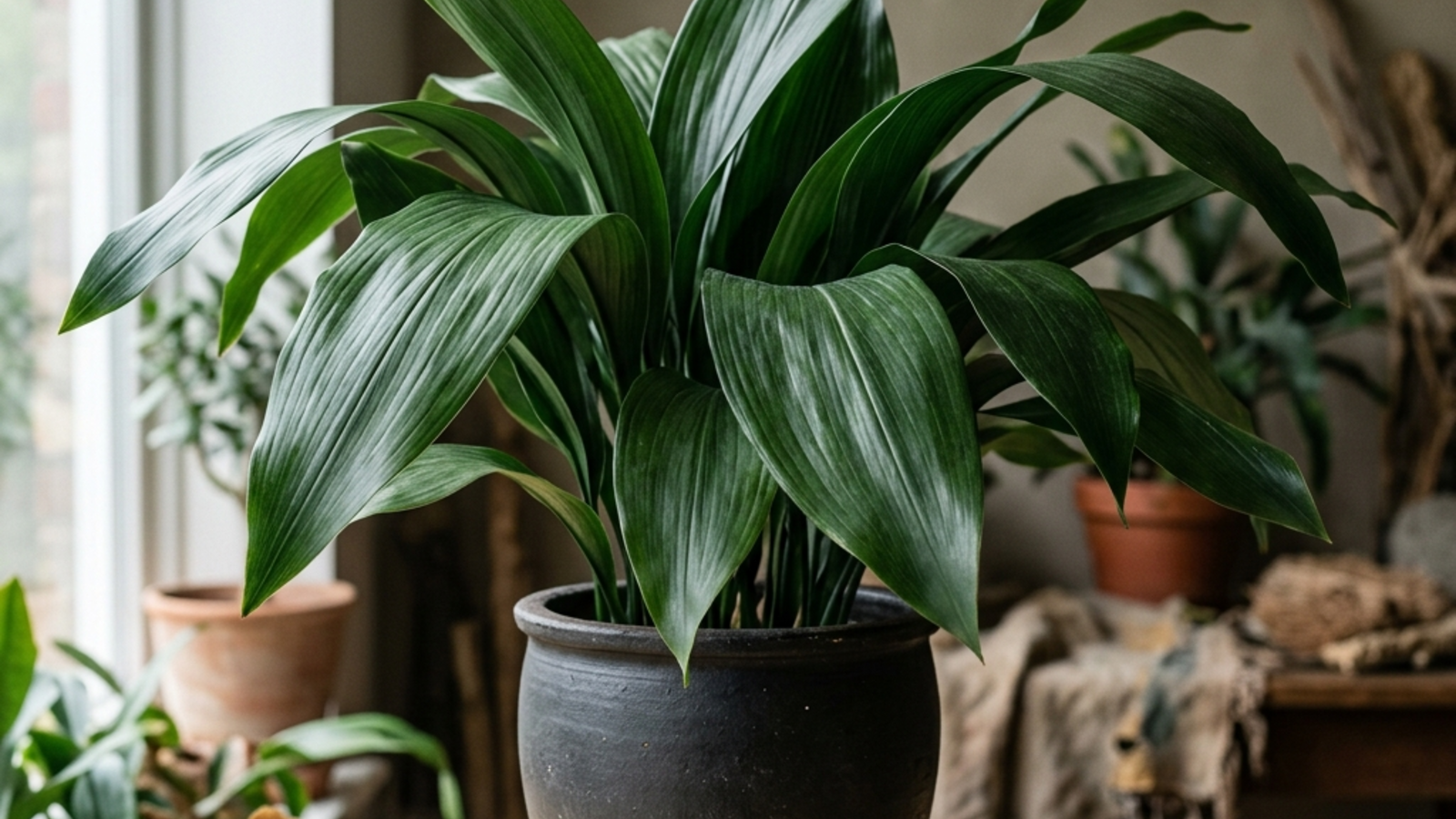
Cast iron plant earns its name. University of Florida IFAS Extension says it tolerates heavy shade, drought and nutrient-poor soil. Iowa State Extension adds heat, dust and low humidity. If your plant is struggling, the cause is usually one of three things: direct sun, a soggy pot, or a spot so dark it barely grows.
This guide covers Aspidistra elatior, the species sold as cast iron plant, barroom plant or iron plant. It is an evergreen perennial in the asparagus family (Asparagaceae), native to Japan according to NC State Extension. UF/IFAS notes the genus holds over 200 woodland species from Asia.
Cast iron plant care at a glance
| Factor | What the sources say |
|---|---|
| Light | Dappled sun to deep shade (NC State). Avoid direct sun, which scorches leaves (RHS, UF/IFAS) |
| Water | Only when the mix is dry to the touch (RHS). Regularly from spring to autumn, sparingly in winter (NC State) |
| Temperature | 7–27 °C (45–81 °F); protect from extreme cold (RHS) |
| Humidity | Average home humidity is fine (RHS); tolerates below-average humidity (Iowa State) |
| Feeding | April to September at half the label rate; reduce in autumn and winter (RHS) |
| Repotting | Rarely; it prefers to be slightly root-bound. Every 3–4 years or when it outgrows the pot (RHS) |
| Size | 30–90 cm (1–3 ft) tall and wide; slow-growing (NC State) |
| Propagation | Division of the clump (UF/IFAS) |
| Pets | Non-toxic to dogs, cats and horses (ASPCA) |
Light: the darkest spot it will accept
Cast iron plant is the usual answer for a hallway, a north room or a corner far from the window. University of Missouri Extension calls it “one of the best plants where only low light conditions exist” and notes it tolerates cool locations. Clemson Extension groups it with peace lily and heartleaf philodendron as a low-light plant for north windows or several feet from an east window.
Two limits apply:
- Direct sun burns it. NC State says it is intolerant of direct sun. UF/IFAS and the RHS both warn of leaf scorch. Keep it back from unscreened south and west windows.
- Low light means slow growth. NC State describes it as slow-growing even in good conditions. In deep shade, expect very few new leaves. Missouri Extension lists the signs of too little light: smaller new leaves, pale growth, and yellowing lower leaves.
Variegated cultivars, such as ‘Milky Way’ (small white spots), ‘Okame’ (white streaks) and ‘Hoshi-zora’ (yellow or white dots), are listed by NC State. Give them the brighter end of what you have. For light levels by window, see our low light plants guide.
Watering: check the mix, not the calendar
NC State describes cast iron plant as drought tolerant. Its guidance is to water regularly from spring to autumn and sparingly in winter. The RHS is more direct: water only when the compost is dry to the touch, because it prefers the drier side and overwatering can cause root rot.
A practical routine:
- Push a finger into the mix. If it is still damp, wait and check again in a few days.
- When it is dry, water until it runs from the drainage holes.
- Empty the saucer or outer pot once it has drained.
- In winter and in dim rooms, expect the gap between waterings to grow.
Iowa State recommends well-drained, evenly moist soil. Read that alongside the RHS advice: moist, never soggy. A slow-growing plant in low light uses little water, so the mix can stay wet far longer than you expect.
Potting mix, repotting and division
The RHS says repotting is rarely needed because the plant prefers to be slightly root-bound. Iowa State goes further: frequent repotting harms cast iron plant, so divide and repot infrequently. Repot every 3–4 years, or when roots have filled the pot (RHS).
When you do repot:
- Use a free-draining potting mix and a pot with drainage holes (RHS).
- Choose a pot only slightly larger than the root mass. Spare mix stays wet.
- Repot while the plant is actively growing. University of Illinois Extension puts that at spring or early summer for houseplants.
Division. UF/IFAS says propagation is by division of the matted clumps. Lift the plant and separate the clump into pieces, each with leaves and roots attached, then pot each one. Expect each piece to establish slowly.
Feeding
Cast iron plant needs little fertilizer. The RHS suggests feeding from April to September at half the label rate, and cutting back in autumn and winter. UF/IFAS notes that variegated cultivars need nutrient-poor soil to keep their colouring. Overfeeding a variegated plant can blur the pattern.
Leaf problems and what to check
| What you see | Likely cause | What to do |
|---|---|---|
| Bleached, yellow or brown patches in the middle of leaves | Direct sun scorch (RHS, UF/IFAS) | Move away from direct sun. Scorched areas will not recover; remove badly damaged leaves at the base |
| Brown tips or margins | Salt build-up; UF/IFAS rates its salt tolerance as poor. Clemson lists brown tips among salt-injury signs | Flush the pot with plenty of plain water and empty the saucer. Feed less |
| Yellowing leaves, wet mix, slow decline | Overwatering and possible root rot (RHS) | Check roots. UW–Madison lists soft, brown, foul-smelling roots as root rot signs |
| Very few new leaves | Normal slow growth, or too little light (NC State, Missouri) | Move it somewhat brighter, still out of direct sun |
| Variegation fading | Rich soil (UF/IFAS) or too little light | Feed less; give brighter indirect light |
| Winter leaf burn on outdoor plants | Cold wind (UF/IFAS, zones 8 and above) | Shelter container plants from winter wind |
UF/IFAS says no serious pests are normally seen on the plant, and the RHS describes it as resistant to most pests and diseases. Still inspect leaf undersides and leaf bases on any new plant before it joins your collection.
If root rot is confirmed, UW–Madison’s advice is to reduce soil moisture, use fresh pasteurized potting mix, and never reuse old mix or drainage water. Our root rot guide covers the checks step by step.
Tidying and flowers
The RHS says pruning is not needed beyond removing yellow or damaged leaves at the base. UF/IFAS notes old foliage can be removed in spring to make way for fresh growth.
Flowers are rare indoors. NC State describes them as cup-shaped, fleshy and borne close to the ground in early summer, and says the plant needs higher light to flower. Look at soil level if you want to find one.
Is cast iron plant safe for pets?
Yes. The ASPCA lists Aspidistra elatior as non-toxic to dogs, cats and horses. That makes it one of the few deep-shade plants suited to a home with pets. For more options, see our pet-safe plants guide.
References
- NC State Extension Gardener Plant Toolbox: Aspidistra elatior
- UF/IFAS Extension, K. Graves et al.: Aspidistra spp.: Cast Iron Plant (FPS53)
- Royal Horticultural Society: Care tips for low-light tolerant houseplants
- Iowa State University Extension and Outreach, A. Steil: Easy low-maintenance houseplants
- University of Missouri Extension, D. H. Trinklein: Lighting Indoor Houseplants, G6515
- Clemson Cooperative Extension HGIC 1450: Indoor Plants – Cleaning, Fertilizing, Containers & Light Requirements
- University of Wisconsin–Madison Plant Disease Diagnostics Clinic, B. Hudelson and L. Jull: Root rots on houseplants
- University of Illinois Extension: Houseplants: Repotting
- ASPCA Animal Poison Control Center: Cast Iron Plant