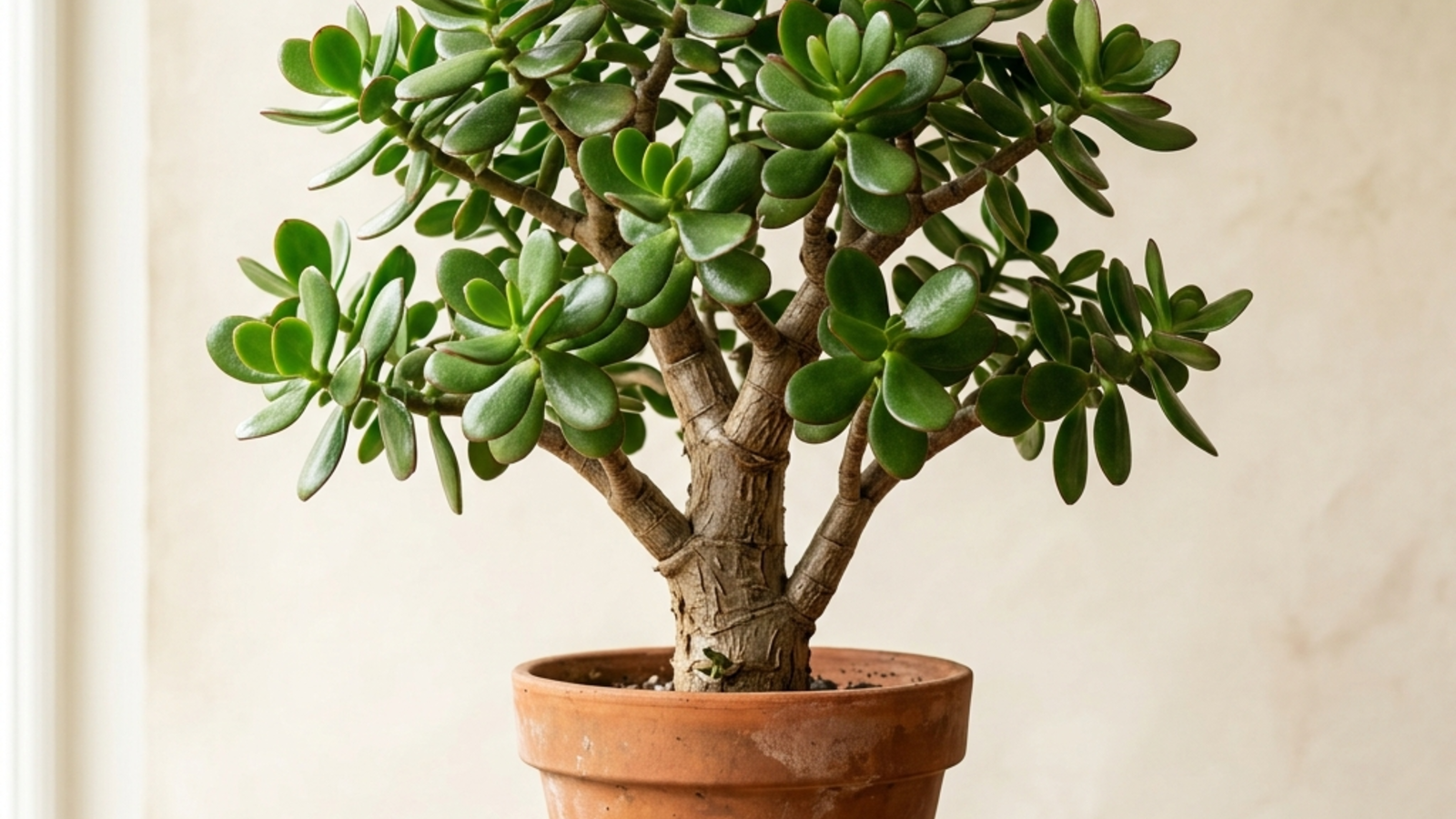
Jade plant is a long-lived succulent shrub that can grow into a small indoor tree. Clemson Extension says it can reach 1.5 m (5 ft) indoors and live for a very long time. Most problems come from two things: too little sun, and watering that ignores the season.
Crassula ovata (formerly C. argentea) is in the stonecrop family, Crassulaceae, and is native to South Africa (NC State Extension). Its thick, oval leaves are 2.5–9 cm (1–3.5 in) long. NC State notes the margins turn red in direct sun.
Jade plant care at a glance
| Factor | Guidance |
|---|---|
| Light | Four or more hours of direct sun daily (Clemson). High or bright light minimum (Illinois) |
| Day temperature | 18–24 °C (65–75 °F) (Clemson) |
| Night temperature | 10–13 °C (50–55 °F) (Clemson) |
| Water, spring and summer | Moist but not wet (Clemson); water when the soil is dry (NC State) |
| Water, autumn and winter | Let soil dry between waterings (Clemson); reduce watering (NC State) |
| Soil | Very well-drained: cactus mix with some organic matter (Clemson) |
| Feeding | Every three to four months with liquid houseplant fertilizer (Clemson) |
| Repotting | Rarely; it lives happily root-bound for years (Clemson) |
| Pets | Toxic to dogs, cats and horses (ASPCA) |
Light: as much sun as you can give it
Jade is a sun plant. Clemson Extension says it prefers full sun or the bright filtered light of a south-facing window, and does best with four or more hours of direct sun a day. University of Illinois Extension lists it as a high-light plant. In practice that means directly in front of an east or west window, or within about 1.5 m (5 ft) of a south window.
NC State suggests a sunny spot that also gets some afternoon shade.
University of Missouri Extension notes jade will tolerate light as low as 25 foot-candles, but growth will be thin and leaves small. If your jade is stretching, with long gaps between leaves and small new growth, move it closer to the sunniest window. Do it gradually if the plant has been in a dim spot, so the leaves can adjust.
Temperature
Clemson gives 18–24 °C (65–75 °F) by day and 10–13 °C (50–55 °F) at night as the best range. NC State says average to cool indoor temperatures are essential for good health. In winter, Clemson advises protecting jade from drafts and keeping the leaves from touching window glass.
Watering through the year
The succulent leaves suggest a plant that barely needs water. Clemson warns against that reading: drought can cause dwarfing, leaf spotting, leaf drop and death. The goal is to match water to the season.
- Spring and summer (active growth): Clemson says keep the soil moist but not wet. NC State says water in moderation when the soil is dry. Both point to the same habit: water thoroughly when the top of the mix has dried, then let it drain.
- Autumn to late winter: NC State says reduce watering. Clemson says let the soil dry between waterings in winter.
- Every time: avoid splashing the leaves (Clemson), and never leave the pot standing in drained water.
To check, use the methods Clemson lists for any houseplant: push a finger into the mix, lift the pot to judge its weight, or look for the mix turning lighter in colour as it dries. A jade in a cool, dim winter room will take far longer to dry than the same plant in a sunny summer window.
Soil and pots
Clemson says jade needs a very well-drained mix to prevent root rot. It suggests a cactus mix with some added organic matter, or a home mix of one part sterilized organic soil, one part sphagnum peat moss and three parts coarse sand by volume. University of Missouri Extension warns against overwatering and tight soils.
Jade grows top-heavy. Clemson recommends moving an older plant into a large, heavy pot so it does not tip over. Always use a pot with drainage holes.
Repotting and feeding
Clemson says jade plants can live happily for years while root-bound. If repotting is needed, do it as new growth starts. Let the soil become dry after repotting before watering again.
Feed every three to four months with a liquid houseplant fertilizer (Clemson). After repotting, wait four months before feeding.
Propagation
Jade roots easily from cuttings. NC State recommends leaf cuttings, and Clemson recommends stem cuttings. For general technique, see our propagation guide.
Leaf problems and what they mean
| What you see | Likely cause | What to check |
|---|---|---|
| Leaves wrinkled, soft but stem firm, mix dry | Too dry | Water thoroughly; Clemson lists leaf drop and spotting among drought effects |
| Leaves dropping, mix wet, stem base soft | Overwatering and root rot (NC State, Clemson) | Unpot and inspect roots; repot healthy parts into dry, gritty mix |
| Thin, stretched growth with small leaves | Too little light (Missouri) | Move to four or more hours of direct sun |
| White, cottony tufts in leaf joints | Mealybugs, the most common jade pest (Clemson) | Wipe off with a cotton swab dipped in rubbing alcohol |
| Dull, speckled or dusty-looking leaves | Spider mites (Clemson) | Inspect undersides; isolate the plant |
| Red leaf edges | Normal response to direct sun (NC State) | Nothing to fix |
Clemson notes that diseases are rarely a problem for jade grown indoors. Root rot usually follows a slow-draining mix or watering too often. NC State lists aphids, scale, spider mites and mealybugs as occasional pests.
One important treatment warning: Clemson says do not use insecticidal soap on jade plants, because it may damage them. Use alcohol on a cotton swab for mealybugs instead. Our overwatered or underwatered guide has more on telling the two apart.
Flowers
Jade rarely blooms as a houseplant (NC State). Clemson says mature plants can produce clusters of star-shaped white or pink flowers in winter.
Cultivars
NC State and Clemson list several forms with the same care needs:
- ‘Gollum’: tubular leaves with suction-cup tips.
- ‘Hobbit’: spoon-shaped or tubular leaves that curl inward; Clemson says it is slow-growing and reaches about 90 cm (3 ft).
- ‘Hummel’s Sunset’ and ‘Sunset’: yellow to orange or gold-edged leaves in bright light.
- ‘Tricolor’ and ‘Variegata’: cream, white and pink variegation.
- ‘Minima’: a dwarf with small, rounded leaves.
Coloured forms show their best colour in strong light.
Pets
The ASPCA lists jade plant as toxic to dogs, cats and horses, with vomiting, depression and incoordination as signs. Keep it out of reach of pets that chew plants.
References
- NC State Extension Gardener Plant Toolbox: Crassula ovata
- Clemson Cooperative Extension HGIC 1507, K. Russ, A. Pertuit, rev. B. H. Smith (2015): Jade Plant
- University of Missouri Extension, D. H. Trinklein: Lighting Indoor Houseplants, G6515
- University of Illinois Extension: Houseplants: Lighting
- Clemson Cooperative Extension HGIC 1459: Indoor Plants – Watering
- ASPCA Animal Poison Control Center: Jade Plant