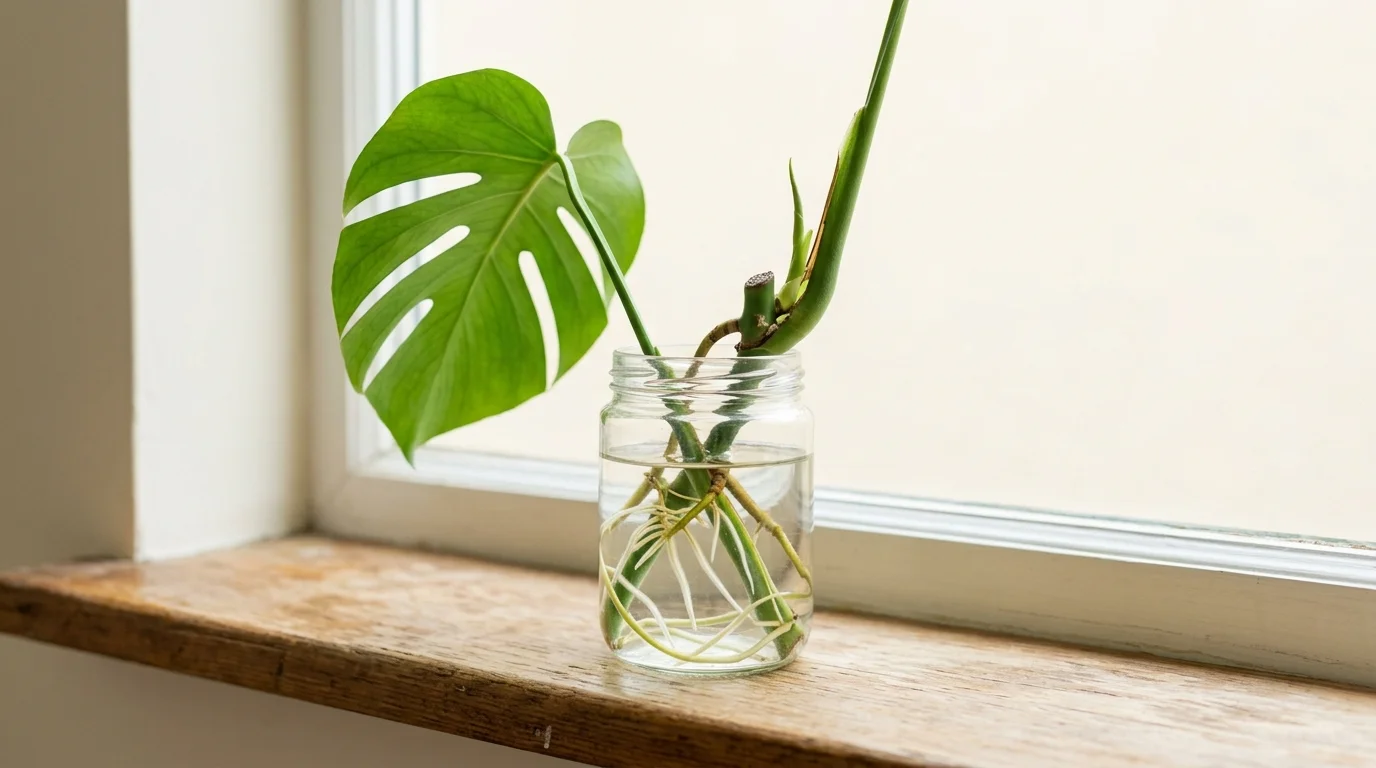
Most houseplants can make new plants from a piece of themselves. The trick is matching the method to how the plant grows. Iowa State University Extension puts it plainly: pothos stems root easily, while African violet’s growth habit makes leaf propagation the better choice. This guide covers the main methods, which plants suit each one, and the conditions cuttings need.
Start with a healthy parent
Iowa State says to propagate only from healthy, vigorously growing plants. Skip plants with pests, disease or signs of virus, such as mottled leaves and weak growth. Most houseplants can be propagated at any time of year, but early spring through summer is best for both the new plant and the parent.
The NC State Extension Gardener Handbook adds that stock plants short of nutrients, heavily fed with nitrogen or under water stress may not root well. Iowa State suggests watering the parent the day before you cut.
The methods at a glance
| Method | What you use | Houseplant examples (source) |
|---|---|---|
| Stem tip or stem segment cutting | 7.5–15 cm (3–6 in) of stem with at least two nodes | Pothos, philodendron, monstera, hoya, tradescantia (Iowa State) |
| Leaf-bud (single-node) cutting | One leaf, its petiole and a bit of stem with a bud | Devil’s ivy, heartleaf philodendron, grape ivy, jade (NC State) |
| Cane cutting | Leafless 5–7.5 cm (2–3 in) stem sections with nodes | Dumb cane, corn plant, Chinese evergreen (NC State, Iowa State) |
| Leaf-petiole cutting | A leaf with 2.5–4 cm (1–1½ in) of stalk | African violet, peperomia, ZZ plant (Iowa State) |
| Leaf-section cutting | 7.5–10 cm (3–4 in) slices of a long leaf | Snake plant (Iowa State, NC State) |
| Leaf-vein (split-vein) cutting | A whole leaf with its main veins cut | Rex begonia, iron cross begonia (Iowa State) |
| Division | A clump split into rooted pieces | Peace lily, ferns, cast iron plant, calathea (Iowa State) |
| Offsets and plantlets | Small plants at the base or on runners | Spider plant, aloe, bromeliads (Iowa State, Illinois) |
| Layering | Stems rooted while still attached | Rubber plant, dieffenbachia, pothos (NC State) |
Iowa State’s species table lists dozens more. Seed is rarely practical: houseplants rarely flower indoors (Iowa State), and seedlings may not resemble the parent (Illinois Extension).
Stem cuttings
Stem cuttings are the most common method. Roots form at the nodes, where leaves join the stem. Iowa State’s stem cutting guide gives the steps:
- Cut stems 7.5–15 cm (3–6 in) long with at least two nodes.
- Remove the lower leaves and any flowers or fruit.
- Dip the cut end in rooting hormone if you want to.
- Insert at least one node into moist medium, with no leaves buried.
- Water, let it drain, and cover with a loose plastic bag or dome.
Iowa State warns that stem segments will not root upside down; angle the bottom cut as a reminder.
Some plants need a pause first. Illinois Extension says succulents, cacti, geraniums and rubber plants should air-dry until the cut end calluses before you stick them.
Leaf and leaf-vein cuttings
A leaf cutting has to grow both roots and a shoot. NC State explains that leaf cuttings work only for plants that can form adventitious buds. Most plants produce a few roots from a leaf, or simply decay. That is why a pothos leaf without a node never becomes a vine.
- Leaf-petiole. Iowa State inserts the stalk at a 45-degree angle. Plantlets form at its base.
- Leaf-section. Snake plant leaves are cut into sections and inserted bottom end down. Iowa State says variegated-edge cultivars such as ‘Laurentii’ lose their pattern this way; divide them instead.
- Leaf-vein. Cut the main veins on the underside and pin the leaf flat on the medium. NC State describes a variation: cut the leaf into wedges, each with a main vein. Our Rex begonia leaf-vein guide covers this in detail.
The RHS leaf cuttings guide keeps tropical leaf cuttings humid at about 20 °C (68 °F) and warns they rot if the compost is too wet.
Division, offsets and plantlets
Division suits plants that grow in clumps or from several stems. Iowa State’s division guide says to unpot the plant, loosen the root ball and separate pieces that each have leaves, stems and roots. Larger pieces recover faster. Pot each in fresh mix, usually in a smaller pot, and wait a few weeks before feeding.
Offsets are small plants beside the parent, as on aloe and bromeliads. Illinois Extension says to cut them away only once they have roots. Plantlets grow on runners, as on spider plants. Pin them to a pot of mix until they root, then cut the runner. See our spider plant propagation guide and, for corm-forming aroids, the Alocasia pup and corm guide.
Layering
Layering roots a stem while it is still attached. NC State notes it usually succeeds because water stress is low.
- Simple layering. Iowa State bends a flexible stem into an adjacent pot, buries a node 5–10 cm (2–4 in) deep and pins it. Roots form in about 6 to 12 weeks.
- Compound (serpentine) layering. NC State alternately buries and exposes sections of a vine such as pothos or heartleaf philodendron.
- Air layering. For tall, leggy plants such as rubber plant or dieffenbachia. Wound the stem, dust with rooting hormone, wrap in moist sphagnum moss and seal with plastic. Iowa State expects roots in several weeks, or months for some species. Cut below the moss once roots are several inches long.
Water or potting mix?
Missouri Botanical Garden’s water rooting guide says begonias, coleus, ivies and philodendrons root easily in water. Woody plants such as hibiscus and citrus usually rot first.
The trade-off is root quality. Iowa State says water roots are coarser and less suited to soil, so potted cuttings may wilt, drop leaves or brown at the tips for a while. Illinois Extension goes further and does not recommend water rooting. If you use water:
- Keep leaves out of the water (Missouri Botanical Garden).
- Change it once or twice a week and never let the roots dry out (Iowa State).
- Pot up when roots reach about 2.5 cm (1 in) (Iowa State) to 2.5–5 cm (1–2 in) (Missouri Botanical Garden).
Green water? See our water propagation algae guide.
Rooting conditions
| Factor | What the sources say |
|---|---|
| Medium | Perlite, or peat mixed with perlite or sand; potting soil only as part of a mix (Iowa State). Vermiculite alone packs and stays too wet (NC State) |
| Container | Clean, drained, at least 5 cm (2 in) deep (Iowa State) |
| Humidity | High; use a bag or dome held off the leaves, not sealed tight (Iowa State) |
| Light | 4 to 6 hours of bright indirect light; too much burns leaves under a cover (Iowa State) |
| Temperature | Air 18–24 °C (65–75 °F); medium 24–27 °C (75–80 °F) with a heat mat (Iowa State) |
| Hormone | Optional for easy rooters, helpful for hard ones (Illinois) |
| Moisture | Evenly moist, not soggy; ventilate covered cuttings (Illinois) |
Common mistakes
- Leaves under the medium or water. They rot and foul the cutting (Iowa State, Missouri Botanical Garden).
- Dipping into the hormone container. Iowa State says this can spread disease; use a separate dish.
- A sealed bag in sun. Leaves can burn under a cover, and a sealed bag stops air exchange (Iowa State).
- Dirty tools. Illinois Extension sterilizes blades in alcohol before and between cuts.
- Waiting too long to pot up. Illinois lists this among its tips for success.
Potting up and aftercare
Iowa State’s aftercare is the same for most methods: pot rooted cuttings in regular potting mix, keep them watered and in bright, indirect light, and begin regular feeding once they are established, usually within a few weeks.
Plant-specific guides
- Pothos: cuttings step by step, choosing nodes, rooting hormone
- Spider plant: plantlets and division
- Begonias: Rex begonia leaf-vein cuttings, Begonia maculata stem cuttings
- Aroids: Monstera adansonii, Alocasia pups and corms
- Lab-grown plants: acclimating tissue-culture plantlets
References
- Iowa State University Extension and Outreach, A. Steil: Propagating Houseplants
- Iowa State University Extension and Outreach: How to Propagate Houseplants by Stem Tip Cuttings
- Iowa State University Extension and Outreach: How to Propagate Houseplants by Division and Offsets
- Iowa State University Extension and Outreach: How to Propagate Houseplants by Air Layering and Simple Layering
- NC State Extension Gardener Handbook: Chapter 13, Propagation
- University of Illinois Extension: Houseplants: Propagation
- University of Illinois Extension: Houseplants: Cuttings
- Royal Horticultural Society: Leaf cuttings
- Missouri Botanical Garden: Rooting Cuttings in Water