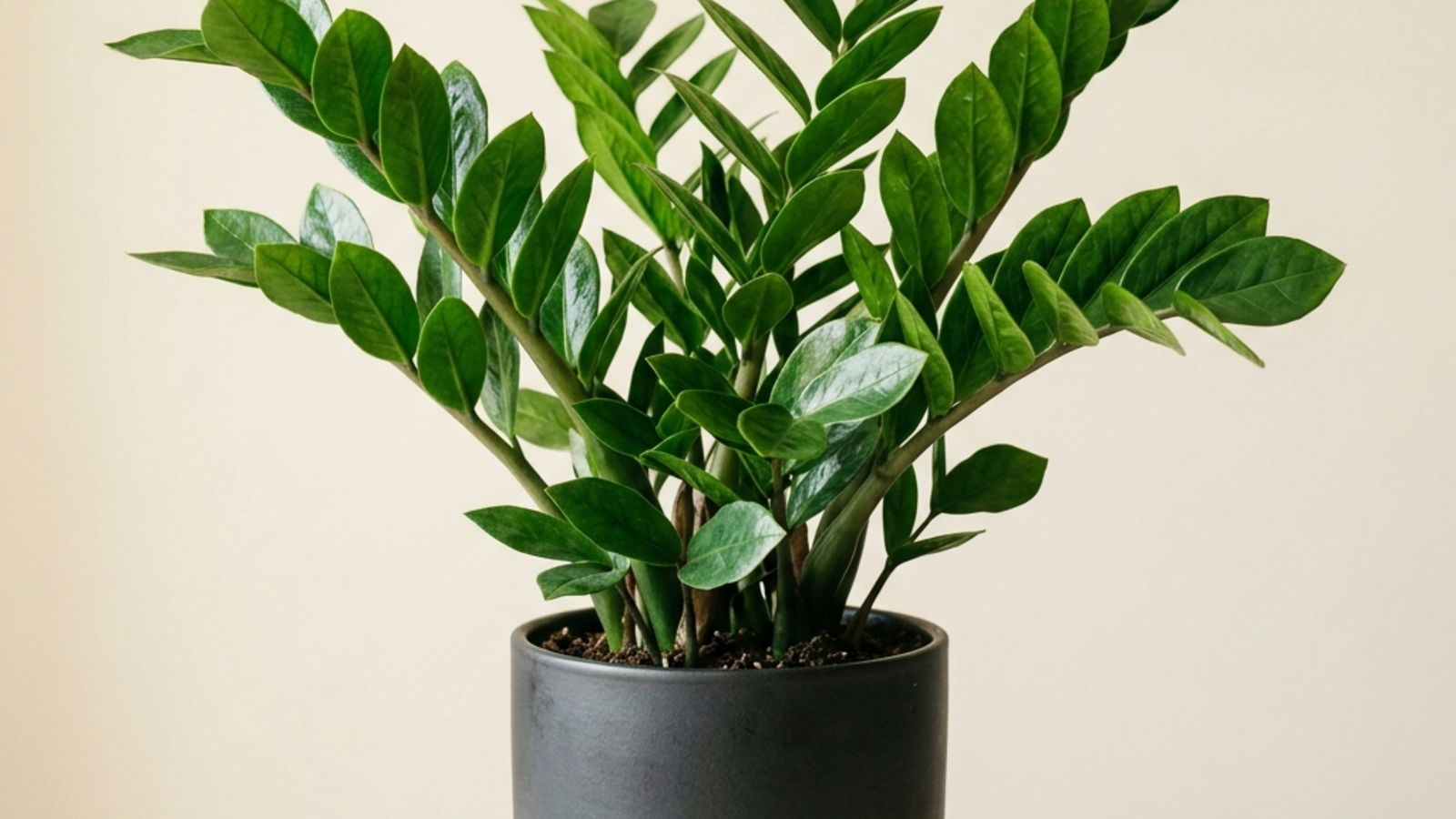
A ZZ plant rarely dies of neglect. It dies of kindness, usually in the form of a watering can. The reason sits under the soil: thick rhizomes that store water. UF/IFAS Extension explains that they let the plant ride out dry seasons in its native eastern Africa. The same feature means a pot that stays wet can rot it.
This guide covers Zamioculcas zamiifolia, the only species in its genus (Clemson Extension). It is an aroid, related to peace lily and Chinese evergreen, and is also sold as Zanzibar gem, aroid palm or eternity plant (NC State Extension).
Choosing between a ZZ and a money tree? See ZZ plant vs money tree.
ZZ plant care at a glance
| Factor | What the sources say |
|---|---|
| Light | Best in bright indirect light; tolerates very low light (NC State, UF/IFAS). No direct sun |
| Water | Only after the mix has dried. About twice a month in summer, once a month in winter (NC State) |
| Mix | Any well-drained peat- or bark-based potting mix (UF/IFAS); Clemson adds perlite and sand |
| Temperature | 18–32 °C (65–90 °F); growth slows and injury can occur below 10 °C (50 °F) (UF/IFAS) |
| Humidity | Regular indoor humidity is fine (Clemson) |
| Feeding | Low-dose liquid fertilizer twice a year (UF/IFAS); once or twice a year (NC State) |
| Size | 61 cm–1.2 m (2–4 ft) tall and wide; slow-growing (NC State) |
| Propagation | Division or leaf cuttings (NC State, Iowa State) |
| Pets | Toxic to cats and dogs (NC State) |
Light: tolerant, not indifferent
NC State says a ZZ will grow in very low light, even in rooms with only fluorescent light. It still does best in bright, indirect sunlight. Clemson puts it plainly: it survives low light, but brighter indirect light speeds its very slow growth.
Two limits matter:
- Direct sun scalds it. NC State warns of scalding and browning leaves in direct sunlight. Iowa State Extension singles out direct afternoon sun. Keep it back from unscreened south and west windows.
- Dim corners slow everything. A ZZ in deep shade makes few new stalks and uses little water. Its mix stays wet longer, which is where most trouble starts.
UF/IFAS notes that a ZZ will not flower in low light. Indoors, flowers are rare anyway: a green spathe close to the soil (NC State).
Watering: let the rhizomes do their job
NC State’s guidance is to let the mix dry out between waterings, because wet feet are not tolerated. It suggests watering about twice a month in summer, and only if the soil has dried out completely, and about once a month in winter. Clemson gives 1–2 times a month, only after the mix has completely dried. Iowa State says a thorough watering every 7 to 14 days is usually fine once the mix has dried, and UF/IFAS suggests moderate watering every week or two, never leaving the roots in water. Iowa State adds: water thoroughly, let some run out of the bottom, and discard the excess.
Treat those numbers as a ceiling, not a schedule. Light, pot size and season change how fast the mix dries. Our ZZ plant watering guide covers how to check the mix, how to water, and how to tell thirst from overwatering.
One Clemson tip is worth repeating here: let the nursery pot drain fully before you set it back in a decorative pot or saucer. A hidden pool at the bottom keeps the rhizomes wet.
Potting mix, pot and repotting
UF/IFAS says any well-drained peat- or bark-based potting soil works. Clemson suggests a coarser blend: half peat moss or coir-based potting soil, a quarter perlite and a quarter sand. NC State adds that a ZZ can be treated much like a cactus or succulent.
Use a pot with drainage holes, and size up only modestly. A ZZ grows in spurts (Iowa State) and slowly overall, so a large pot holds wet mix around a small root system. University of Illinois Extension lists the signs a houseplant needs repotting:
- roots growing through the drainage holes or onto the surface;
- a root mass that fills the pot;
- new leaves smaller than normal;
- wilting between normal waterings.
Repot while the plant is actively growing, typically spring or early summer (Illinois).
Temperature and humidity
UF/IFAS gives a preferred range of 18–32 °C (65–90 °F). Growth slows and injury can occur below 10 °C (50 °F), and it has no frost tolerance. Clemson recommends keeping it above 16 °C (60 °F). NC State says a pot summered outdoors should come back in once temperatures fall below 16 °C (60 °F).
Humidity is not a concern. Clemson notes ZZ plants are adapted to arid conditions and do well at regular indoor humidity.
Feeding
A ZZ needs very little. UF/IFAS recommends a low-dose liquid fertilizer twice a year, at the label rate. NC State says a balanced liquid houseplant fertilizer once or twice a year. Clemson suggests once or twice during the growing season.
Iowa State’s older advice is more generous: a dilute solution once or twice a month in spring and summer. Given the plant’s slow growth and the UF/IFAS rating of “slight” salt tolerance, we would start at the lower end.
Propagation
NC State and Iowa State list two methods: division and leaf cuttings.
- Division. Unpot the plant and separate the rhizome clump into pieces, each with stalks and roots. Pot each in fresh, well-drained mix.
- Leaf cuttings. The RHS recommends single leaflets. UF/IFAS calls the plant easy to propagate from leaf cuttings. The ZZ is slow-growing, so expect a long wait before a cutting looks like a plant.
Wear gloves. The RHS lists the plant as a skin and eye irritant.
Problems and what to check
| What you see | Likely cause | What to do |
|---|---|---|
| Yellowing stalks, wet mix, soft stalk bases | Root rot from wet, poorly drained mix (UF/IFAS, Clemson) | Stop watering and check the rhizomes and roots. See our root rot guide |
| Leaflets falling after a long dry spell | Drought response: UF/IFAS describes leaflets and upper stalks dropping while the swollen base survives | Water thoroughly once the cause is clear; keep the rhizome |
| Bleached or brown patches | Direct sun (NC State, Iowa State) | Move it out of direct sun |
| Dark spots on the stems | Normal for the plant (Clemson) | No action needed |
| No new growth for months | Normal slow growth, or very low light (Clemson, Iowa State) | Move it brighter, still out of direct sun |
| Damage after a cold spell | Chill below 10 °C (50 °F) (UF/IFAS) | Move it to a warmer spot, away from cold glass |
UF/IFAS says no pests or diseases are an issue for this plant apart from root rot. University of Maryland Extension lists the signs of root rot on indoor plants: yellowing, browning and dieback, with dark, soft roots. Its management advice is to avoid excess water, use clean pots and sterile potting mix, and take cuttings only from healthy tissue.
The RHS says no pruning is needed. Remove faded leaves at soil level.
Is a ZZ plant safe for pets?
No. NC State lists Zamioculcas zamiifolia as a problem for cats and dogs, with medium poison severity. The toxic principle is calcium oxalate in the leaves, and eating them in quantity can cause vomiting and diarrhea. UF/IFAS says all parts are toxic if ingested, and Iowa State calls it poisonous to people and pets. The ASPCA does not have a ZZ plant entry.
Place it where pets and children cannot chew it. For low-light plants without this risk, see our pet-safe plants guide and the ZZ plant hub.
References
- NC State Extension Gardener Plant Toolbox: Zamioculcas zamiifolia
- UF/IFAS Extension, R. J. Henny and J. Chen: Florida Foliage House Plant Care: ZZ Plant (EP480)
- UF/IFAS Gardening Solutions: ZZ Plant
- Clemson Cooperative Extension HGIC 1570, J. Jordan: ZZ Plant (Zamioculcas zamiifolia): Indoor Care, Growing Tips & Plant Guide
- Iowa State University Extension and Outreach, R. Jauron: The ZZ Plant
- Royal Horticultural Society: Zamioculcas zamiifolia
- University of Illinois Extension: Houseplants: Repotting
- University of Maryland Extension: Root Rots of Indoor Plants