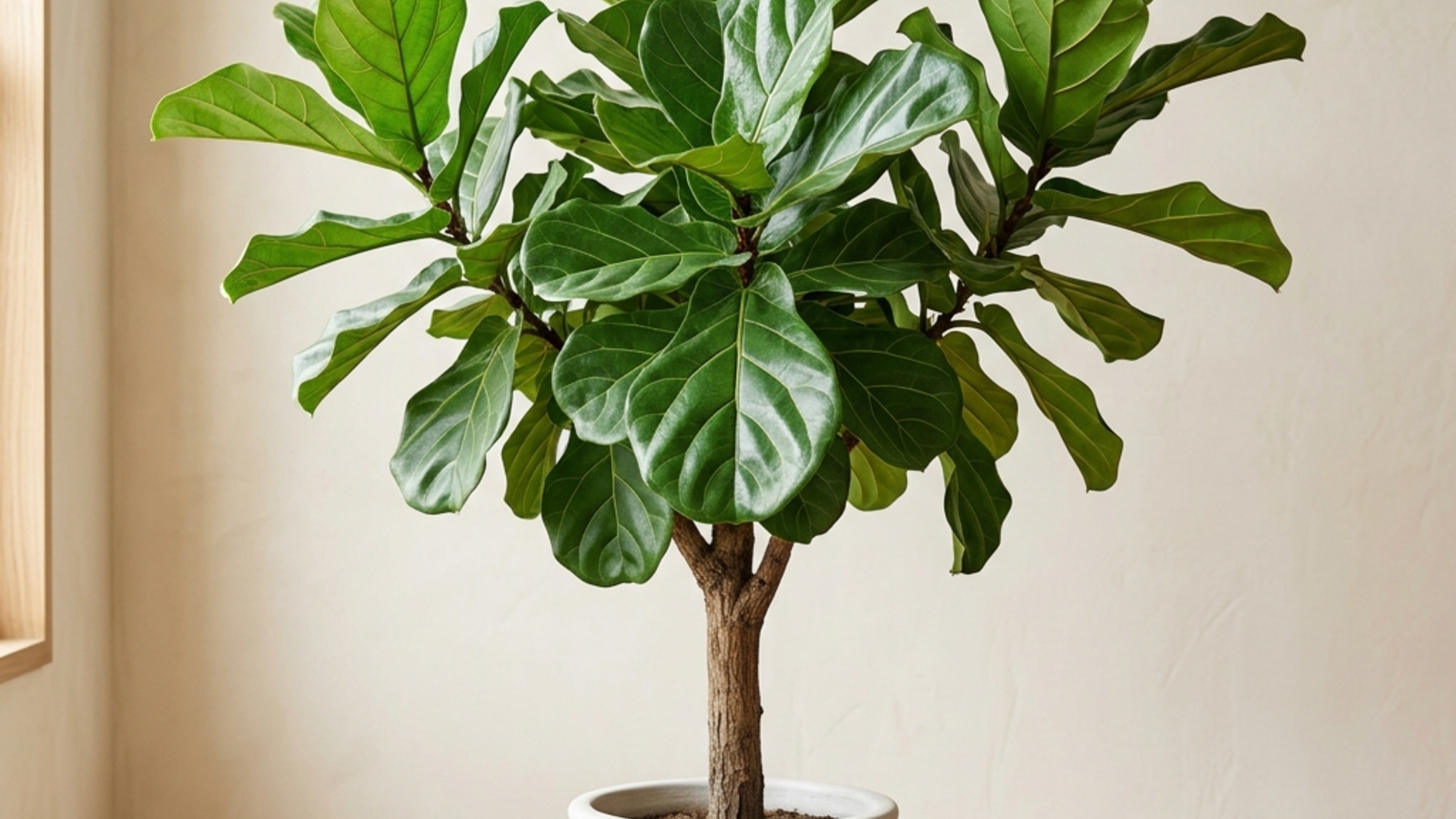
Fiddle-leaf fig has a reputation for sulking, and it is partly earned. It is a tree from the rainforests of tropical western and central Africa, kept in a pot in a living room. NC State Extension describes it as relatively low-maintenance once it is in the right spot. Most problems trace back to three things: too little light, a pot that stays wet, or a sudden change in conditions.
As a houseplant, Ficus lyrata grows 0.6–3 m (2–10 ft) tall, with lyre-shaped leaves up to 45 cm (18 in) long (NC State). It rarely flowers or fruits indoors. Give it room: NC State notes that this heavy-textured plant suits large spaces.
Fiddle-leaf fig care at a glance
| Factor | What the sources say |
|---|---|
| Light | Bright indirect light or partial shade; protect from afternoon sun (NC State). Medium light range; low light can cause leaf drop (Missouri) |
| Water | Sensitive to overwatering; leaf drop can follow too much or too little water (NC State). Check the mix 5 cm (2 in) down (Illinois) |
| Temperature | Above 13 °C (55 °F) (NC State). Keep away from heating and cooling vents |
| Humidity | Medium humidity is best (NC State); tolerates low humidity (Missouri) |
| Soil | Moist, well-drained mix (NC State) in a pot with drainage holes |
| Feeding | Only while actively growing; most houseplants need feeding no more than every 1–3 months, March to September (Illinois) |
| Repotting | Spring, into a pot 2.5–5 cm (1–2 in) wider (Clemson) |
| Propagation | Stem cuttings (NC State); layering and cuttings (UF/IFAS). Wear gloves |
| Pets | Toxic to cats, dogs and horses (NC State; ASPCA lists Ficus species) |
Light: the spot decides most outcomes
NC State Extension says fiddle-leaf fig prefers bright indirect light or partial shade, with protection from afternoon sun. University of Illinois Extension lists Ficus lyrata as a medium-light plant. Its window guide puts medium light directly in front of a north window, a few feet from an east or west window, or 1–3 m (3–10 ft) back from a south window.
University of Missouri Extension groups it with rubber plant and weeping fig as large figs best grown in medium light. It warns that low light may result in a drop of foliage. Missouri also lists the general signs of too little light:
- long stretches of stem between leaves;
- new leaves smaller than the old ones;
- pale stems and foliage;
- lower leaves that turn yellow and drop.
Too much sun causes a different problem. NC State notes leaf scorch when the plant receives too much direct sunlight. Clemson Extension explains that leaves bleach or scald when light rises suddenly, often after a move outdoors, so any change in light should be gradual. If you put your fig outside for summer, Illinois Extension suggests a shaded spot and a 1–2 week build-up in time outdoors.
For light levels by plant and window, see our houseplant light guide.
Watering: check before you pour
NC State says fiddle-leaf fig is sensitive to overwatering, and that leaf drop may occur from too much or too little water. Missouri Extension advises keeping the soil evenly moist. Read the two together: moist through the root zone, never soggy.
A routine that fits both:
- Push a finger 5 cm (2 in) into the mix, as Illinois Extension recommends. If it is dry at that depth, water.
- Water until it runs out of the drainage holes. Clemson notes that thorough watering also washes out excess salts.
- Empty the saucer or cachepot. Do not let the pot sit in water (Illinois).
- Use room-temperature water. Clemson suggests 17–22 °C (62–72 °F) and advises against softened water.
Do not water on a fixed day. Illinois lists light, temperature, humidity, pot type, pot size and mix as factors that change how fast a pot dries. A fig in a dim winter room may need water far less often than in summer.
A wilting fig is not always thirsty. Clemson points out that root rot also causes wilting, and that watering then makes it worse. If the mix is wet and the plant droops, check the roots. Our fiddle-leaf fig watering guide covers water quality and peat-based mixes in more detail.
Temperature, drafts and humidity
NC State recommends temperatures above 13 °C (55 °F) and medium relative humidity. Illinois gives 18–24 °C (65–75 °F) by day as the preferred range for most foliage plants. It adds a warning about hot and cold air blasts from windows, radiators and vents.
Drafts matter for this plant in particular. NC State links brown spots on fiddle-leaf fig to fluctuating room temperatures near heating or cooling vents. Move the plant away from vents and cold glass before trying anything else. Missouri notes that indoor figs tolerate low humidity, so a humidifier is optional rather than essential.
Leaf drop and brown spots: what to check
| What you see | Likely cause | What to check or do |
|---|---|---|
| Leaves dropping, mix wet | Overwatering (NC State) | Let the top 5 cm (2 in) dry; check roots for soft, brown tissue |
| Leaves dropping, mix bone dry | Underwatering (NC State) | Water thoroughly until it drains; if the mix has shrunk from the pot, rewet it slowly |
| Leaves dropping after a move | New conditions; NC State notes most plants drop a few leaves when moved | Keep watering and light steady; look for drafts if drop continues beyond a few weeks |
| Lower leaves yellow, small pale new growth | Too little light (Missouri) | Move closer to a window, out of direct afternoon sun |
| Bleached or brown patches on sun-facing leaves | Leaf scorch from direct sun (NC State) | Move back from the glass; scorched tissue will not recover |
| Brown spots, plant near a vent | Temperature swings (NC State) | Move away from heating and cooling vents |
| Raised red dots or corky spots | Possible edema | See our fiddle-leaf fig edema guide |
| Sticky leaves, bumps on stems | Scale (UF/IFAS, NC State) | Inspect stems and leaf undersides; see our pest guide |
NC State lists scale, aphids, mealybugs, thrips and spider mites as pests to watch for, and says there are no serious pests or diseases. For a step-by-step on leaf loss, see fiddle-leaf fig dropping leaves.
Potting mix, repotting and feeding
NC State says fiddle-leaf fig prefers moist, well-drained, loamy, acidic soil. Use a quality potting mix and a pot with drainage holes.
Repot when roots form a solid mass around the root ball, grow out of the drainage holes, or the plant wilts soon after watering (Clemson). Do it in spring while the plant is actively growing. Clemson advises a pot only 2.5–5 cm (1–2 in) wider than the current one. Do not add a layer of gravel at the bottom: both Clemson and NC State explain that it slows drainage instead of helping it. For a tall fig in a pot too heavy to move, Clemson suggests replacing the top 5–7.5 cm (2–3 in) of mix every other year.
Feed only when the plant is actively growing. Illinois advises no more than every 1–3 months between March and September, and warns that too much fertilizer can burn roots.
Dust blocks light on such large leaves. Clemson recommends wiping both surfaces with a cloth dampened with water and avoiding leaf-shine products.
Pruning, propagation and sap
NC State says fiddle-leaf fig may be pruned as needed. Its recommended propagation method is stem cuttings; UF/IFAS lists layering and cuttings. The stems bleed a milky sap that can irritate skin, so wear gloves when pruning or taking cuttings (NC State).
NC State lists smaller cultivars for limited space: ‘Bambino’, a dwarf that grows a few feet tall, and ‘Compacta’, which reaches about 1.5 m (5 ft).
Is fiddle-leaf fig safe for pets?
No. NC State Extension lists Ficus lyrata as a problem for cats, dogs and horses. It names insoluble calcium oxalates and lists oral irritation, burning of the mouth, excessive drooling, vomiting and difficulty swallowing. The ASPCA files Ficus species under its weeping fig entry as toxic to dogs, cats and horses. Keep fallen leaves picked up. For alternatives, see our pet-safe plants guide.
References
- NC State Extension Gardener Plant Toolbox: Ficus lyrata
- University of Missouri Extension, D. H. Trinklein: Lighting Indoor Houseplants, G6515
- University of Illinois Extension: Houseplants: Lighting
- University of Illinois Extension: Houseplants: Watering
- University of Illinois Extension: Houseplants: Care
- Clemson Cooperative Extension HGIC 1459: Indoor Plants – Watering
- Clemson Cooperative Extension HGIC 1458: Indoor Plants – Transplanting & Repotting
- Clemson Cooperative Extension HGIC 1450: Indoor Plants – Cleaning, Fertilizing, Containers & Light Requirements
- NC State Extension Gardener Handbook: 18. Plants Grown in Containers
- UF/IFAS Extension, E. F. Gilman et al.: Ficus lyrata: Fiddleleaf Fig (ENH413/ST254)
- ASPCA Animal Poison Control Center: Weeping Fig (Ficus sp.)