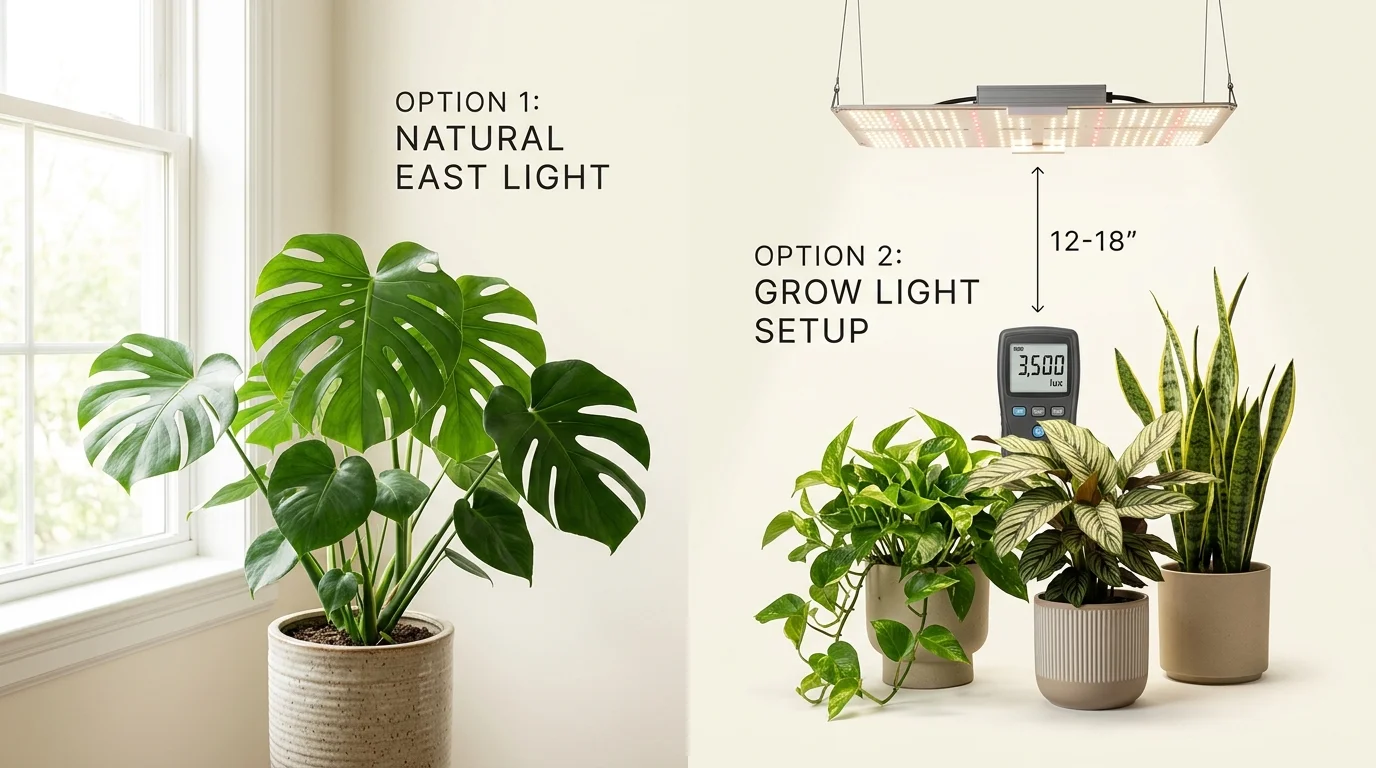
Most houseplant care tags say “bright indirect light” or “low light” without saying where that is in your home. This guide turns those labels into distances from a window. Find the light category for your plant in the chart, then use the window table to find a spot that delivers it.
A plant labelled “low light” tolerates dim conditions; it still needs light. Growth is usually best at the brighter end of each plant’s range.
What the light categories mean
University of Illinois Extension describes four light levels by where they occur near a window. University of Missouri Extension uses broader ranges. One foot-candle is about 10.8 lux, so a lux reading from a meter or phone app can be compared directly.
| Category | Illinois Extension reference | Missouri Extension range | Where you find it (Illinois Extension) |
|---|---|---|---|
| Low | About 75 foot-candles (~810 lux) | 50–250 foot-candles (~540–2,700 lux) | A few feet from a north window; 3–10 ft (1–3 m) from an east or west window; 15–20 ft (4.5–6 m) from a south window |
| Medium | About 150 foot-candles (~1,600 lux) | 250–1,000 foot-candles (~2,700–10,800 lux) | Directly in front of a north window; a few feet from an east or west window; 3–10 ft (1–3 m) from a south window |
| High or bright | About 300 foot-candles (~3,200 lux) | 1,000+ foot-candles (~10,800+ lux) | Directly in front of an east or west window; up to 5 ft (1.5 m) from a south window |
| Direct | About 1,500 foot-candles (~16,000 lux) | — | Directly in front of a south window |
Window directions above are for the Northern Hemisphere. In the Southern Hemisphere, swap north and south.
Missouri adds three placement rules:
- Even low-light plants usually do not get enough light more than about 3 m (10 ft) from an average window.
- Large windows let you place plants farther back into the room.
- Overhangs, trees and nearby buildings cut the light a window delivers.
Light requirements chart: 45 houseplants
The categories come from the University of Illinois Extension houseplant lighting chart. Where a plant’s botanical name has changed since that chart was written, we give the current name.
| Plant | Botanical name | Light needed |
|---|---|---|
| Boston fern | Nephrolepis exaltata | Low |
| Chinese evergreen | Aglaonema | Low |
| Heartleaf philodendron | Philodendron hederaceum | Low |
| Snake plant (mother-in-law’s tongue) | Dracaena trifasciata (formerly Sansevieria trifasciata) | Low |
| Parlor palm (Neanthe bella) | Chamaedorea elegans | Low |
| Peace lily | Spathiphyllum | Low |
| Anthurium | Anthurium | Medium |
| Asparagus fern | Asparagus densiflorus ‘Sprengeri’ | Medium |
| Begonia | Begonia | Medium |
| Bird’s nest fern | Asplenium nidus | Medium |
| Coralberry | Ardisia crispa | Medium |
| Dracaena | Dracaena | Medium |
| Dumb cane | Dieffenbachia | Medium |
| Fiddle-leaf fig | Ficus lyrata | Medium |
| Grape ivy | Cissus rhombifolia | Medium |
| Dwarf umbrella tree | Schefflera arboricola | Medium |
| Inch plant | Tradescantia zebrina | Medium |
| Arrowhead vine | Syngonium podophyllum | Medium |
| Peperomia | Peperomia obtusifolia | Medium |
| Piggyback plant | Tolmiea menziesii | Medium |
| Pleomele | Dracaena reflexa (formerly Pleomele reflexa) | Medium |
| Pothos | Epipremnum aureum | Medium |
| Prayer plant | Maranta | Medium |
| Rubber plant | Ficus elastica ‘Decora’ | Medium |
| Sago palm | Cycas revoluta | Medium |
| Spider plant | Chlorophytum comosum | Medium |
| Staghorn fern | Platycerium bifurcatum | Medium |
| Ti plant | Cordyline fruticosa (listed as C. terminalis) | Medium |
| Umbrella tree | Schefflera actinophylla | Medium |
| Baby’s tears | Soleirolia soleirolii | High or bright |
| Crown of thorns | Euphorbia milii | High or bright |
| English ivy | Hedera helix | High or bright |
| False aralia | Dizygotheca elegantissima | High or bright |
| Jade plant | Crassula ovata (listed as C. argentea) | High or bright |
| Norfolk Island pine | Araucaria heterophylla | High or bright |
| Pittosporum | Pittosporum tobira | High or bright |
| Podocarpus | Podocarpus macrophyllus | High or bright |
| Ponytail palm | Beaucarnea recurvata | High or bright |
| Purple passion plant | Gynura aurantiaca | High or bright |
| Wax plant (hoya) | Hoya carnosa | High or bright |
| Weeping fig | Ficus benjamina | High or bright |
| Zebra plant | Aphelandra squarrosa | High or bright |
| Gardenia | Gardenia | Direct |
| Citrus (orange, lemon) | Citrus | Direct |
| ZZ plant | Zamioculcas zamiifolia | Low to partial shade (NC State Extension) |
Notes that change placement
These details come from the University of Missouri Extension plant list and NC State Extension profiles:
- Snake plant tolerates poor light but makes its best growth in medium to bright light.
- Pothos suits low and medium light.
- Peace lily adapts to low light but needs medium light to flower.
- Hoya tolerates low light, needs medium light to grow and high light to flower.
- Jade plant tolerates light as low as 25 foot-candles, but growth will be thin and leaves small.
- Ficus (rubber plant, fiddle-leaf fig, weeping fig) does best in medium light. Low light can cause leaf drop.
- Croton needs high light for good colour and growth; Missouri Extension considers crotons generally unsuited to indoor conditions for that reason.
- ZZ plant is listed by NC State for deep shade to partial shade.
- Cacti and succulents need high light. Missouri notes most are not satisfactory under artificial light alone.
Seasonal changes at the window
Missouri Extension notes a south window benefits any houseplant in winter. From late spring to early fall, though, the same window can sunburn plants that do not need bright light. Move African violets and other medium-light plants to a north window, or to the side of a large south window, during those months.
Recheck any spot when the season changes, when trees leaf out, or when you add curtains. A spot that was medium light in January may be bright in May.
Signs a plant needs more light
University of Missouri Extension lists four signs that a healthy plant is short of light:
- Long gaps between leaves on the stem (long internodes).
- New leaves smaller than normal.
- Pale green stems and foliage.
- Lower leaves that yellow and drop.
Move the plant one category brighter before changing water or fertilizer. If no brighter spot exists, a grow light can make up the difference. Our grow light comparison covers lamp types, distances and timer hours.
For dim rooms, start with our low-light houseplant guide.
Updated October 14, 2026: rebuilt around the University of Illinois Extension light chart and University of Missouri Extension light ranges. Earlier unsupported survival figures remain removed.
References
- University of Illinois Extension: Houseplants: Lighting
- University of Missouri Extension, D. H. Trinklein (rev. 2016): Lighting Indoor Houseplants, G6515
- NC State Extension Gardener Plant Toolbox: Zamioculcas zamiifolia
- NC State Extension Gardener Plant Toolbox: Crassula ovata