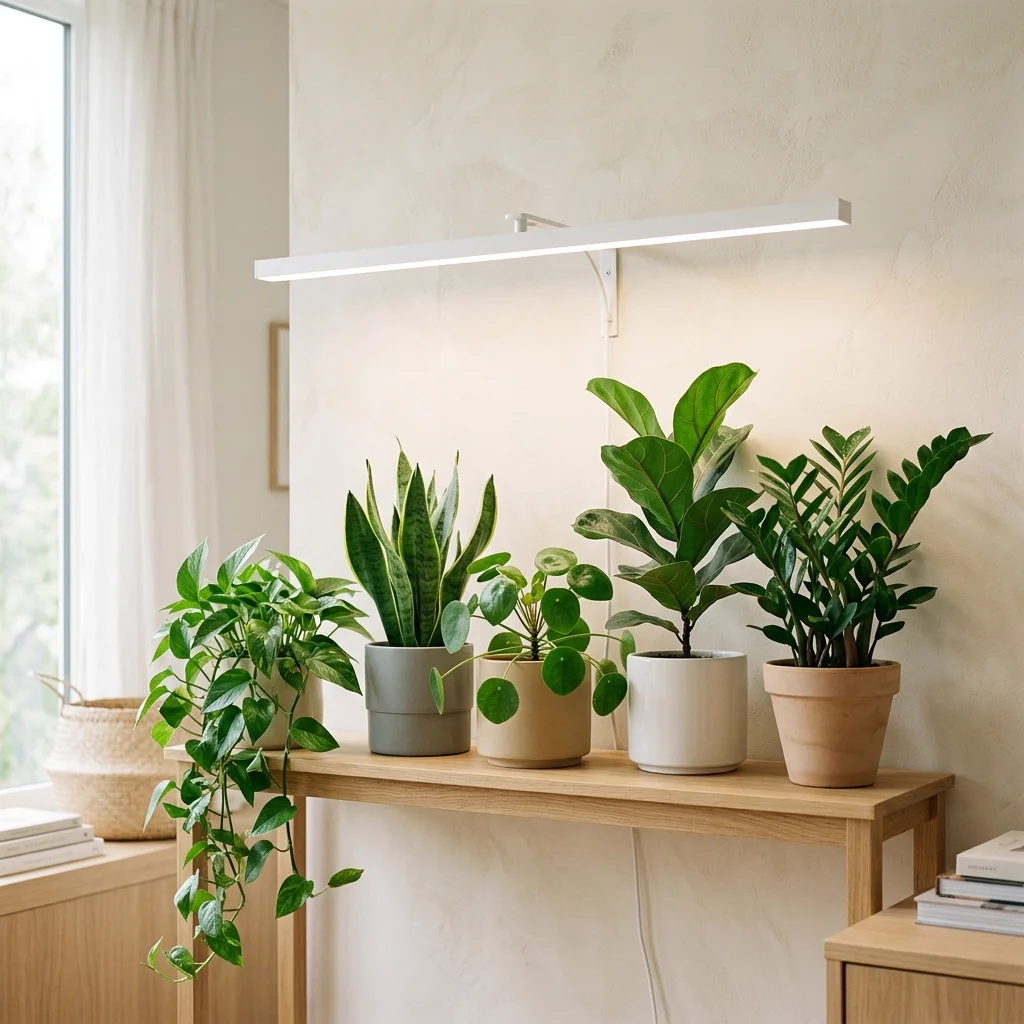
The best grow light for your plants depends on what the light has to do. One shelf of African violets, one tall monstera in a dark corner, and a windowsill of cacti need different fixtures. Before you compare brands, work out how much light your plants need and how large an area you have to light. This guide compares the four lamp types, then walks through choosing, mounting and timing a light.
We have not bench-tested retail grow-light models, so we do not rank products. Every specification below comes from university extension publications.
The four types of grow light compared
University of Missouri Extension describes four sources of artificial light for plants: incandescent, fluorescent, high-intensity discharge (HID) and light-emitting diodes (LEDs).
| Lamp type | Light it gives plants | Heat | Efficiency and lifespan | Best home use |
|---|---|---|---|---|
| LED | Can be built for specific wavelengths; some plant LEDs emit only red and blue | Very little; no ballast or reflector needed | Extremely energy efficient and very long-lived | Most home setups: shelves, single plants, floor plants |
| Fluorescent tube (T5/T8, cool-white or plant tubes) | Cool-white is mostly blue and low in red; plant-growing tubes add red | Relatively little | About 2.5× more efficient than incandescent; tube life normally 10,000 hours or more | Shelves of low- and medium-light plants, African violets, seedlings |
| Incandescent / halogen spotlight | Rich in red, poor in blue | High; must sit far from leaves, which cuts the light reaching them | Inefficient; standard bulb life often about 1,000 hours | Not recommended as a single source |
| HID (metal halide, high-pressure sodium) | High output | High | About 10× more efficient than incandescent; long-lived bulbs | Greenhouses; Missouri Extension calls them questionable for homes because of heat, bulky and expensive fixtures, and few small wattages |
Two points from the Missouri guide shape the choice:
- Leaves use red and blue light most. Leaves reflect and get little energy from yellow and green wavelengths. Red and blue drive plant growth.
- Watts measure electricity, not plant light. Missouri’s watts-per-square-foot rules apply to fluorescent tubes only. An LED rated at the same wattage can deliver a different amount of usable light, so compare LEDs by their measured output at your mounting distance.
LED vs fluorescent
For a new setup, LED is usually the practical choice. It is efficient, long-lived and runs cool, so it can sit close to leaves.
Fluorescent tubes still work well, especially if you already own shop fixtures. Missouri Extension notes cool-white tubes remain the most popular, warm-white tubes are also fairly effective, and tubes labelled “white” or “daylight” are less desirable for plants. Cool-white tubes are low in red. Missouri suggests pairing one plant-growing tube with each one or two cool-white tubes. That is cheaper than buying only plant tubes and avoids adding hot incandescent bulbs for red light.
For a species-specific example, see our African violet LED vs fluorescent setup.
Why not incandescent bulbs or spotlights?
Missouri Extension calls incandescent lights “not particularly good” as a single source. They are rich in red but poor in blue, produce too much heat, and convert little electricity into light. Spotlights work in a pinch for a plant that cannot be moved into better light, but they are not the most effective option.
Step 1: Match the light to the plant
University of Missouri Extension sorts indoor plants into three light groups. The figures are minimums; growth is often best at the higher end of each range.
| Plant group | Light target | Examples from extension lists | Fluorescent rule of thumb |
|---|---|---|---|
| Low light | 50–250 foot-candles (about 540–2,700 lux) | Chinese evergreen, cast iron plant, snake plant, heartleaf philodendron, peace lily, parlor palm | 10–15 watts of fluorescent light per square foot |
| Medium light | 250–1,000 foot-candles (about 2,700–10,800 lux); best growth above 750 | Pothos, spider plant, peperomia, rubber plant, fiddle-leaf fig, begonias | 15+ watts per square foot; a two-tube fixture |
| High light | At least 1,000 foot-candles (about 10,800 lux) | Cacti and succulents, citrus, crotons, flowering hoya | 20+ watts per square foot; three- to four-tube fixtures |
One foot-candle is about 10.8 lux. Many free phone apps and inexpensive meters read lux, so divide by 10.8 to compare with these targets. Missouri cautions that the human eye is a poor judge of light intensity because it adjusts automatically, so measure before you buy.
High-light plants are the hardest to satisfy under home lighting. Missouri notes most cacti and succulents are not satisfactory under artificial light alone. Lights can maintain them for limited periods if they are kept close to a high-intensity source.
For plant-by-plant light needs, use our houseplant light requirements guide.
Step 2: Read the specifications that matter
| What to check | Why |
|---|---|
| Light output at a stated distance (PPFD or foot-candles/lux) | Tells you how much usable light reaches the leaves at the height you will mount it |
| Coverage area at that distance | A fixture lights a footprint, not a room. Measure the area your plants occupy. |
| Actual power draw in watts | Needed for running cost. Ignore “equivalent” wattage claims. |
| Mounting and adjustability | Missouri recommends an adjustable fixture so you can keep a constant distance as plants grow |
| Built-in timer or timer compatibility | Lights should switch on and off at the same times every day |
| Grounded plug | Missouri notes grounding matters because water is used around plants |
Step 3: Mount it at the right distance
Missouri Extension places most plants with their tips 15–30 cm (6–12 in) from fluorescent tubes, because intensity drops rapidly with distance. The brightest spot is directly beneath the centre of the tubes; the ends give less light. HID lamps need much more distance because of their heat and intensity.
For LEDs, start with the manufacturer’s distance chart, then adjust by watching new growth. Our grow light distance and duration guide covers that adjustment step by step.
Practical ways to get more from the same fixture, from the Missouri guide:
- Use reflectors, or white paint or foil around the growing area.
- Space plants so they do not shade one another.
- Keep tubes and reflectors clean and replace old tubes promptly.
- Light the lower leaves of tall plants with a side light or vertical tube.
Step 4: Set the timer
| Situation | Hours of light per day | Source |
|---|---|---|
| No outdoor light at all | 16–18 hours | University of Missouri Extension |
| Some window light as well | 12–14 hours | University of Missouri Extension |
| Supplementing low light | 14–16 hours, never more than 16 | University of Illinois Extension |
| Short-day bloomers (poinsettia, chrysanthemum) to set flowers | About 10 hours until flower colour shows | University of Missouri Extension |
The two extensions differ on the upper limit. Plants do need a dark period, so we suggest starting at the lower figure for your situation and lengthening only if growth stays weak. Missouri adds that lights work best when they run during the same hours the plant gets window light.
Signs the light is not enough
University of Missouri Extension lists these signs that a healthy plant needs more light:
- Long gaps between leaves on the stem (long internodes).
- New leaves smaller than normal.
- Pale green stems and foliage.
- Lower leaves that turn yellow and drop.
No growth at all can mean poor light, but it can also have other causes. Check the root zone before blaming the lamp. A plant under a new light does not automatically need more water.
Estimate the running cost
Multiply the fixture’s actual watts by the hours per day, then divide by 1,000 to get kilowatt-hours (kWh). A 30-watt LED panel on a 14-hour timer uses 0.42 kWh a day, or about 12.6 kWh over 30 days. Multiply by the rate on your electricity bill to get the monthly cost.
If your space is a dim apartment rather than a shelf, start with our grow lights for low-light apartments guide. For large aroids, see grow lights for monstera, alocasia and pothos.
Updated October 14, 2026: rebuilt as a lamp-type comparison from University of Missouri and Illinois Extension publications. We still do not rank retail products, because we have no documented tests of them.
References
- University of Missouri Extension, D. H. Trinklein (rev. 2016): Lighting Indoor Houseplants, G6515
- University of Illinois Extension: Houseplants: Lighting