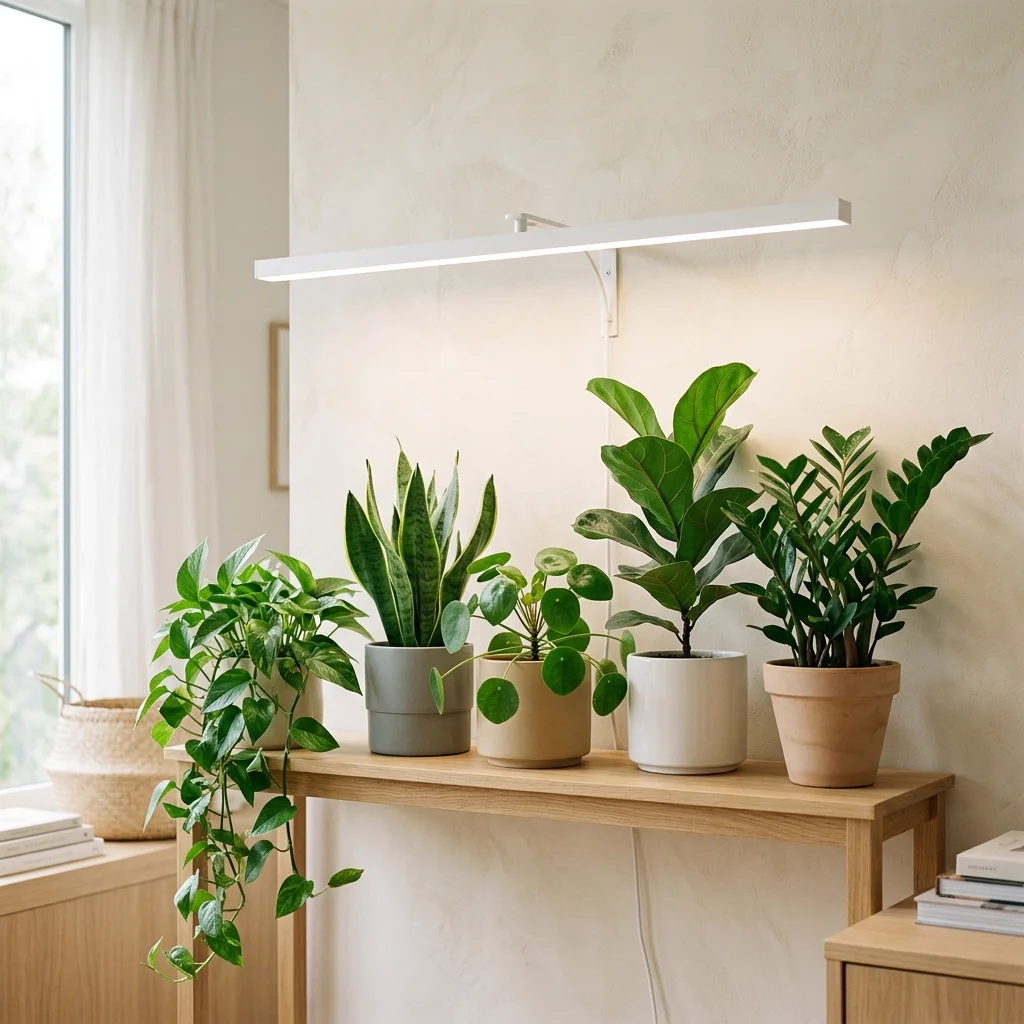
Grow-light distance and duration work together, but they are not interchangeable. Moving a fixture closer increases intensity and usually shrinks the evenly lit area. Running it longer increases the daily total, but it cannot repair severe edge falloff or turn a weak decorative lamp into a high-output panel.
Start with fixture-specific data. Then use Extension ranges as a reasonableness check and adjust from the newest growth.
Starting ranges, not universal prescriptions
University of Minnesota Extension provides these general starting points:
| Plant use | Starting distance | Total light duration |
|---|---|---|
| Foliage houseplants | 12 to 24 inches | 12 to 14 hours |
| Flowering houseplants | 6 to 12 inches | 14 to 16 hours |
| Seedlings | 4 to 6 inches | 16 to 18 hours |
| Hydroponic lettuce and herbs | 6 to 12 inches | 12 to 14 hours |
Those ranges describe broad plant uses, not every fixture. A 9-watt bulb, a linkable shelf bar, and a dimmable horticultural panel can deliver radically different light at 12 inches. Follow the maker’s map for the exact model when one exists.
For seedlings, Extension guidance also varies by fixture. Minnesota recommends keeping common seed-starting lights close and raising them as plants grow; Utah State notes that heat output must be considered. A powerful modern panel may require more distance or dimming than a traditional shop light.
The five measurements that matter
1. Canopy height
Measure from the emitting surface to the top leaves, not to the pot or shelf. If plants have different heights, use risers for short plants or split them into separate zones.
2. Canopy width and depth
A center reading does not describe a collection. Measure the actual rectangle occupied by leaves. The light must cover the corners as well as the center.
3. PPFD distribution
PPFD measures photosynthetic photons arriving at a square metre each second. Missouri Extension recommends using a manufacturer’s PPFD map at the intended height or measuring with a quantum sensor. Look at distribution, not only the highest number in the center.
4. Daily operating hours
Use a timer. Include meaningful window light in the total schedule rather than automatically adding 14 artificial hours after a full sunny day.
5. Leaf response
The next leaves are the final check. Old stretching or scorch will not reverse, so record the starting position and compare new growth after the plant has had time to respond.
A reliable setup sequence
- Group plants by need and height. Use the houseplant light chart to separate low-, medium-, and high-light plants.
- Mount securely. Keep cords, plugs, and fixtures away from watering paths.
- Begin at the maker’s stated distance. If no useful data exists, that is a mark against the product; use the Extension range only as a cautious starting point.
- Dim before moving a powerful light very high. Excess height can waste light outside the canopy.
- Measure center and corners. Raise, lower, dim, or add another bar to improve uniformity.
- Set a consistent timer. Give foliage plants a dark period and do not vary the schedule daily.
- Photograph and record. Note distance, timer hours, dimmer setting, and plant position.
- Adjust one variable. Changing height, duration, watering, and fertilizer together hides the cause.
How distance changes coverage
Moving a fixture closer usually raises center intensity but narrows the beam. That can work for one plant and fail across a shelf. Moving it higher spreads light across a larger area, but intensity falls and more light may miss the foliage.
Use bars for long shelves, a bulb or pendant for one compact canopy, and a panel for a dense rectangular area. The grow-light buying guide compares those formats.
Tall plants need special attention. A ceiling light can illuminate the top while lower leaves remain shaded. Side lighting or more than one fixture may provide better distribution than an increasingly powerful source above the crown.
Duration, PPFD, and DLI
Daily light integral combines PPFD and time:
DLI = PPFD x 3,600 x hours / 1,000,000
For example, the same measured PPFD run for twice as long supplies twice the photon total. But the equation is not permission to run lights continuously. Photoperiod affects flowering, plants require darkness, and low intensity may still produce weak form.
Use DLI only when the PPFD estimate is credible. Lux from a phone cannot be converted reliably to PPFD for every spectrum. A conversion calibrated for one white LED may be wrong for a red-and-blue fixture.
Signs to move the light closer or increase output
- new stems stretch toward the source;
- spaces between new leaves lengthen;
- new leaves become smaller or paler;
- compact succulents open or elongate;
- the center grows while edge plants stall;
- flowering plants remain mature and healthy but produce no buds.
Before moving closer, check whether the fixture simply has poor coverage. More center intensity can make the center too strong while corners remain weak.
Signs to raise, dim, or shorten exposure
- bleached areas face the fixture;
- tan dry patches appear soon after a setup change;
- top leaves feel distinctly warm;
- upper leaves cup, curl, or angle away;
- pale variegated tissue browns while green tissue remains less affected;
- edge plants look normal while the center shows stress.
Acclimate gradually. A plant moved from winter window light to a strong panel can be damaged even when the eventual setting is suitable.
Timer patterns for common situations
A window plus supplemental light
Run the fixture during the useful daytime window to fill weak hours. Reassess seasonally because summer and winter window light differ.
A windowless shelf
Use a stable timer based on the plant class and fixture output. Foliage plants commonly start within the Extension 12-to-14-hour range.
Flowering houseplants
Total light and flowering photoperiod are separate. Poinsettia, holiday cactus, and other photoperiod-sensitive plants may need controlled darkness. More hours can prevent the desired response.
Seedlings
Keep common seed-starting fixtures close enough to prevent stretching, raise them as seedlings grow, and preserve darkness. Use the fixture’s heat and output guidance rather than copying a height from a different lamp.
Bottom line
Use distance to set intensity and coverage; use duration to set the daily schedule. Begin with published fixture data, check Extension ranges, measure the whole canopy, preserve darkness, and judge new growth. There is no honest single distance for every grow light.
Next, use the window light guide to decide whether a fixture is needed at all, then match each plant with the 50+ houseplant light chart.