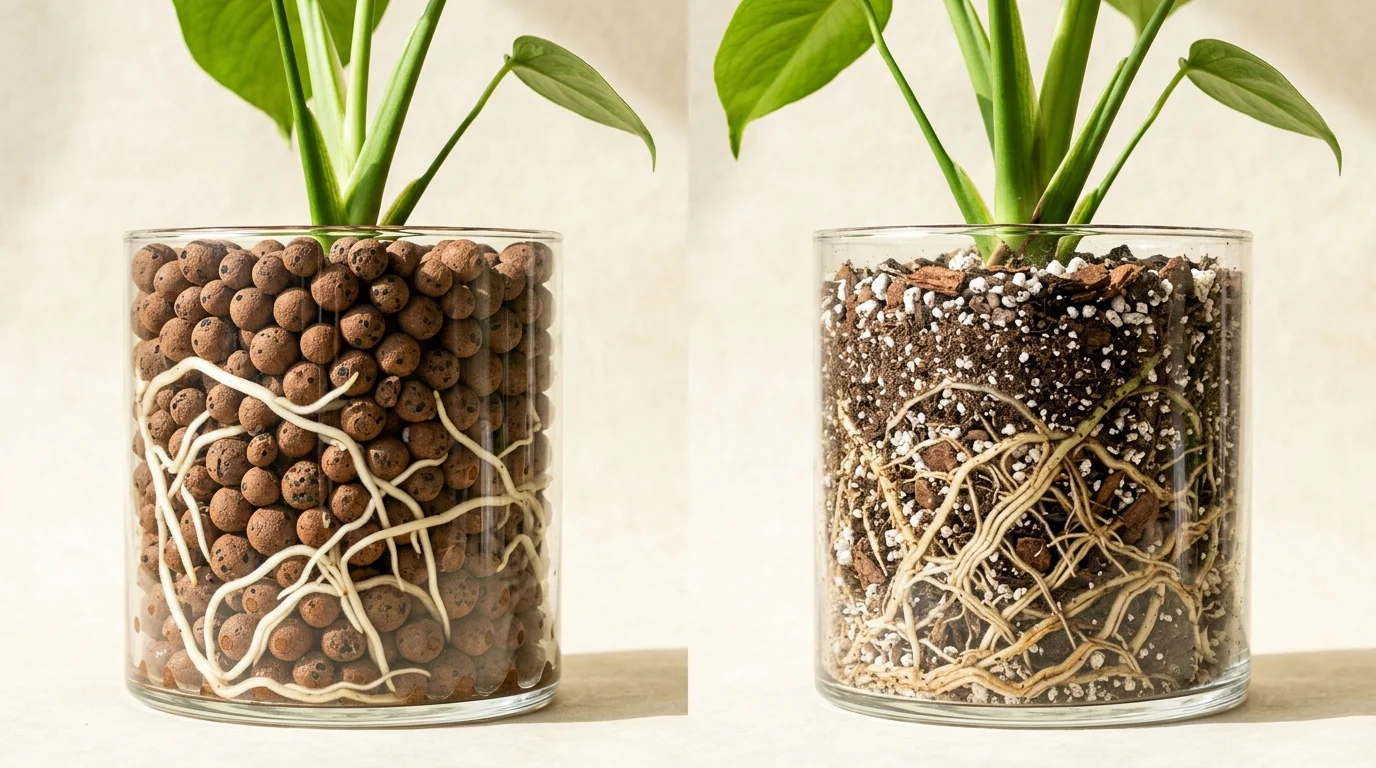
LECA stands for lightweight expanded clay aggregate. The University of Washington’s Miller Library describes it as clay balls made from clay, brick dust and waste from processing the mineral albite. Its main use is as a substrate in hydroponics. Houseplant growers use it for “semi-hydro”: a pot of clay balls standing in a shallow reservoir of water and fertilizer.
Switching from potting mix to LECA is not just a change of material. It changes how water, air and nutrients reach the roots. This guide compares the two systems.
A note on evidence. University sources on LECA for houseplants are thin. The best public sources cover hydroponic media in general (UF/IFAS, RHS) or answer a single question (UW Miller Library). We found no extension trial comparing houseplant growth or root health in LECA and potting mix. Treat any claim that LECA is “healthier for roots” with caution.
The two systems side by side
| Factor | Potting mix | LECA (semi-hydro) |
|---|---|---|
| What it is | Peat, bark, coir, perlite and similar (Virginia Tech) | Fired clay balls, 1–18 mm (UF/IFAS) |
| Water held by the medium | Fine peat or coir hold more; bark and perlite drain faster (Virginia Tech) | Very low water-holding capacity (UF/IFAS); limited (UW Miller Library) |
| Air around roots | Good after draining; lost when pores stay full of water (Virginia Tech) | Air spaces between balls (UW Miller Library, RHS) |
| Nutrients | Many mixes include slow-release fertilizer (Maryland) | None of its own; all from the nutrient solution (UF/IFAS) |
| pH | Set by the mix | Neutral clay (UF/IFAS); solution pH must be managed (RHS) |
| Salts | Build up from fertilizer; leach through the pot (NC State) | Solution concentrates as plants drink (RHS); clay can store salts (UF/IFAS) |
| Reuse | Usually replaced | Washed, sterilized and reused (UF/IFAS) |
| Disease | Overwatering and dirty pots favour root rot (Maryland) | Reused media can carry pathogens (UF/IFAS); stagnant water kills roots (RHS) |
| Cost | Low | Expensive (UF/IFAS) |
How each holds water and air
Potting mix. Virginia Cooperative Extension explains that the ingredients set the balance. Mixes of fine peat moss or coconut coir hold more water and less air. Mixes with coarse bark or perlite drain readily. Most commercial mixes are engineered to drain well and hold plenty of air after watering. Trouble starts when the mix stays wet: water fills the pore spaces, oxygen falls, and roots stop growing and die.
LECA. UF/IFAS describes expanded clay as having very low water-holding capacity and good aeration, so it may need more frequent watering cycles. The UW Miller Library says the spaces between the balls give more airflow and ease root development. It adds that absorption varies with the clay’s make-up.
That is why semi-hydro uses a reservoir. The RHS describes the simplest hydroponic setup as a pot of inert aggregate given water with liquid fertilizer often enough that it does not dry out. The spaces between the particles hold air, so roots do not suffocate. The RHS also warns that the roots of most plants die in stagnant water. Keep the reservoir shallow so most of the root system sits in moist air, not standing water.
Nutrients and pH
Potting mix. University of Maryland Extension notes that high-quality soilless mixes often contain slow-release fertilizer that lasts several months. After that, you feed as the plant grows.
LECA. UF/IFAS explains that in hydroponics the grower supplies the nutrients through fertilizer added to the water. The RHS says a nutrient solution needs the major nutrients and trace elements in balance. It also says pH is crucial and is usually aimed at 5.8–6.2. UF/IFAS says most plants need a pH of around 5.5–7 to take up nutrients.
UF/IFAS also lists expanded clay as having a high cation exchange capacity. That means the clay can hold some nutrients and salts. Many products are sold as “inert,” so expect some variation between brands.
What to do. Use a fertilizer made for hydroponics, at the label’s rate. Do not reuse a potting-mix dilution, which assumes the mix supplies part of the plant’s needs.
Salts
Both systems accumulate salts. They deal with them differently.
Potting mix. NC State’s container handbook says that if salt accumulation is seen, leach the mix by running water slowly through it for several minutes. It also warns that fertilizer flushed into the saucer becomes concentrated, and can be absorbed back and burn roots. Empty the saucer.
LECA. The RHS explains that a nutrient solution gets stronger as plants remove water, and can become salty enough to damage roots. It suggests checking it with a conductivity meter and adding water as needed. It also advises discarding the solution and making it up fresh every two weeks or so.
Root disease
Neither medium prevents root rot.
University of Maryland Extension names Pythium, Phytophthora and Rhizoctonia as common root rots of indoor plants. Its advice applies to both systems: avoid excess water, use clean or new pots and sterile media, separate infected plants, and inspect new plants.
For LECA, UF/IFAS adds that reusable media such as expanded clay can hold pathogens from a previous planting. It recommends starting each planting with a clean system. Clay can be steam-sterilized above 82 °C (180 °F), or treated chemically, though chemicals such as bleach are hazardous to handle.
If leaves wilt while the roots are wet, check for soft, brown roots. See our root rot guide and Monstera root oxygen guide.
Do not mix them
The UW Miller Library says not to mix clay balls into potting soil and not to put them in the bottom of a pot. A layer of a different material creates a perched water table, so water collects in the soil above it. NC State Extension gives the same warning about gravel. Use one system or the other, in a pot that drains.
Moving a plant from soil to LECA
Public sources on this step are thin. We found no extension guidance on transplant stress when moving a houseplant from soil to LECA, and no trial of how long plants take to adjust. These points follow from the sources above:
- Start healthy. Maryland Extension advises taking cuttings only from healthy tissue and discarding severely infected plants. A plant with root rot is a poor candidate for a new system.
- Clean the roots and the clay. Remove old mix and dead roots, and start with clean clay (UF/IFAS).
- Feed from the start. LECA supplies no nutrients (UF/IFAS).
If you want to try LECA with less risk, start with a cutting rather than an established plant. NC State notes that pothos vines root easily in water.
Which plants suit each
The RHS says any plant can be grown hydroponically, though commercial use is mainly greenhouse crops. That is not the same as saying every houseplant does well in a home semi-hydro pot.
- Potting mix suits most houseplants. The UW Miller Library says it is still best to grow indoor plants in a potting soil suited to them.
- Plants that need to dry out completely are a poor fit for a reservoir. NC State, for example, says to let aloe vera’s soil dry completely between waterings. A semi-hydro pot is designed never to dry out (RHS).
- Easy-rooting tropical vines are the lower-risk trial. Pothos is one example; NC State says its vines root easily in water.
Which should you choose?
- You want the simplest routine: potting mix, a pot with drainage, and water when the top of the mix is dry.
- You will test pH, mix nutrient solution and refresh the reservoir: LECA is an option.
- Your plant is already struggling: keep it in fresh potting mix; do not change systems now.
- Succulents and cacti: potting mix made for them.
For more on mixes and pots, see our potting mix guide, terracotta vs plastic pots and watering guide.
References
- UF/IFAS Extension, M. G. Pinkerton, B. Whitman, H. W. Eason and C. Gómez: Common Media Used in Hydroponics, ENH1359/EP623
- University of Washington Botanic Gardens, Elisabeth C. Miller Library, Plant Answer Line: LECA balls
- Royal Horticultural Society: Hydroponics
- Virginia Cooperative Extension, K. S. Criscione and A. Holliday-Goulart: Properly Watering Container Houseplants, SPES-804P
- NC State Extension Gardener Handbook: 18. Plants Grown in Containers
- University of Maryland Extension: Root Rots of Indoor Plants
- University of Maryland Extension: Potting and Repotting Indoor Plants