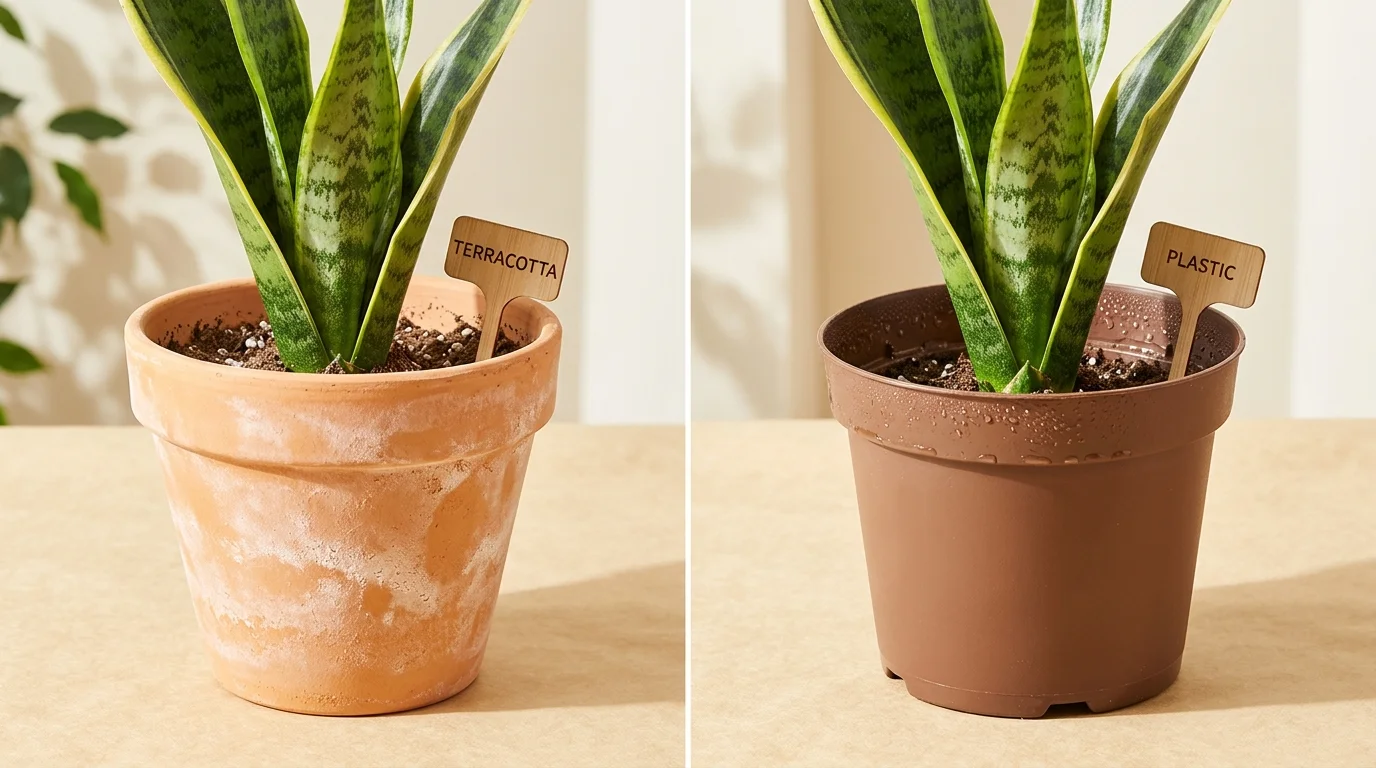
Terracotta or plastic? The material changes how fast the potting mix dries, how heavy the pot is, where salts end up and how warm the roots get. None of these makes one material better for every plant. The right choice depends on the plant, the room and how you water.
This guide compares unglazed terracotta (porous clay) with plastic. Glazed ceramic behaves like plastic for drying, as covered below.
The differences at a glance
| Factor | Unglazed terracotta | Plastic |
|---|---|---|
| Moisture loss | Through the wall, surface and drainage holes (Virginia Tech) | Only through the surface and drainage holes (Virginia Tech) |
| How fast the mix dries | Faster; needs watering more often (Illinois, Clemson) | Slower; holds moisture longer (Nebraska, NC State) |
| Air to roots | Porous wall lets air reach the root ball edge (Nebraska, Clemson) | Less air movement through the wall (Colorado State) |
| Weight | Heavier; less likely to tip (Nebraska, Penn State) | Lightweight and easy to move (Penn State, Maryland) |
| Salts | White crust forms on the outside of the pot (Nebraska) | Less salt crust on the pot (Maryland) |
| Root temperature | Thick wall buffers rapid temperature changes (Nebraska) | Thin wall gives little insulation; black plastic can overheat in sun (Nebraska) |
| Durability | Breaks easily (Nebraska, Penn State); cracks if wet clay freezes outdoors (NC State) | Durable; may fade and turn brittle in strong sun (Nebraska) |
| Best for | Cacti, succulents, orchids, bromeliads (Colorado State) | Moisture-loving plants such as Boston fern (Colorado State) |
1. Drying speed
This is the difference you will notice first. Virginia Cooperative Extension explains that terracotta is fired at low heat and left unglazed, so moisture evaporates through the pot walls. Regardless of the potting mix used, terracotta tends to dry out the root zone more quickly. Plastic is nonporous, so it loses water only from the drainage holes and the surface of the mix.
Clemson and Illinois Extension both say plants in porous clay need watering more often than plants in plastic or glazed pots. Glazed clay is fired at higher temperatures and coated, so Virginia Tech classes it as nonporous: its mix holds water longer, like plastic.
What this means for you. If you switch a plant from plastic to terracotta, your old watering interval no longer applies. Check the mix with a finger 5 cm (2 in) down before each watering, as Illinois Extension recommends.
2. Pot size and shape matter as much as material
Material is only one factor in how fast a pot dries. Virginia Tech lists several others:
- Volume. Small containers dry faster than large ones, because they store less water.
- Height. Taller containers drain more after watering, and their top few inches dry faster. Shorter pots hold more water and less air. Width has no influence on drainage.
- Oversizing. Moving a plant into a container that is too large leaves roots in a root zone that is too wet.
Clemson adds that a large plant in a small pot needs water more often than a small plant in a large pot. Heavy, peaty mixes also hold more water than loose mixes of bark and perlite. A terracotta pot two sizes too big can stay wetter than a snug plastic one. For sizing rules, see our repotting guide.
3. Weight and stability
Nebraska Extension notes that clay pots have a fair amount of weight and do not blow over as easily as some plastic pots. Penn State says terracotta is heavier than plastic but lighter than stone. Stone and concrete are the least likely to tip when a plant becomes top-heavy and the mix dries out.
That cuts both ways. NC State’s handbook says to weigh up pot weight for top-heavy plants and for plants you move often. Colorado State suggests lightweight plastic for large plants. A tall, top-heavy plant may need a heavy pot; a large floor plant you move with the seasons may be easier in plastic.
4. Salts and white crust
Water and fertilizer leave dissolved salts in potting mix. Nebraska Extension explains what happens in clay. The salts are wicked from the mix into and through the pot wall, forming a white crust on the outside. Penn State notes that clay’s pull on water and salts reduces waterlogging and salt build-up in the mix. Maryland Extension says plastic pots accumulate fewer soluble salts.
Salt can still build up in the mix in either pot. Clemson says a white film on the soil surface, or crust on the rim or drainage hole, may mean over-fertilizing. Salt damage shows as reduced growth, brown leaf tips, dropping lower leaves and wilting. The fix is the same for both materials. Water thoroughly so excess drains out, empty the tray, and feed less. NC State’s handbook suggests scrubbing salt from clay pots with water and a wire brush before reuse.
5. Root temperature
Nebraska Extension says thick clay walls protect roots from rapid temperature changes. Plastic pots have thinner walls with little insulation. Black plastic can act as a solar collector, heating the mix to damaging levels. NC State’s handbook adds that dark containers absorb more heat and dry faster, so avoid dark pots in full sun.
Indoors, away from a hot window, this matters less. It matters most for pots on a sunny sill, balcony or patio. If a plant in a dark plastic pot wilts quickly in sun, Nebraska suggests checking it is watered, then moving it to shade.
6. Durability and outdoor use
Clay breaks easily (Nebraska). Penn State’s snake plant guide warns that a root-bound plant can break a clay pot. Outdoors, NC State says unglazed pots should not stay out over winter, because absorbed water freezes and cracks them. Plastic is durable but can fade and turn brittle in sunlight; Nebraska notes many outdoor pots include UV inhibitors.
7. Which plants suit which pot
| Plant or habit | Better pot | Why |
|---|---|---|
| Cacti, succulents, snake plant, jade | Terracotta | Fast drying suits arid plants (Virginia Tech, Colorado State) |
| Orchids, bromeliads | Terracotta or orchid pots | Colorado State lists them for clay; Virginia Tech notes slotted orchid pots dry evenly and fast |
| Boston fern and other moisture-loving plants | Plastic or glazed | Clay dries too fast for moisture-loving plants (Nebraska, Colorado State) |
| You tend to overwater | Terracotta | NC State, Nebraska |
| You water infrequently | Plastic | NC State, Nebraska |
| Large plant you move often | Plastic | Lightweight (Colorado State, Penn State) |
| Tall, top-heavy plant | Terracotta, stone or a heavy outer pot | Stability (Penn State, NC State) |
Choosing a pot for a snake plant
Snake plant is the textbook case for a drying pot, but size and drainage matter more than material.
- Material. Unglazed terracotta suits it: fast drying favours arid plants (Virginia Tech, Colorado State), and Penn State Extension says root rot from overwatering is a common affliction of snake plants. Plastic works too if you water sparingly.
- Drainage. Penn State says to choose only containers with drainage holes. The RHS asks for plenty of them, and says to tip away water that collects in the saucer or outer pot.
- Size. The RHS says sansevierias prefer a cosy-fitting pot. Repot only once roots and leaves fill the container, into one only slightly larger. Penn State says the plant does not mind being snug and needs repotting only every 5 years or so.
- Weight. Penn State suggests a heavy pot for tall varieties, which can topple when the mix is dry. It also warns that a badly rootbound plant can break a clay pot, so do not leave it in clay until it cracks.
- Mix. Penn State suggests a cactus mix or one with perlite. The RHS recommends a free-draining, peat-free cactus compost, or two parts loam-based compost to one part grit.
Step-by-step repotting is in our snake plant repotting guide; the snake plant hub lists the rest.
What matters more than material
- Drainage holes. Nebraska says any pot, clay or plastic, needs drainage holes to prevent over-watering. NC State and Penn State suggest drilling a hole, or using the decorative pot as a cachepot around a pot that drains.
- No gravel layer. NC State explains that gravel in the base makes water collect in the mix above it, so it does not prevent saturation. Clemson and Maryland Extension give the same advice.
- Empty the saucer. Illinois says do not let a pot sit in drained water. Virginia Tech says no more than 60 minutes.
- Soak new terracotta. Penn State suggests soaking a new clay pot overnight before potting, so it does not pull water from fresh mix.
Neither material prevents root rot by itself. If a plant wilts in wet mix, check the roots with our root rot guide. For watering technique in any pot, see the watering guide.
References
- Virginia Cooperative Extension, K. S. Criscione and A. Holliday-Goulart: Properly Watering Container Houseplants, SPES-804P
- NC State Extension Gardener Handbook: 18. Plants Grown in Containers
- Nebraska Extension in Lancaster County, S. Browning: Choosing Clay or Plastic Pots for Plants
- Colorado State University Extension, PlantTalk Colorado: 1315 – Houseplants: Containers
- Penn State Extension: Repotting Houseplants
- Penn State Extension: Snake Plant: A Forgiving, Low-maintenance Houseplant
- Clemson Cooperative Extension HGIC 1450: Indoor Plants – Cleaning, Fertilizing, Containers & Light Requirements
- Clemson Cooperative Extension HGIC 1459: Indoor Plants – Watering
- Clemson Cooperative Extension HGIC 1458: Indoor Plants – Transplanting & Repotting
- University of Illinois Extension: Houseplants: Watering
- University of Maryland Extension: Potting and Repotting Indoor Plants
- Royal Horticultural Society: How to grow sansevierias