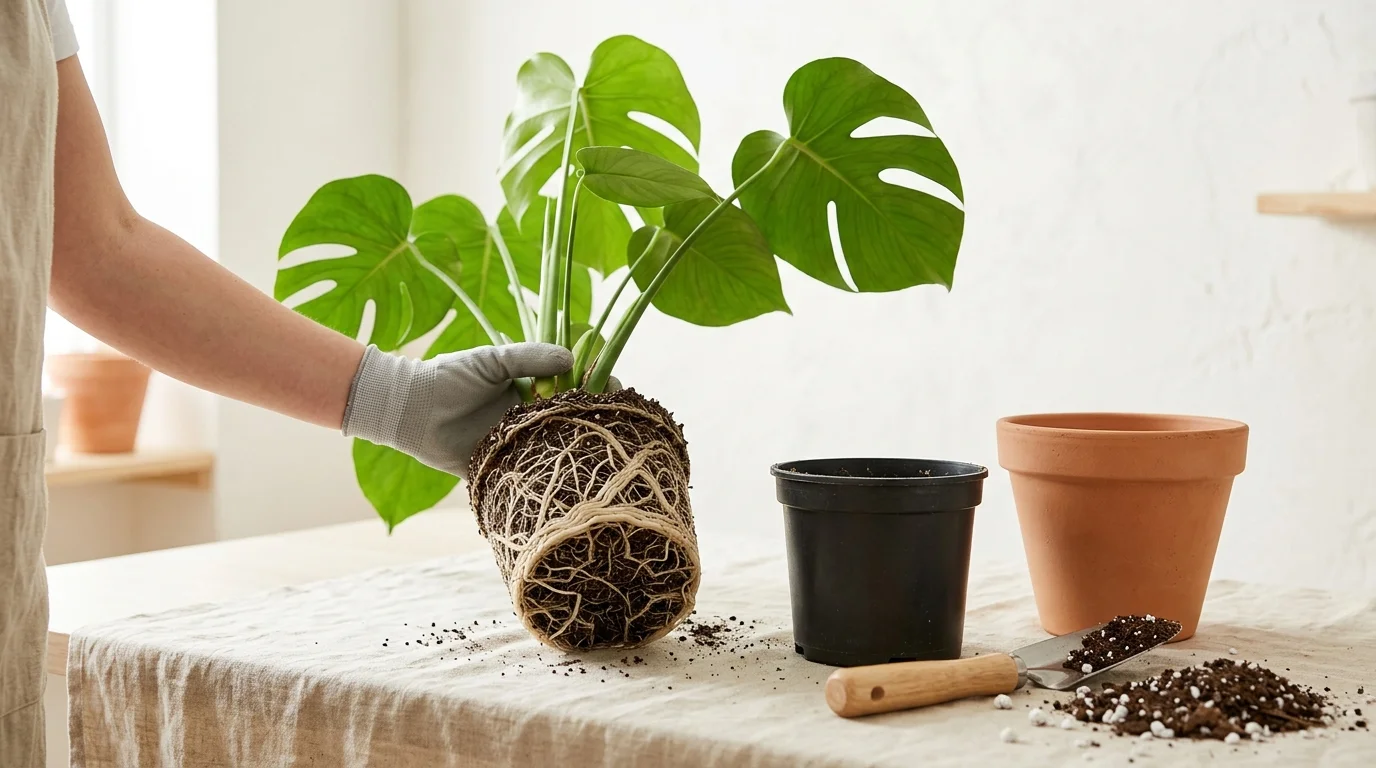
Repotting at the right moment gives roots room and fresh mix. Repotting at the wrong moment, or into a pot that is far too big, can leave a plant sitting in wet mix it cannot use. The way to decide is to look at the roots, not the calendar.
Illinois Extension notes that some plants need repotting every year, others not for many years, and some do well pot-bound. Clemson Extension says fast growers may need a new pot each year, while slow growers may go two or three years. The signs below tell you which group your plant is in right now.
8 signs a houseplant needs repotting
| Sign | What it suggests | Source |
|---|---|---|
| 1. Roots growing out of the drainage holes | Roots have filled the pot | Illinois, Clemson, NC State, Penn State |
| 2. Wilting between normal waterings, then recovering after water | Too little mix for the root mass to hold enough water | Illinois, NC State |
| 3. Mix dries out very quickly, even in cool weather | Roots have displaced the mix | Penn State, Clemson |
| 4. Growth stalls in spring and summer despite feeding | Roots have no room to expand | Penn State, NC State |
| 5. Roots circle the root ball or form a solid mass | The plant is pot-bound | Clemson, Penn State, NC State |
| 6. White crust on the mix surface or pot rim | Salt build-up; fresh mix needed | Illinois, Clemson HGIC 1450 |
| 7. Crown or roots exposed on the surface | Mix has settled or washed aside; top-dressing may be enough | NC State |
| 8. Plant tips over when the mix is dry | Top-heavy for its container | Penn State |
Confirm before you act. Signs 1 to 4 have other possible causes. A single root at a drainage hole does not mean the whole pot is full. Penn State’s advice is to remove the plant and examine the roots. If roots circle the root ball, or are so dense you can barely see mix in the bottom third, it is time to repot.
When not to repot
- The plant wilts and stays wilted after watering. NC State says continuous wilting most likely means rotted roots that cannot absorb water. A bigger pot makes this worse. Reduce watering, or “down-pot” into a smaller container that fits the remaining roots. See our root rot guide.
- The plant is ailing, dormant or starting to flower. Clemson advises against repotting at those times.
- The plant thrives when pot-bound. Clemson names amaryllis; Illinois notes some plants do well pot-bound.
- The plant is already as large as you want it. Penn State suggests trimming away the outer roots and returning it to the same pot with some fresh mix. Cut back some top growth to match.
- The pot is too big to lift. Clemson suggests top-dressing instead: replace the top 5–7.5 cm (2–3 in) of mix every other year or so.
When to repot
Repot while the plant is actively growing, typically spring or early summer (Illinois). Penn State says spring is best because roots grow quickly into new mix as seasonal growth begins. NC State notes that some signs, such as roots escaping the pot, can justify repotting at other times.
Choosing the new pot
Size. Go up only slightly.
- Clemson: 2.5–5 cm (1–2 in) larger in diameter than the current pot.
- Arkansas Extension: no more than 5 cm (2 in) larger.
- NC State: for pots up to 20 cm (8 in), 2.5–5 cm (1–2 in) wider than the root ball. For pots 25 cm (10 in) and wider, 5–7.5 cm (2–3 in) wider. Vigorous species may need two sizes up.
Virginia Cooperative Extension explains why oversizing backfires. Extra mix holds extra water, and the roots end up in a root zone that is too wet.
Drainage. Penn State says a drainage hole is necessary to stop the mix waterlogging. Drill one if needed, or use a decorative pot as an outer cachepot. Do not add gravel at the bottom: NC State, Clemson and Maryland all say it does not improve drainage.
Material. Clay dries faster than plastic. See terracotta vs plastic pots to choose.
Mix. Use a soilless potting mix made for containers, not garden soil, which Penn State says can bring disease and pest problems. Specialty mixes suit orchids, cacti and African violets. Our potting mix guide explains the ingredients.
Match the fresh mix to the plant: a chunky mix for aroids, a gritty one for cacti and succulents, bark for most orchids. Our potting mix guide covers each group.
How to repot, step by step
- Prepare. Water the plant in its old pot and leave it an hour (Penn State). Moisten the new mix so it absorbs water evenly. Soak a new clay pot overnight, so it does not pull water from the fresh mix.
- Clean a reused pot. Wash and disinfect it. NC State suggests scrubbing salt crust off clay pots with water and a wire brush.
- Cover the drainage hole. Penn State uses a square of screen; Clemson and Maryland use a pot shard. This keeps mix in while water drains.
- Remove the plant. Turn the pot upside down with your hand over the soil and knock the rim against a solid edge (Clemson). If roots cling to the sides, run a knife around the inside (NC State).
- Check and loosen the roots. Cut away dead, brown roots (Maryland). Unwind or tease apart circling roots (Illinois, Penn State). If they are too tight to loosen, score the root ball with a knife (Clemson).
- Set the height. Add mix to the base so the top of the root ball sits about 2.5 cm (1 in) below the rim (Penn State, Clemson). Replant at the same depth as before; do not bury the stem (Illinois, Arkansas).
- Fill and firm gently. Fill around the root ball and press with your fingers. Do not pack the mix (Clemson).
- Water thoroughly. Water until it drains. Clemson suggests repeating several times, especially with peat mixes. Then hold off until the top of the mix dries (Maryland).
Aftercare
The new pot will dry at a different rate from the old one, so check the mix before each watering instead of keeping the old schedule. If you down-potted a plant after root loss, NC State stresses not to overwater, nor to let the few remaining roots dry out.
A leaf or two may yellow as the plant settles. NC State notes that plants tend to drop a few leaves when moved to a new environment; check light and watering before blaming the pot. For plant-specific aftercare, see peace lily transplant shock and monstera transplant shock.
References
- University of Illinois Extension: Houseplants: Repotting
- Clemson Cooperative Extension HGIC 1458: Indoor Plants – Transplanting & Repotting
- NC State Extension Gardener Handbook: 18. Plants Grown in Containers
- Penn State Extension: Repotting Houseplants
- University of Maryland Extension: Potting and Repotting Indoor Plants
- University of Arkansas Cooperative Extension: How To: Repotting Your Houseplant
- Virginia Cooperative Extension, K. S. Criscione and A. Holliday-Goulart: Properly Watering Container Houseplants, SPES-804P
- Clemson Cooperative Extension HGIC 1450: Indoor Plants – Cleaning, Fertilizing, Containers & Light Requirements