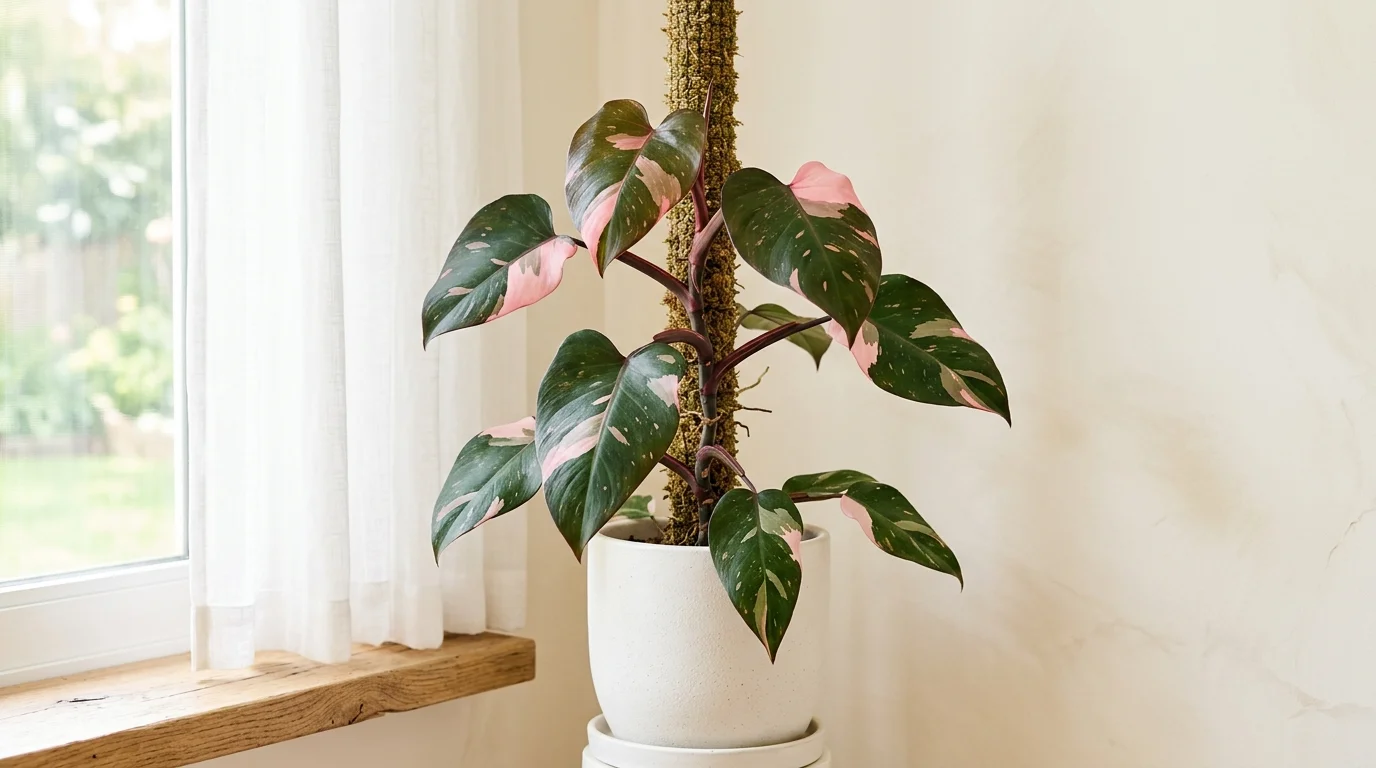
Philodendrons are among the easiest houseplants to keep. Clemson Extension says many tolerate low light and neglect, and Illinois Extension says they grow better than most houseplants under the adverse conditions of most homes. When a philodendron struggles, the usual causes are a wet pot, too little light, or cold.
Philodendron is a large genus in the arum family (Araceae), native to tropical Central and South America (RHS, UConn). This guide covers the two growth habits you will meet as houseplants. For named species and cultivars, see our philodendron varieties guide.
Climbing or self-heading: which do you have?
Clemson Extension divides philodendrons into two groups:
- Vining (climbing) types, such as heartleaf philodendron, Philodendron hederaceum. Their height is limited by their support and by pruning. NC State lists it under several older names, including P. scandens and P. oxycardium.
- Self-heading types, which send out leaves from a heavy clump at the base. Tree philodendron, P. bipinnatifidum (also listed as Thaumatophyllum bipinnatifidum), and ‘Xanadu’ are examples. Clemson says these can become very large and need ample space.
The care basics are shared. The differences are in light, space and support.
Philodendron care at a glance
| Factor | What the sources say |
|---|---|
| Light | Indirect or curtain-filtered light; heartleaf tolerates very low light (Clemson). Most prefer medium light (Missouri). No direct summer sun (RHS) |
| Water | Let the top of the mix dry, then water; never leave standing in water (RHS). Evenly moist, not soggy (Clemson, UConn) |
| Temperature | Keep above 15 °C (59 °F) (RHS). Clemson gives 24–29 °C (75–85 °F) by day and 18–21 °C (65–70 °F) at night as ideal |
| Humidity | Prefers moderate to high humidity; tolerates average homes (RHS, Clemson) |
| Mix and pot | Loose, free-draining mix, pot only a few centimetres larger than the roots (RHS) |
| Feeding | April to September (RHS); dilute and regular (Clemson, UConn) |
| Propagation | Stem cuttings or air layering; some produce offsets (Clemson) |
| Pets | Toxic to dogs, cats and horses (ASPCA) |
Light
Clemson Extension says most philodendrons prefer indirect or curtain-filtered sunlight but will tolerate low light. Heartleaf philodendron tolerates very low light and grows well near a north, east or west window or under room lighting. NC State notes it can survive long periods in extremely low light, though it prefers medium light. University of Missouri Extension says most philodendrons prefer a medium light range for best growth.
Self-heading types want more. Clemson says tree philodendron grows best in medium to bright light near an east, west or south window. NC State notes that low light and overwatering make its leaves smaller, with fewer or no lobes.
Direct sun is the other limit. The RHS warns that direct summer sun can scorch the leaves. UConn says full sun can yellow the leaves or cause a sunburn spot. The RHS also lists the signs of too little light: leggy stems and fewer, smaller leaves. Our philodendron light guide covers light levels in more detail.
Watering
The RHS advises waiting until the top of the compost dries before watering, and taking care not to overwater. Never leave the plant standing in water, as saturated compost can cause root rot. Clemson and UConn both describe the target as evenly moist but not soggy. NC State suggests slowing down on watering in winter.
The RHS suggests rainwater or filtered water at room temperature, especially in hard-water areas. NC State notes that tree philodendron does not tolerate salt build-up and advises flushing the soil regularly.
Humidity and temperature
The RHS says philodendrons prefer moderately humid air but are happy in the lower humidity of most homes. Clemson agrees: high humidity is ideal, but philodendrons tolerate typical indoor air. UConn notes that a pebble tray or grouping plants encourages larger leaves.
Keep them warm. The RHS sets a minimum of 15 °C (59 °F) and advises keeping plants away from hot radiators and cold drafts. UConn gives 18 °C (65 °F) as the minimum. NC State says blushing philodendron, P. erubescens, prefers 18–29 °C (65–85 °F) and protection from cold drafts.
Mix, pots and repotting
The RHS says philodendrons can usually stay in their original pot for at least a couple of years, until the roots are densely packed. Spring is the best time to repot. It recommends a loose, free-draining, slightly acidic mix, such as two parts orchid compost to one part peat-free ericaceous compost. UConn adds that soilless peat-perlite or peat-vermiculite mixes also work.
Choose a pot only a few centimetres larger than the root ball. The RHS explains that a much larger pot stays wet longer and can cause root rot. For more on mix components, see our potting mix guide.
Feeding
UConn calls philodendrons heavy feeders. It says regular feeding with a nitrogen fertilizer increases leaf size, and that frequent half-strength feeding works better than one strong dose. Apply fertilizer to mix that is already moist, to avoid root injury. Plants in low light need less.
The RHS recommends feeding from April to September with a general houseplant fertilizer. Clemson warns that too much fertilizer can make leaf tips curl and brown. If leaves are pale or patterned yellow, our nutrient deficiency guide helps you read the pattern.
Support, pruning and propagation
Climbing philodendrons grow best with support. The RHS suggests a moss pole, which the plant will root into if kept moist. Clemson notes that velour philodendron leaves will not reach full size unless the plant is trained vertically for several years. Bushy, self-heading species need no support or pruning (RHS).
To control a trailing plant, prune in spring just after a leaf node (RHS). Wear gloves, because the sap irritates skin.
Clemson says philodendrons can be propagated at any season from stem cuttings or by air layering, and some produce offsets. The RHS method for climbing and trailing types:
- In spring to late summer, cut a 10 cm (4 in) piece of stem just below a leaf joint.
- Strip the lower leaves and stand the cutting in water. The RHS says roots form in a couple of weeks.
- Once well rooted, pot it into a free-draining mix.
UConn suggests air layering to shorten leggy plants that have dropped their lower leaves.
Problems and what to check
| What you see | Likely cause | What to check or do |
|---|---|---|
| Lower leaves yellow, growing tips die | Too little light or overwatering (Clemson) | Check the mix and move closer to a window. See philodendron yellow leaves |
| Leaves yellow, plant collapses, mix wet | Root rot from overwatering or poor drainage (RHS) | Check roots; let the surface dry between waterings |
| Brown, curled leaf tips | Too much fertilizer (Clemson); salts or dry mix | See philodendron brown leaf tips |
| Leggy stems, small leaves | Too little light (RHS) | Move to brighter indirect light |
| New leaf stuck in its sheath | Dry air or dry root zone | See philodendron stuck leaf |
| Tan, brown or black leaf spots | Fungal or bacterial leaf spot | See philodendron leaf spot |
| Webbing, cottony clusters or bumps | Spider mites, mealybugs, scale, aphids (Clemson, RHS) | Inspect leaf undersides; see our pest guide |
Clemson notes that the long leaf stalks of self-heading types are brittle, so keep these plants out of busy walkways.
Philodendron and pothos are often confused. Clemson says pothos leaf stalks are grooved and philodendron stalks are not, and that new philodendron leaves emerge from a protective sheath. See pothos vs philodendron for more.
Are philodendrons safe for pets?
No. The ASPCA lists heartleaf philodendron and other Philodendron species as toxic to dogs, cats and horses. The toxic principle is insoluble calcium oxalates. Signs include oral irritation, pain and swelling of the mouth, tongue and lips, excessive drooling, vomiting and difficulty swallowing. Clemson says all parts are toxic if eaten. NC State also lists contact dermatitis from the sap. See our philodendron toxicity guide for what to do if a pet chews one.
References
- NC State Extension Gardener Plant Toolbox: Philodendron hederaceum
- NC State Extension Gardener Plant Toolbox: Philodendron bipinnatifidum
- NC State Extension Gardener Plant Toolbox: Philodendron erubescens
- Clemson Cooperative Extension HGIC 1509: Philodendron
- Royal Horticultural Society: Philodendron growing guide
- UConn Home & Garden Education Center: Philodendron
- University of Missouri Extension, D. H. Trinklein: Lighting Indoor Houseplants, G6515
- University of Illinois Extension: Houseplants: Philodendron
- ASPCA Animal Poison Control Center: Heartleaf Philodendron
- ASPCA Animal Poison Control Center: Philodendron Pertusum (Philodendron spp.)