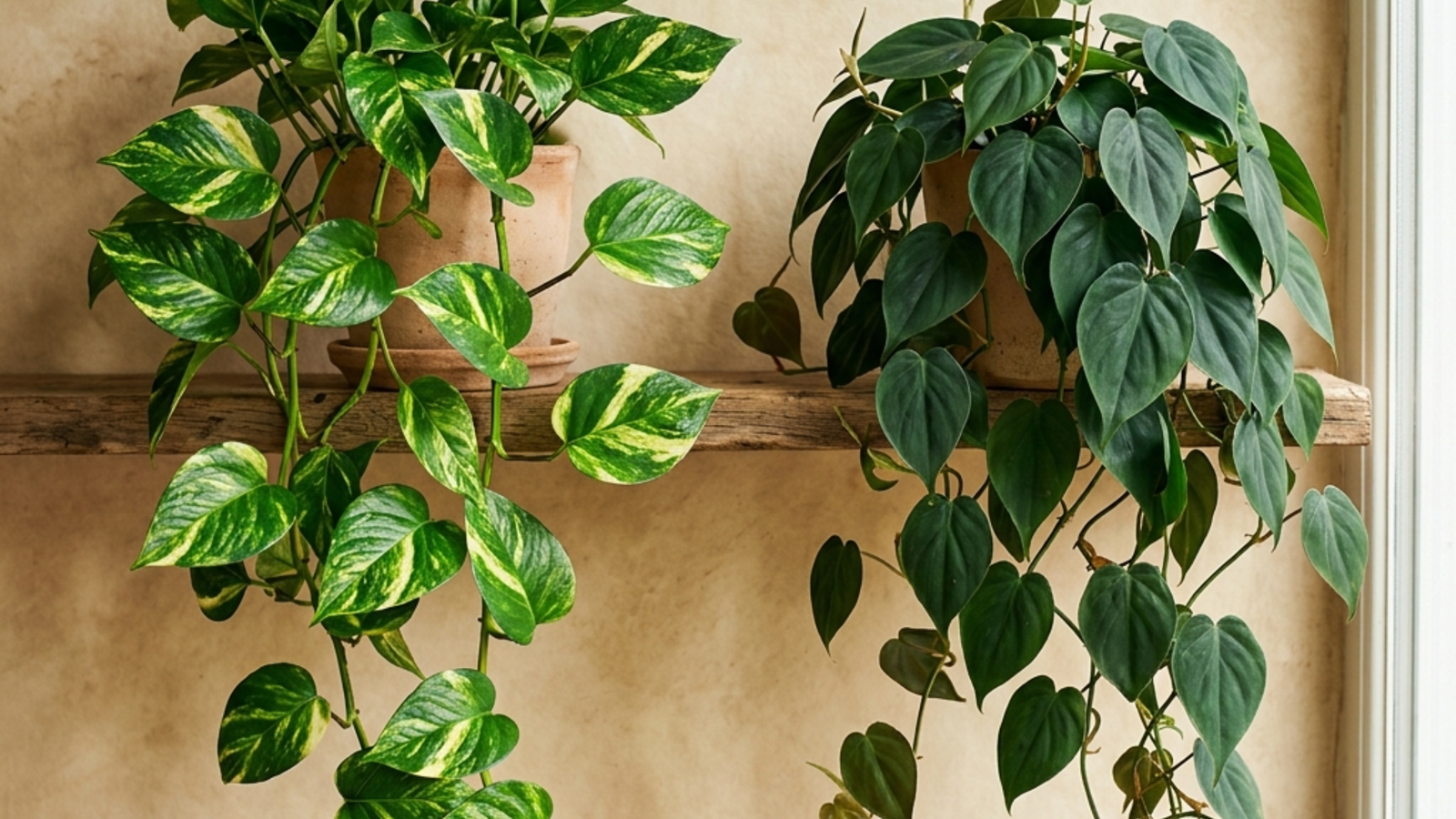
Pothos and heartleaf philodendron are both trailing aroids with heart-shaped leaves, and garden centres often mislabel them. They are different genera, though. Pothos is Epipremnum aureum, native to the Society Islands. Heartleaf philodendron is Philodendron hederaceum, native from Mexico to tropical America (NC State Extension).
The good news: their care is close enough that a mix-up rarely kills either plant. The differences are in light, watering rhythm and growth speed, and they matter more once you know which plant you have.
Why the labels get mixed up
Old names add to the confusion. NC State lists Scindapsus aureus as a former name for pothos, and notes it was once treated as a cultivar of Epipremnum pinnatum. Heartleaf philodendron has been sold as P. scandens, P. oxycardium and P. micans, all now placed under P. hederaceum. University of Illinois Extension still uses some of these older names in its light tables.
Common names overlap as well. Pothos is also called devil’s ivy or golden pothos. Heartleaf philodendron is sold as sweetheart plant or parlor ivy. A plant tag reading “philodendron pothos” tells you nothing, so check the stems.
How to tell them apart
NC State Extension gives two reliable checks, both on the stems rather than the leaves.
1. The leaf stalk (petiole). On pothos, the leaf stalk is grooved where it clasps the stem. On heartleaf philodendron, the stalk is not grooved. Roll a stalk between your fingers, or look at it side-on.
2. The stipules on new growth. Heartleaf philodendron has large, free, lance-shaped stipules that sheath each new leaf. NC State describes them as conspicuous on new growth and “messy, falling” on older growth, leaving dry brown scraps along the stem. Pothos has no conspicuous free stipule. Its stipule is fused to the leaf stalk, with whitish edges that turn brown and drop.
Other clues that support the stem checks:
- Leaf undersides. NC State describes both as leathery and glossy. Pothos undersides are paler green; heartleaf undersides may be green or red-purple.
- New leaves. NC State says heartleaf leaves emerge bronze and quickly turn green.
- Stems. Iowa State Extension notes that pothos has smooth-textured, ridged stems.
- Leaf size. Iowa State gives pothos leaves 5–15 cm (2–6 in) long, and heartleaf leaves 7.5–13 cm (3–5 in).
Variegation is the least reliable guide. ‘Neon’ pothos (yellow leaves) and ‘Lemon Lime’ heartleaf (yellow to chartreuse) look similar, and ‘Brasil’ philodendron is easily confused with variegated pothos. Use the petiole and stipule checks for these.
Comparison table
| Feature | Pothos (Epipremnum aureum) | Heartleaf philodendron (P. hederaceum) |
|---|---|---|
| Leaf stalk | Grooved, clasping the stem | Not grooved |
| Stipules on new growth | Not conspicuous; fused to stalk | Conspicuous, falling messily as stems age |
| Leaf underside (NC State) | Paler green | Green or red-purple |
| Growth rate (NC State) | Medium | Rapid |
| Vine length (NC State) | Can reach 12 m (40 ft) | Up to 4 m (13 ft) |
| Minimum light (Illinois) | Medium | Low |
| Preferred light (NC State) | Bright, indirect | Medium; tolerates low |
| Watering (NC State) | Let the mix dry between waterings | Keep slightly moist; water less in winter |
| Humidity (NC State) | Benefits from a humidifier or pebble tray | Tolerates dry air; prefers medium humidity |
| Common cultivars (NC State) | ‘Golden’, ‘Marble Queen’, ‘Jade’, ‘Neon’, ‘Snow Queen' | 'Brasil’, ‘Lemon Lime’, ‘Rio’, ‘Cream Splash’ |
| Pets (ASPCA) | Toxic: insoluble calcium oxalates | Toxic: insoluble calcium oxalates |
Care differences that matter
Light
Both tolerate dim rooms, but heartleaf philodendron tolerates less light. University of Illinois Extension lists heartleaf philodendron among plants for low light and pothos among plants needing medium light. NC State says heartleaf “can survive for long periods in extremely low light”, though it prefers medium light.
NC State says pothos prefers bright, indirect light and survives for long periods in low light. Among pothos cultivars, NC State notes the solid green ‘Jade’ is “great in low light”. Heavily white cultivars such as ‘Snow Queen’ have less green leaf area, so give them a brighter spot. Our pothos varieties guide compares the cultivars.
Watering
This is the main care difference. NC State’s pothos guidance is to let the well-drained medium dry out between waterings. Its heartleaf guidance is to keep the soil slightly moist and slow down in winter. University of Missouri Extension puts it simply: pothos requires less uniform moisture than philodendron.
In practice, check both pots with a finger before watering. Water pothos when the top of the mix is dry. Water heartleaf philodendron a little sooner, before it dries right through. Both need pots with drainage holes and an empty saucer.
Growth and pruning
Heartleaf philodendron grows rapidly; NC State rates pothos as medium. NC State notes that pothos keeps its juvenile leaf shape in a container. Given a support to climb and enough light, it starts producing larger, mature leaves. Older pothos stems lose leaves near the base, so NC State recommends pruning stems back to keep the plant bushy.
Iowa State suggests cutting back heartleaf philodendron when stems grow too long, which encourages new branches.
Feeding and cleaning
NC State suggests feeding pothos every other month except in winter, when it is dormant. Wipe pothos leaves occasionally to remove dust (NC State); Iowa State gives the same advice for heartleaf philodendron.
Propagation
Both root easily from stem cuttings with a node (NC State). NC State notes pothos vines root readily in water. See our pothos propagation guide.
Pet safety
Neither plant is safe to chew. The ASPCA lists golden pothos and heartleaf philodendron as toxic to dogs and cats. Both contain insoluble calcium oxalates. The ASPCA’s listed signs include oral irritation, intense burning of the mouth, tongue and lips, excessive drooling, vomiting and difficulty swallowing. See is pothos toxic to pets for what to do if a pet chews one.
Which should you choose?
- Very dim room, north window or office: heartleaf philodendron, or ‘Jade’ pothos.
- You tend to forget watering: pothos, which NC State says to let dry out between waterings.
- You want a large climbing plant with bigger leaves: pothos on a moss pole in good light.
- You want fast fill on a shelf: heartleaf philodendron, the faster grower.
For more philodendron types beyond heartleaf, see our philodendron varieties guide.
References
- NC State Extension Gardener Plant Toolbox: Epipremnum aureum
- NC State Extension Gardener Plant Toolbox: Philodendron hederaceum
- Iowa State University Extension and Outreach, A. Steil: Easy low-maintenance houseplants
- University of Missouri Extension, D. H. Trinklein: Lighting Indoor Houseplants, G6515
- University of Illinois Extension: Houseplants: Lighting
- ASPCA Animal Poison Control Center: Golden Pothos
- ASPCA Animal Poison Control Center: Heartleaf Philodendron