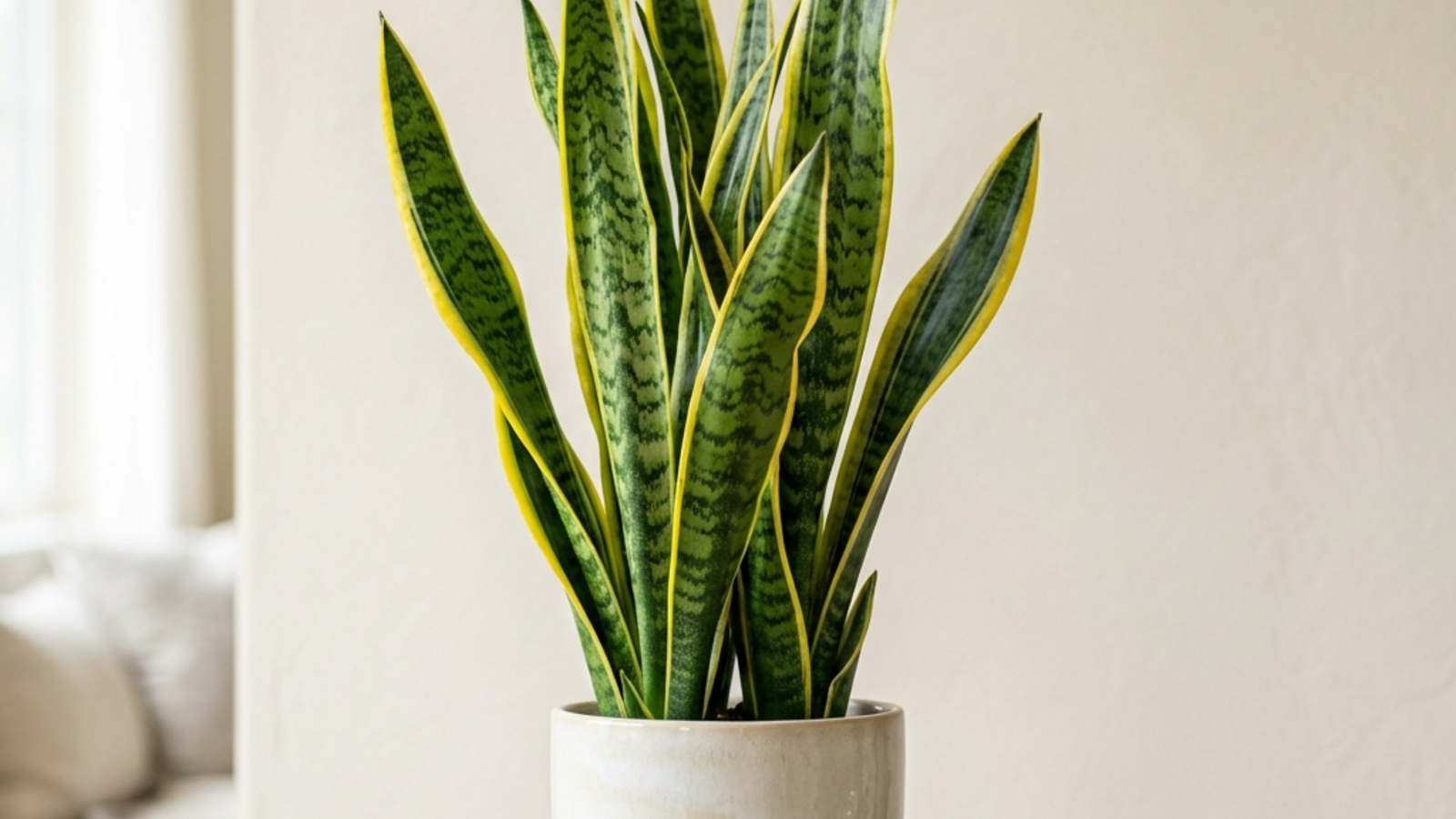
Snake plant is hard to kill, and overwatering is the main way it happens. Penn State Extension says you can neglect it for a month and it will be no worse for wear, but you can kill it by overwatering. The RHS names overwatering as the most common cause of poor health. If your plant is leaning, soft at the base or sitting in wet mix, go straight to the root rot rescue section.
Dracaena trifasciata was formerly Sansevieria trifasciata. NC State Extension places it in the asparagus family and gives its origin as West and West Central Africa. Leaves grow up to 1.2 m (4 ft) long and 5–10 cm (2–4 in) wide, in clumps that spread from rhizomes.
Snake plant care at a glance
| Factor | Guidance |
|---|---|
| Light | Tolerates very low light (NC State); best growth in medium to bright light (Missouri) |
| Water | Only when the mix has dried out (RHS). Every one to two months at most in winter (NC State) |
| Temperature | 15–24 °C (60–75 °F); tolerates cool rooms around 10 °C (50 °F) (RHS, NC State) |
| Humidity | Low humidity suits it; do not mist (RHS) |
| Mix | Free-draining cactus mix, or one with perlite (RHS, Penn State) |
| Feeding | Monthly in the growing season, April to September (RHS); Penn State suggests half strength |
| Repotting | Only when roots fill or distort the pot (RHS) |
| Pets | Toxic to cats and dogs: saponins (ASPCA) |
Light
Snake plant copes with a wide range of light. NC State says it tolerates very low light and suggests a spot with direct sun for part of the day, 2–6 hours. Penn State prefers bright indirect light and warns that direct sun can burn it. The RHS advice reconciles the two: bright, lightly shaded positions are ideal, but keep the plant out of midday summer sun.
What light changes:
- Shape. The RHS notes plants in shade grow taller leaves, while plants in sun stay more compact.
- Growth. Missouri Extension says it tolerates poor light but grows best in medium to bright light.
- Flopping. In very low light, tall leaves may flop. The RHS says a whole plant leaning over, rather than a single leaf, is a reason to check for root rot.
Turn the pot a quarter each time you water so it does not lean towards the window (RHS).
Watering
The RHS advice is to water only once the compost has dried out, checking with a finger rather than watering routinely. Water the mix from above, avoiding the centre of the rosette. Pour away any water in the saucer or outer pot.
Season matters. NC State says to let the soil dry between waterings from spring to autumn, and to water only every one to two months in winter. The RHS says that in winter the plant draws on water stored in its leaves and barely needs any, unless it sits somewhere particularly warm.
Clemson Extension uses snake plant as its example of a plant prone to rotting from overwatering. It also notes that a plant with damaged roots wilts because it cannot take up water, so watering makes it worse. Before watering a soft or wrinkled plant, check whether the mix is wet. Our snake plant wrinkled leaves guide separates thirst from root damage.
Potting mix and repotting
Use a free-draining mix. The RHS suggests cactus compost, or two parts loam-based compost to one part horticultural grit. Penn State suggests cactus mix or a mix with perlite. Always use a pot with drainage holes.
The RHS says snake plants prefer a snug pot and only need repotting once roots or leaves fill the container or make it buckle. Choose a new pot only slightly larger; a much bigger pot holds spare compost that stays wet and encourages root rot. Penn State notes a rootbound plant can break a clay pot, and recommends a heavy pot for tall cultivars, which can topple when dry.
Propagation: division, offsets and leaf cuttings
The RHS recommends propagating in spring (March to May), wearing gloves because the sap irritates skin.
- Offsets. Pull well-rooted young rosettes from the edge of the clump and pot them up.
- Division. Split the clump into pieces, each with leaves and roots. Discard damaged or dead sections.
- Leaf cuttings. Cut a mature leaf into 5 cm (2 in) sections, keep track of which end was lower, and let the cuts callus for a day or two. Insert the lower half into damp cuttings compost, ideally with bottom heat of 18 °C (65 °F).
Iowa State notes that division keeps the leaf pattern, while leaf cuttings may produce plain green plants. The RHS says cuttings from variegated cultivars such as ‘Laurentii’ tend to revert to green. See our snake plant propagation guide for more detail.
Root and rhizome rot rescue
UW–Madison’s Plant Disease Diagnostics Clinic describes the pattern: a plant wilting even though the soil is wet, with roots that are soft, brown and often bad-smelling. Several soil fungi and water moulds cause root rot, and most thrive in wet soil.
Signs to look for on a snake plant:
- leaves soft, collapsing or folding at the base;
- the whole plant leaning or wobbling in its pot (the RHS uses a firmly anchored rosette as a sign of a well-rooted plant);
- mix that stays wet long after watering, or roots with a bad smell.
What to do:
- Unpot and look. Ease the plant out and remove the old mix so you can see the roots and rhizomes.
- Sort healthy from rotten. Healthy tissue is firm. Rotten roots and rhizomes are soft, brown and may smell (UW–Madison).
- Cut out the rot. Discard soft, damaged or dead sections and keep only healthy pieces with leaves attached, as the RHS advises for division.
- Clean up. UW–Madison advises disinfesting tools and surfaces with a 10% bleach or detergent solution, or alcohol. Do not reuse the old mix or drainage water, and discard plastic pots that held a rotted plant.
- Repot small. Use fresh, pasteurized, free-draining cactus mix in a pot only slightly larger than what remains.
- Keep it on the dry side. UW–Madison’s main advice for a plant you decide to keep is to reduce soil moisture: enough water to prevent drought stress, never more.
- If no healthy rhizome remains, take leaf cuttings from the firmest leaves, using the RHS method above.
UW–Madison is frank that discarding a badly rotted plant is often the most practical choice. It does not recommend fungicides for houseplant root rot. For a closer look at rhizome damage, see why your snake plant has a mushy rhizome and our snake plant root rot guide.
Pests
The RHS lists three occasional pests:
- Mealybugs, which hide between the leaves at the base;
- Red spider mites, usually only in hot, dry conditions;
- Vine weevil grubs, which feed on the roots and can make leaves collapse.
Penn State also mentions mealybugs and spider mites. Collapsing leaves can mean root damage from vine weevil grubs as well as from rot, so check the roots either way.
Pets and people
The ASPCA lists snake plant as toxic to dogs and cats because of saponins, with nausea, vomiting and diarrhea as clinical signs. NC State notes the sap can cause skin irritation. Keep it out of reach of pets that chew plants. For more plant choices and care routes, visit our snake plant hub.
References
- NC State Extension Gardener Plant Toolbox: Dracaena trifasciata
- Royal Horticultural Society: How to grow sansevierias
- Penn State Extension (2023): Snake plant: a forgiving, low-maintenance houseplant
- University of Wisconsin–Madison Plant Disease Diagnostics Clinic, B. Hudelson and L. Jull: Root rots on houseplants
- Clemson Cooperative Extension HGIC 1459: Indoor Plants – Watering
- Iowa State University Extension and Outreach, A. Steil: Easy low-maintenance houseplants
- University of Missouri Extension, D. H. Trinklein: Lighting Indoor Houseplants, G6515
- ASPCA Animal Poison Control Center: Snake Plant