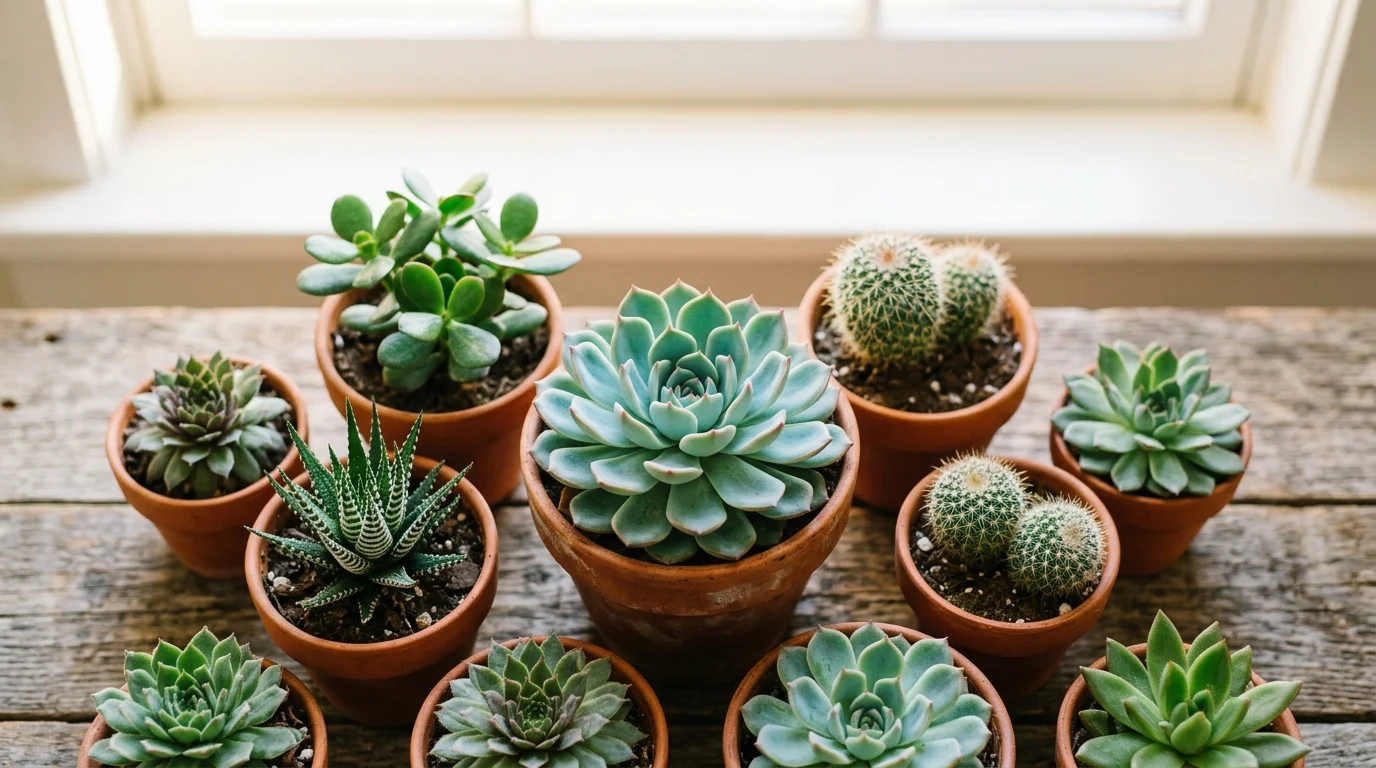
“Succulent” is a description, not a plant family. It covers any plant that stores water in thick leaves or stems: jade plant, aloe, echeveria, haworthia, desert cacti and many more. Most desert succulents want the same things indoors: strong light, a gritty mix that dries out, a pot that drains, and a cool, dry winter. This guide covers that shared routine.
There are exceptions. The RHS notes that rainforest succulents, such as Christmas cactus (Schlumbergera), orchid cacti (Epiphyllum) and Rhipsalis, prefer more frequent watering and semi-shade. Treat those more like a general houseplant. See our Easter cactus problems guide for one of them.
Succulent care at a glance
| Factor | What the sources say |
|---|---|
| Light | Sunny windowsill all year (RHS). Ten or more hours of bright light (Iowa State) |
| Water | Soak, drain, let the mix dry completely (Iowa State). Minimal in winter (RHS) |
| Mix | 1 part organic to 2 parts mineral (Iowa State). 2 parts John Innes No 2 to 1 part grit (RHS) |
| Pot | Drainage holes essential; clay or terracotta dries fastest (Iowa State) |
| Temperature | 13–24 °C (55–75 °F), cooler at night (Iowa State) |
| Winter | Rest from November to early March at 8–10 °C (46–50 °F) at night (RHS) |
| Feeding | Spring and summer only, at half to a quarter of label strength (Iowa State) |
| Propagation | Offsets, stem cuttings, leaf cuttings (Iowa State, RHS) |
Light: the brightest spot you have
The RHS recommends a sunny windowsill all year for most cacti and succulents. Clemson Extension says south- or west-facing windows that give desert cacti several hours of direct sun a day are ideal. University of Missouri Extension puts cacti and succulents among the high-light plants. It says most are not satisfactory grown under artificial lights alone, though lights can keep them going for limited periods.
Iowa State gives a measurable target. Succulents need ten or more hours of bright light indoors, and most need at least six to eight. It describes bright indirect light as light that casts a shadow without direct sun. It suggests turning plants so they grow evenly, and LED or fluorescent lights where windows are dim.
The sources differ on direct sun. Plants that grow in it, such as echeveria and jade, take more. NC State says echeveria leaf color improves with sunlight. It recommends a sunny spot with some afternoon shade for jade. Stretched, pale growth means too little light; see aloe etiolation, echeveria light and jade plant light.
Watering: the soak-and-dry cycle
Iowa State calls it a wet-dry cycle. Water thoroughly until water drains from the bottom, then let the soil dry completely before watering again. It suggests starting at every two to three weeks, then adjusting for soil, light, humidity and container. The RHS says to water once the compost surface feels dry in spring and summer, and let excess drain away.
Never leave the pot standing in water. Iowa State says not to let water sit in saucers, sleeves or double pots for more than a few hours. Clemson says a cactus must never stand in water.
The RHS links overwatering to rotting and stunted growth, and underwatering to shrivelling. Clemson says root and stem rots usually come from a mix that does not drain quickly or from watering too often. A soft, wrinkled plant can mean either problem, so check the mix and roots before watering again. Our soft or wrinkled cactus guide and echeveria root rot guide explain the checks.
Mix and pot
A succulent mix needs more grit than ordinary potting compost. Iowa State suggests one part organic material, such as potting soil, pine bark, compost or coir, to two parts mineral material, such as perlite, coarse sand, pumice or fine gravel. The RHS suggests two parts peat-free John Innes No 2 to one part horticultural grit or sharp sand, topped with a grit mulch. Clemson suggests equal volumes of peat-based potting soil and very coarse sand or grit. A commercial cactus mix also works.
The pot must have drainage holes. Iowa State says clay or terracotta is ideal because it is porous and dries faster. NC State says the same for aloe vera. Choose a pot just big enough for the roots. Iowa State says succulents often do better in a slightly smaller container, because the soil dries more quickly. The RHS warns that a pot that is too large can stay waterlogged.
Repot in spring, only when the plant has outgrown its pot (RHS). Clemson suggests waiting several days after repotting a cactus before watering. For aloe, see aloe repotting stress.
Temperature, humidity and the winter rest
Iowa State gives 13–24 °C (55–75 °F) as ideal, with nights cooler than days. Some succulents tolerate 7–29 °C (45–85 °F). Low indoor humidity suits them, especially in winter.
Most desert succulents need a winter rest. The RHS says to rest them from November to the beginning of March, with night temperatures of only 8–10 °C (46–50 °F) and minimal or no water. Clemson gives a winter range of 7–13 °C (45–55 °F) for desert cacti, with light watering every few weeks. NC State says to reduce watering for jade from fall to late winter.
Cool and dry go together. Clemson says winter oedema, corky swellings on leaves, is common on succulents. It follows wet soil combined with poor light and low temperatures. See jade plant edema.
Feeding
Feed only while the plant is growing. Iowa State recommends an all-purpose or succulent fertilizer in spring and summer, at half to a quarter of the label rate. It says not to feed in winter. The RHS suggests a monthly feed from April to September, using a high-potassium liquid feed or a cactus feed. Clemson says not to feed newly repotted cacti. White crust on the mix or pot points to salt build-up; see jade plant mineral deposits.
Propagation
Most succulents propagate easily, according to Iowa State, by offsets, stem cuttings or leaf cuttings. The RHS describes each:
- Offsets. Clump-forming and rosette-forming species make small new plants at the base. Once they are well rooted, detach them.
- Leaf cuttings. The RHS names echeveria and crassula as easy from leaves. NC State says an echeveria leaf left on the soil will eventually form a small rosette.
- Stem cuttings. Let the cut end dry and callus first; the RHS says this can take from a day to a week. Then insert it into a mix of two parts peat-free John Innes No 1 to one part grit.
Aloe vera is propagated by division of its offsets (NC State). For jade, see our jade plant care guide.
Pests and problems
The RHS lists mealybugs, red spider mites and scale insects as the main pests. Clemson adds aphids. Check the base of rosettes and leaf joints for cottony tufts. Our string of pearls mealybugs guide covers treatment options.
| What you see | Likely cause | Guide |
|---|---|---|
| Soft, mushy base or stem | Rot from wet mix (Clemson, RHS) | Echeveria root rot |
| Shrivelled, wrinkled leaves | Underwatering, or roots lost to rot | Soft or wrinkled cactus |
| Pale, stretched growth | Too little light (RHS) | Aloe etiolation |
| Corky bumps on leaves in winter | Oedema (Clemson) | Jade plant edema |
| Fuzzy growth on the mix | Mold on damp mix | Echeveria mold |
| Soft pads, wet or dry mix | Watering mismatch | Prickly pear watering |
Pets
Succulents are not automatically pet-safe. The ASPCA lists jade plant as toxic to dogs, cats and horses, causing vomiting, depression and incoordination. It lists aloe as toxic too, causing vomiting, lethargy and diarrhea, though it notes the gel is considered edible. It lists Echeveria elegans (hens and chickens) and Haworthia species as non-toxic to dogs and cats. See our pet-safe houseplants guide and aloe gel harvesting guide.
References
- Royal Horticultural Society: Cacti and succulents as houseplants: growing guide
- Iowa State University Extension, A. Steil: Growing Succulents Indoors
- Clemson Cooperative Extension HGIC 1502: Indoor Cacti
- Clemson Cooperative Extension HGIC 2251: Houseplant Diseases & Disorders
- NC State Extension Gardener Plant Toolbox: Crassula ovata
- NC State Extension Gardener Plant Toolbox: Echeveria
- NC State Extension Gardener Plant Toolbox: Aloe vera
- University of Missouri Extension, D. H. Trinklein: Lighting Indoor Houseplants, G6515
- ASPCA Animal Poison Control Center: Jade Plant
- ASPCA Animal Poison Control Center: Aloe
- ASPCA Animal Poison Control Center: Hens and Chickens
- ASPCA Animal Poison Control Center: Haworthia