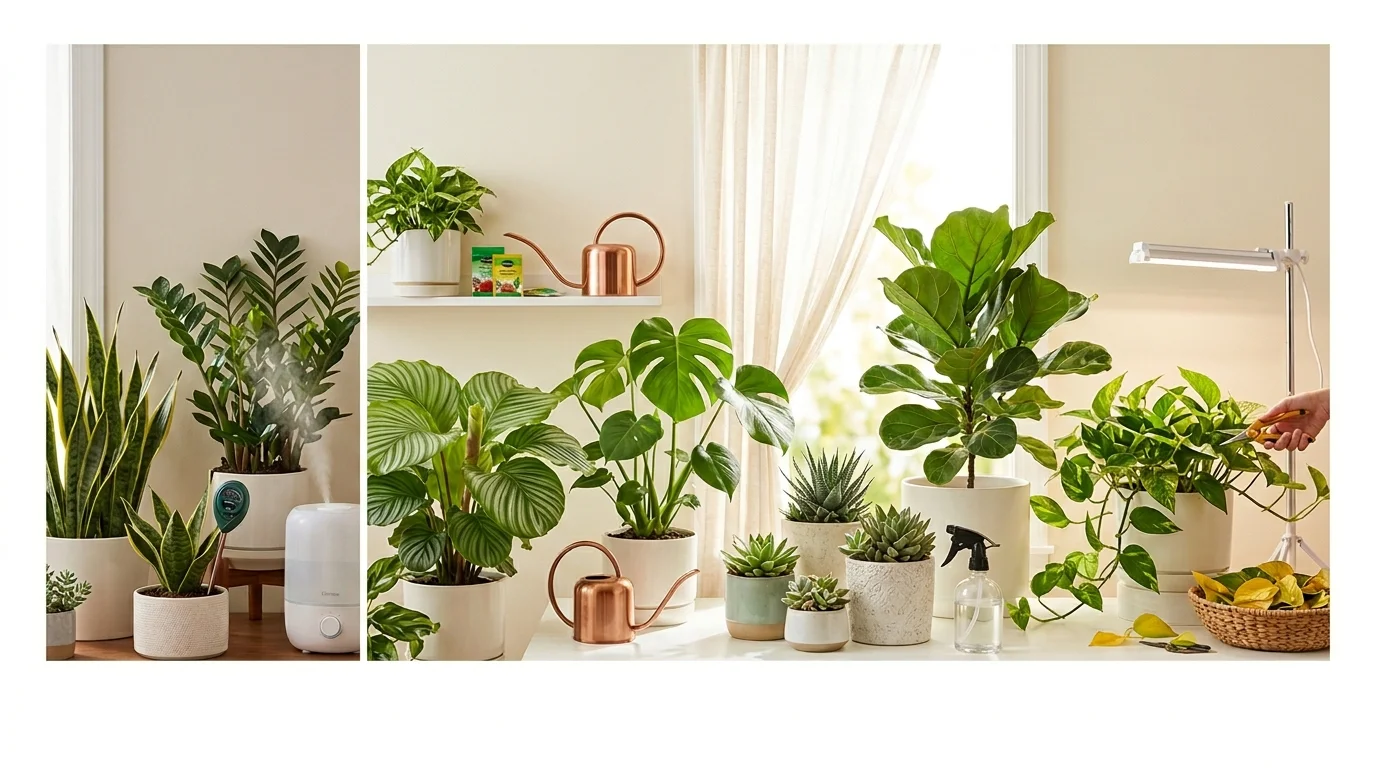
The same plant needs different care in January and July, because the light, temperature and humidity around it change. A watering calendar cannot follow those changes. University of Illinois Extension says plainly that watering by schedule “usually does not work”, and Clemson Extension says there is no fixed answer to how often to water.
This calendar is organised by season instead: what changes in your room, what to check, and what to adjust. Months are for the Northern Hemisphere; the Southern Hemisphere equivalents are in the table and at the end.
The checks that replace a watering schedule
Before every watering, in every season, check the pot:
- Finger test. Illinois Extension recommends pushing a finger about 5 cm (2 in) into the mix. If it is dry at that depth, the plant probably needs water.
- Weight. Clemson Extension notes a pot gets noticeably lighter as the mix dries.
- Colour and sound. Potting mix turns lighter as it dries, and a drying clay pot sounds hollow when tapped (Clemson).
- The saucer. Water until it runs from the drainage holes, then empty the saucer. Illinois and Clemson both warn against leaving the pot sitting in drained water.
Wilting is not proof of thirst. Clemson notes that roots damaged by rot cannot take up water, so a plant can wilt in wet mix, and watering makes it worse. Check the mix before reaching for the can. Our overwatered or underwatered guide walks through that distinction.
The year at a glance
| Season | Northern months | Southern months | Light | Water | Feed | Repot | Watch for |
|---|---|---|---|---|---|---|---|
| Winter | Dec–Feb | Jun–Aug | Lowest; move plants closer to windows | Mix dries slowest; check before each watering | Little or none | Avoid | Cold glass, heater blasts, dry air |
| Spring | Mar–May | Sep–Nov | Rising; watch south windows | Intervals shorten as growth starts | Resume at label rate | Best time | Pests on new growth |
| Summer | Jun–Aug | Dec–Feb | Strongest; screen bright windows | Fastest drying, especially outdoors | During active growth | Early summer still fine | Sun scorch, mites |
| Autumn | Sep–Nov | Mar–May | Falling | Intervals lengthen | Stop | Before bringing plants in, if needed | Hitchhiking pests, leaf drop |
Winter (December to February)
What changes. Days are short. Clemson Extension says many indoor plants that get little or no artificial light enter a resting stage in winter. Illinois Extension notes that most homes have less than 30 percent humidity in winter.
Light. University of Missouri Extension says any houseplant benefits from a south window in winter. Move plants closer to the brightest window you have, but keep leaves off the glass. Illinois Extension warns that cold window panes can damage foliage.
Watering. Expect the mix to stay wet longer. Clemson notes that resting plants need less water, and a plant in a cool, low-light spot needs it less often. Keep checking; a pot beside a radiator can still dry quickly. Use room-temperature water. Clemson gives 17–22 °C (62–72 °F) as the target water temperature.
Feeding. Clemson says not to fertilize plants in a winter rest period. Illinois Extension says most houseplants need very little or no fertilizer in the short days of winter. Plants under grow lights that keep growing are the exception.
Temperature and air. Illinois gives 18–24 °C (65–75 °F) by day for most foliage plants, with nights 3–6 °C (5–10 °F) cooler. Keep pots out of hot and cold blasts from radiators, vents and doors. A humidifier, a pebble tray or grouping plants raises humidity; Illinois notes misting only works for a short time.
If the room is too dark. Missouri Extension lists the signs of too little light: long gaps between leaves, smaller new leaves, pale growth, and yellow, dropping lower leaves. Its guidance for plants with no outdoor light is 16–18 hours a day under lights; with some window light, 12–14 hours may be enough. See our grow light distance and duration guide.
Spring (March to May)
What changes. Light rises and new leaves appear. Clemson says fertilizer applications should be more frequent when plants are growing, usually spring and summer.
Feeding. Illinois Extension recommends feeding only actively growing plants, and for most houseplants no more than once every one to three months between March and September. Never mix stronger than the label. Our fertilizer schedule covers products and dilution.
Repotting. This is the main repotting window. Illinois Extension says repot when the plant is actively growing, typically spring or early summer. Its signs that a plant needs a bigger pot:
- roots grow through the drainage holes or show on the surface;
- the soil mass is filled with roots;
- new leaves are smaller than normal;
- the plant wilts between normal waterings.
Replant at the same depth, and leave room at the top for watering. If a white crust has formed on the surface, scrape off the top 2.5 cm (1 in) of old mix first.
Light. Missouri Extension warns that plants which do not need bright light may sunburn at south windows from late spring to early autumn. Move African violets and other low-light plants back from a south window as the sun strengthens.
Flushing salts. Illinois suggests leaching pots every 4–6 months: pour a large volume of plain water through and empty the saucer. Clemson lists brown leaf tips, dropping lower leaves and a white crust on the pot as signs of salt build-up.
Summer (June to August)
What changes. Growth and water use peak. Pots dry faster in heat, sun and moving air, so check them more often rather than adding water on a fixed day.
Moving plants outdoors. Illinois Extension says a summer outdoors often reinvigorates houseplants, with conditions:
- Wait for warm nights. Iowa State says most houseplants are tropical and many are damaged by temperatures in the mid-to-low 40s °F (roughly 4–7 °C).
- Choose shade, not direct sun. Illinois suggests a north-side exposure or under a tree.
- Acclimate gradually. Put plants out for a few hours on the first day and increase the time daily over 1–2 weeks.
- Check outdoor pots often. Sun and wind dry them much faster than indoor pots.
Pests. Inspect leaf undersides when you water. Speckled, dull-looking leaves deserve a close look for mites; see our spider mite guide before choosing a treatment.
Autumn (September to November)
What changes. Light falls and nights cool. Plants that grew outdoors face a large drop in light when they come in.
Bringing plants back inside. Iowa State Extension says to move houseplants indoors when nights fall consistently to around 10 °C (50 °F). Illinois Extension’s Richard Hentschel adds that plants should be in before the furnace runs. The steps from both:
- Start the light adjustment outdoors. Move sun-grown plants into shade first, and begin extending watering intervals.
- Clean and inspect. Remove dead leaves and debris. Hose both leaf surfaces and flush the pot to drive out soil insects. If you find spider mites or scale, treat outdoors with a labelled product, repeated as the label directs.
- Consider fresh mix. Illinois suggests repotting into fresh potting mix before plants return indoors.
- Bring them in on the dry side. They will need less water in lower light.
- Quarantine. Keep returning plants apart for 3–4 weeks (Iowa State; Illinois says 2–3 weeks). Iowa State says pests such as scale, mealybugs, aphids and whiteflies usually show within about a month.
Expect some leaf drop. University of Missouri Extension explains why. Leaves grown in outdoor light cannot make enough food indoors, so the plant sheds some. It then grows “shade leaves” suited to lower light. Iowa State names tropical hibiscus and weeping fig as plants that often drop leaves after the move. Missouri advises reducing fertilizer and lengthening the interval between waterings while plants adjust.
Feeding. Iowa State advises stopping fertilizer in autumn and winter, because plants are not actively growing.
Southern Hemisphere and warm climates
South of the equator, shift every month by six: winter care runs June to August and spring repotting falls in September to November. Window directions flip too. In the Southern Hemisphere the north-facing window gets the most sun, so read “south window” in the sources above as “north window”.
Where winters are mild, plants may keep growing through the cool season. Let the plant decide. Feed and repot when you see active new growth, and hold back when growth stops.
References
- University of Illinois Extension: Houseplants: Care
- University of Illinois Extension: Houseplants: Watering
- University of Illinois Extension: Houseplants: Repotting
- University of Illinois Extension: Houseplants: Lighting
- University of Illinois Extension, R. Hentschel (2019): Help your houseplants head back inside
- Iowa State University Extension and Outreach, A. Steil: How and when do I bring my houseplants back indoors before winter?
- University of Missouri IPM, D. Trinklein (2016): Houseplant acclimatization
- University of Missouri Extension, D. H. Trinklein: Lighting Indoor Houseplants, G6515
- Clemson Cooperative Extension HGIC 1459: Indoor Plants – Watering
- Clemson Cooperative Extension HGIC 1450: Indoor Plants – Cleaning, Fertilizing, Containers & Light Requirements