Boston fern
Nephrolepis exaltata
Also known as: sword fern, ladder fern, wild Boston fern, Nephrolepis exaltata 'Bostoniensis'
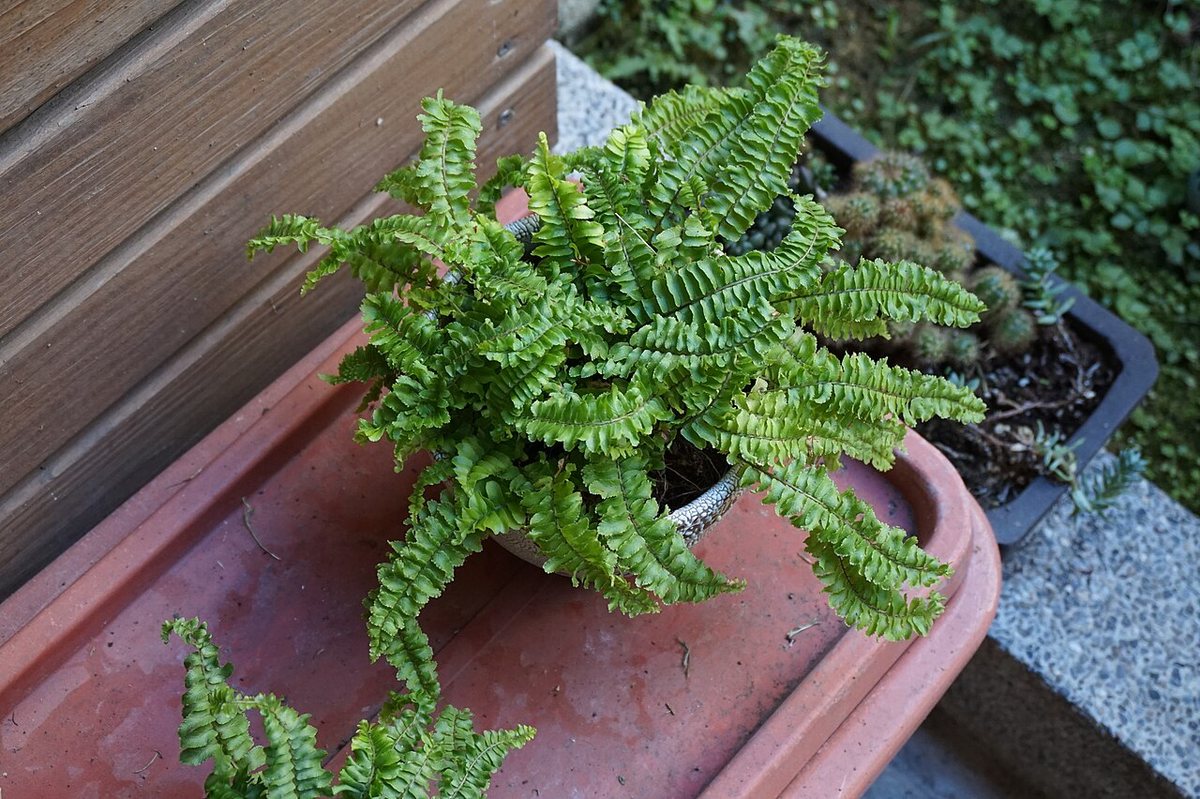

How do you care for a Boston fern?
Light: Bright, indirect or filtered light. Clemson warns never to put ferns directly in a south- or west-facing window. Water: Keep evenly moist but not saturated. Never let it dry out completely, and do not leave water standing in the pot; water less in winter. It is non-toxic to cats and dogs.
About Boston fern
Boston fern (Nephrolepis exaltata, usually the cultivar 'Bostoniensis') is a tropical American fern with arching, finely divided fronds, long grown in hanging baskets. NC State Extension recommends bright, indirect light, 16–21 °C (60–70 °F), high humidity, and moist soil that should never be allowed to dry out, with less water in winter. Clemson Extension links brown leaflets to low humidity, while the rows of dark dots under mature fronds are spores, not pests. The ASPCA lists Boston fern as non-toxic to cats and dogs.
Boston fern quick facts
- Botanical name
- Nephrolepis exaltata
- Family
- Polypodiaceae (polypody family)
- Native to
- Tropical and subtropical America
- Light
- Bright, indirect or filtered light. Clemson warns never to put ferns directly in a south- or west-facing window.
- Water
- Keep evenly moist but not saturated. Never let it dry out completely, and do not leave water standing in the pot; water less in winter.
- Humidity and temperature
- High humidity: a pebble tray, double potting in moist sphagnum moss, or a bright bathroom. 16–21 °C (60–70 °F).
- Feeding
- Half-strength fertilizer every 4 to 6 weeks in active growth and much less in winter; heavy feeding browns the fronds.
- Size
- 61–91 cm (2–3 ft) tall and wide.
- Propagation
- Division of the clump; it also spreads by thin green runners.
- Cats and dogs
- Non-toxic. The ASPCA lists Boston fern (Nephrolepis exaltata 'Bostoniensis') as non-toxic to dogs and cats. Source: ASPCA
Sources: NC State Extension: Nephrolepis exaltata; Clemson Extension HGIC 1505: Indoor Ferns; University of Wisconsin–Madison Extension: Boston fern; UF/IFAS Extension FPS427: Nephrolepis exaltata; ASPCA: Boston Fern
Boston fern guides
- Boston fern care (Nephrolepis exaltata): light, watering, humidity and brown fronds
- Boston fern soil keeps drying out? Check the roots, the mix and the spot
- Boston fern in the bathroom: what the humidity fixes and what it doesn't
- Pet-safe houseplants by light: plants the ASPCA lists as non-toxic to cats and dogs
Boston Fern care at a glance
- Light
- Bright indirect. Wants bright, indirect light — sensitive to both extremes. Too much direct sun causes burns, too little causes stretching. Grow lights: Thrives under artificial grow lights (LED or fluorescent, 10-12 hours/day). A great option if your space lacks natural light.
- Watering
- Water when the top 1-2 inches of soil feel dry. Adjust with the seasons — less in winter, more in summer.
- Humidity
- Loves higher humidity (60%+). If your air is dry, group it with other plants, use a pebble tray, or run a humidifier nearby.
- Temperature
- Prefers moderate temperatures (60-80°F). Keep away from radiators and intense afternoon sun windows.
- Soil
- Needs well-draining soil — add perlite or orchid bark to a standard potting mix. Good drainage is critical to prevent root rot.
- Pets
- The ASPCA lists Boston fern (Nephrolepis exaltata 'Bostoniensis') as non-toxic to dogs and cats.
- Difficulty
- Moderate
Common Boston fern problems, answered
-
Boston Fern Fungus Gnats: Control Without Drying It Out
Fungus gnats breed in moist potting mix rich in organic matter, which is exactly what a Boston fern grows in. The adults are a nuisance. The larvae in the mix feed mostly on fungi and decaying matter but can damage roots when numbers are high.
-
Boston Fern Brown Fronds: Dry Air, Dry Mix, Sun or Salts?
Brown, crispy Boston fern fronds usually trace back to dry air, a root ball that dried out, direct sun, or salts from fertilizer and hard or softened water. Where the browning starts, and which fronds it hits, tells you which one to fix.
-
Boston Fern Shedding Leaflets: Water, Air, Light or the Move?
A Boston fern that drops showers of small leaflets is reacting to stress: a mix that went too dry or stayed too wet, dry indoor air, a darker spot, or a recent move such as coming indoors for winter. Some shedding after a move is normal and should settle within weeks.
-
Do Spider Mites Affect Boston Ferns? Signs and Safe Fixes
Yes, spider mites do attack Boston ferns, mostly when the air around the plant is too dry. Look for fine pale speckling and a faded, dusty look on the leaflets, tiny moving dots underneath, and fine webbing in heavier infestations.
-
Boston Fern Yellow Leaves: Find the Cause and Fix It
Yellowing Boston fern fronds most often trace back to the root zone: mix kept wet, especially in winter, or roots that have filled the pot and run short of nutrients. Too little light and sap-feeding pests such as fern scale also yellow fronds, and some cultivars are simply gold-green.
-
Boston Fern Root Rot: Treatment, Division and Repotting
Boston fern root rot follows mix that stays saturated: slow drainage, water standing in a saucer or cover pot, or summer watering carried into winter. Fronds yellow and wilt while the mix is wet, and the roots turn brown to black and soft. Brown, crispy fronds over dry mix are a different problem.
Questions about Boston fern
Is Boston fern toxic to cats and dogs?
The ASPCA lists Boston fern (Nephrolepis exaltata 'Bostoniensis') as non-toxic to dogs and cats.
Get the Plant Mortality Checklist
Check moisture, roots and recent care changes before choosing a treatment. A practical checklist to keep.
Your checklist is ready!
We also sent it to your inbox. Check your email for the full download.
Open the ChecklistFree. No spam. Unsubscribe anytime.