Calathea orbifolia
Goeppertia orbifolia, formerly Calathea orbifolia
Also known as: orbifolia, Calathea rotundifolia, Maranta orbifolia
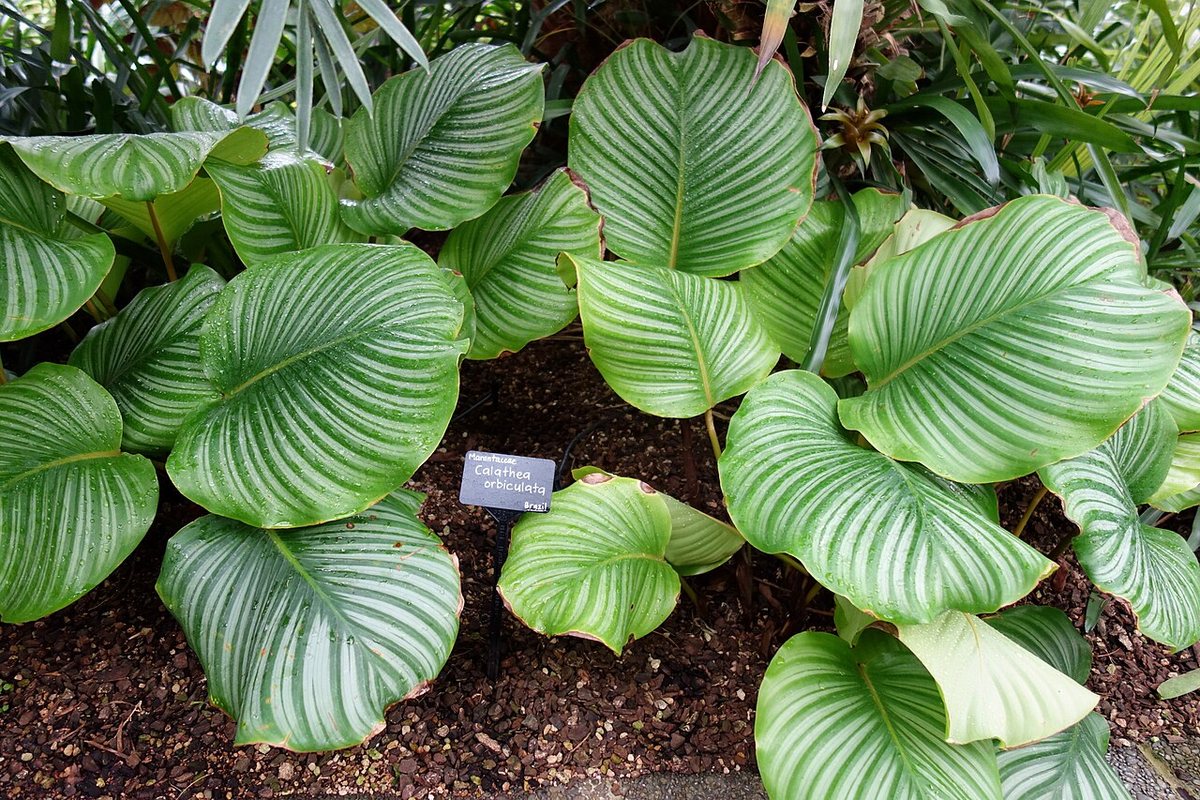

How do you care for a Calathea orbifolia?
Light: Bright, indirect light or partial shade. Water: Keep consistently moist but not wet or soggy, in a well-drained, slightly acidic mix. Use distilled water or rainwater: NC State says fluoride in tap water can brown the leaf tips. It is non-toxic to cats and dogs.
About Calathea orbifolia
Calathea orbifolia (now Goeppertia orbifolia) is a clump-forming member of the prayer plant family from the rainforests of eastern Brazil, grown for round leaves up to 30 cm (12 in) wide with silver-green stripes. As a houseplant it grows 60–90 cm (2–3 ft) tall and 30–60 cm (1–2 ft) wide and rarely flowers. NC State Extension recommends bright, indirect light or partial shade, soil kept consistently moist but not soggy, humidity of at least 60% and steady temperatures of 18–24 °C (65–75 °F). The ASPCA lists Calathea species as non-toxic to cats and dogs.
Calathea orbifolia quick facts
- Botanical name
- Goeppertia orbifolia, formerly Calathea orbifolia
- Family
- Marantaceae (prayer plant family)
- Native to
- Eastern Brazil
- Light
- Bright, indirect light or partial shade.
- Water
- Keep consistently moist but not wet or soggy, in a well-drained, slightly acidic mix. Use distilled water or rainwater: NC State says fluoride in tap water can brown the leaf tips.
- Humidity and temperature
- At least 60% relative humidity; use a humidifier or a pebble tray. Keep at a steady 18–24 °C (65–75 °F), away from cold drafts.
- Size
- 60–90 cm (2–3 ft) tall and 30–60 cm (1–2 ft) wide; leaves up to 30 cm (12 in) across.
- Feeding
- Fertilize monthly during the growing season. Wipe dust off the leaves with a damp cloth.
- Propagation
- Division in spring.
- Cats and dogs
- Non-toxic. The ASPCA lists Calathea species as non-toxic to dogs, cats and horses, and NC State Extension tags Goeppertia orbifolia as non-toxic for cats and dogs. Source: ASPCA
Sources: NC State Extension: Goeppertia orbifolia; NC State Extension: Goeppertia; ASPCA: Calathea
Calathea Orbifolia care at a glance
- Light
- Medium to bright indirect. Tolerates lower light but grows best in medium to bright indirect light. Can get leggy without enough light. Grow lights: Thrives under artificial grow lights (LED or fluorescent, 10-12 hours/day). A great option if your space lacks natural light.
- Watering
- Water when the top 1-2 inches of soil feel dry. Adjust with the seasons — less in winter, more in summer.
- Humidity
- Loves higher humidity (60%+). If your air is dry, group it with other plants, use a pebble tray, or run a humidifier nearby.
- Temperature
- Standard room temperature (60-80°F / 15-27°C) is perfect. Avoid cold drafts and sudden temperature swings.
- Soil
- Needs well-draining soil — add perlite or orchid bark to a standard potting mix. Good drainage is critical to prevent root rot.
- Pets
- The ASPCA lists Calathea species as non-toxic to dogs, cats and horses, and NC State Extension tags Goeppertia orbifolia as non-toxic for cats and dogs.
- Difficulty
- Moderate
Common Calathea orbifolia problems, answered
-
Calathea Orbifolia Care: Light, Water, Humidity and Problems
Calathea orbifolia, now Goeppertia orbifolia, needs bright indirect light, mix that stays evenly moist but never soggy, high humidity and steady warmth. Most of its problems trace back to dry air, uneven watering, hard or fluoridated water, or direct sun.
-
Calathea Orbifolia Curling Leaves: Water, Air or Roots?
Calathea orbifolia leaves curl when the plant is short of water, from dry mix, dry air, heat or damaged roots. Rolled new leaves and leaves that rise at night are normal and need no fix.
-
Calathea Orbifolia Yellow Leaves: Age, Water, Light or Pests?
One old leaf yellowing on a calathea orbifolia is usually normal aging. Several leaves yellowing at once most often point to overwatering and root damage, with too little fertilizer, too much light, drafts or spider mites as other causes.
Questions about Calathea orbifolia
Is Calathea orbifolia toxic to cats and dogs?
The ASPCA lists Calathea species as non-toxic to dogs, cats and horses, and NC State Extension tags Goeppertia orbifolia as non-toxic for cats and dogs.
Get the Plant Mortality Checklist
Check moisture, roots and recent care changes before choosing a treatment. A practical checklist to keep.
Your checklist is ready!
We also sent it to your inbox. Check your email for the full download.
Open the ChecklistFree. No spam. Unsubscribe anytime.