Syngonium
Syngonium podophyllum
Also known as: arrowhead plant, arrowhead vine, nephthytis, American evergreen, African evergreen, trileaf wonder
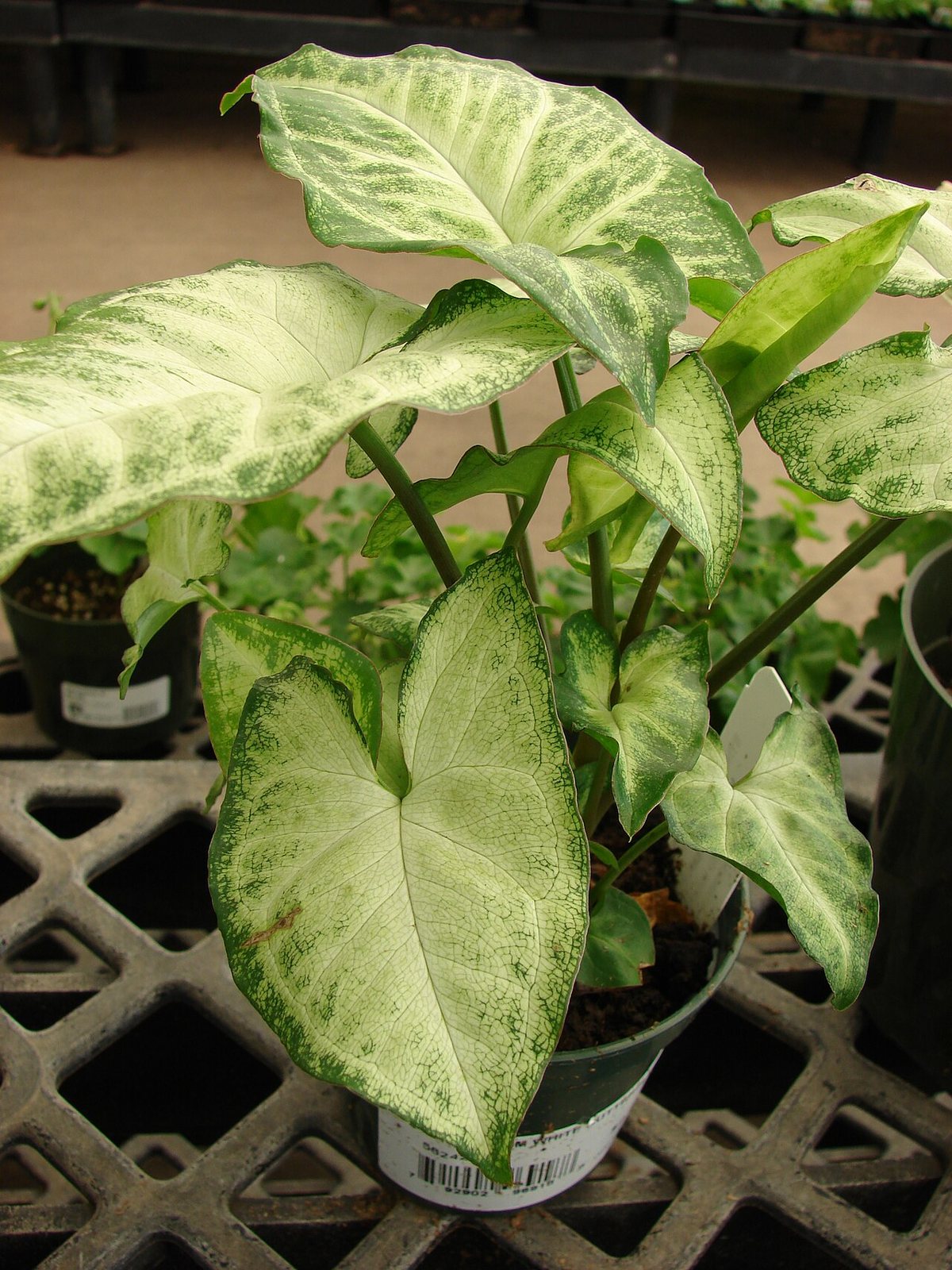

How do you care for a syngonium?
Light: Medium to bright indirect light; tolerates low light. Direct sun burns or bleaches the leaves, and variegated forms turn green in low light. Water: Let the mix dry slightly between waterings. Missouri Botanical Garden advises watering less from fall to late winter. It is toxic to cats and dogs, so keep it out of their reach.
About Syngonium
Syngonium podophyllum, the arrowhead plant, is a climbing aroid from the rainforests of Mexico, Central America and northern South America. It is sold in its compact juvenile form, with arrow- or heart-shaped leaves; as it matures and climbs, the leaves divide into 5 to 11 leaflets. NC State and Clemson Extension recommend medium to bright indirect light with no direct sun, a mix allowed to dry slightly between waterings, and warm, humid conditions. The ASPCA lists it as toxic to cats, dogs and horses.
Syngonium quick facts
- Botanical name
- Syngonium podophyllum
- Family
- Araceae (arum family)
- Native to
- Mexico, Central America and northern South America
- Light
- Medium to bright indirect light; tolerates low light. Direct sun burns or bleaches the leaves, and variegated forms turn green in low light.
- Water
- Let the mix dry slightly between waterings. Missouri Botanical Garden advises watering less from fall to late winter.
- Temperature and humidity
- 18–24 °C (65–75 °F). Clemson Extension says it prefers humidity of 50% or higher but tolerates average home humidity.
- Size
- Common varieties grow 91 cm–1.8 m (3–6 ft) tall and 30–61 cm (1–2 ft) wide; dwarf varieties stay under 61 cm (2 ft).
- Growth habit
- Cutting off climbing stems as they develop keeps the bushy, arrow-leaved juvenile form. A moss pole or trellis supports a climbing plant.
- Propagation
- Stem cuttings, division or layering.
- Cats and dogs
- Toxic. Toxic to dogs, cats and horses. The ASPCA lists insoluble calcium oxalates for arrowhead vine (Syngonium podophyllum), causing oral irritation, pain and swelling of the mouth, tongue and lips, drooling, vomiting and difficulty swallowing. Source: ASPCA
Sources: NC State Extension: Syngonium podophyllum; Clemson Extension HGIC 1573: Arrowhead Vine; Missouri Botanical Garden: Syngonium podophyllum; ASPCA: Arrow-Head Vine
Syngonium care at a glance
- Light
- Bright indirect. Wants bright, indirect light — sensitive to both extremes. Too much direct sun causes burns, too little causes stretching. Grow lights: Thrives under artificial grow lights (LED or fluorescent, 10-12 hours/day). A great option if your space lacks natural light.
- Watering
- Water when the top 1-2 inches of soil feel dry. Adjust with the seasons — less in winter, more in summer.
- Humidity
- Appreciates some humidity but adapts to average home conditions. Brown tips in winter? Your air might be too dry — a light misting helps.
- Temperature
- Standard room temperature (60-80°F / 15-27°C) is perfect. Avoid cold drafts and sudden temperature swings.
- Soil
- Needs well-draining soil — add perlite or orchid bark to a standard potting mix. Good drainage is critical to prevent root rot.
- Pets
- Toxic to dogs, cats and horses. The ASPCA lists insoluble calcium oxalates for arrowhead vine (Syngonium podophyllum), causing oral irritation, pain and swelling of the mouth, tongue and lips, drooling, vomiting and difficulty swallowing.
- Difficulty
- Moderate
Common syngonium problems, answered
-
Syngonium Yellow Leaves: Watering, Light or Leaf Spot?
Yellow leaves on an arrowhead plant usually trace back to the root zone: mix kept too wet, or mix left dry for too long. Old lower leaves also yellow with age, and bacterial leaf spot, direct sun, cold or pests cause their own patterns.
-
Leggy Syngonium: Climbing Form, Low Light and Pruning
A leggy arrowhead plant is usually doing one of two things: growing up out of its compact juvenile form into a climbing vine, or stretching toward the light in a spot that is too dim. Heavy feeding can add to the stretch.
-
How to Propagate Syngonium: Cuttings, Layering and Division
Arrowhead plant roots readily from stem cuttings that carry at least one node. It can also be layered while still attached to the parent or divided when a pot holds several crowns.
-
Syngonium Brown Spots: Bacterial, Fungal or Environmental?
Brown spots on a syngonium have three main sources: bacterial disease (water-soaked or translucent spots, often with yellow halos and limited by the veins), fungal leaf spot (tan to dark brown spots with rings), and the environment (sun scorch, dry-edge browning, or dead spots on lower leaves from poor feeding). The spot's edge and position tell them apart.
Questions about Syngonium
Is syngonium toxic to cats and dogs?
Toxic to dogs, cats and horses. The ASPCA lists insoluble calcium oxalates for arrowhead vine (Syngonium podophyllum), causing oral irritation, pain and swelling of the mouth, tongue and lips, drooling, vomiting and difficulty swallowing.
Get the Plant Mortality Checklist
Check moisture, roots and recent care changes before choosing a treatment. A practical checklist to keep.
Your checklist is ready!
We also sent it to your inbox. Check your email for the full download.
Open the ChecklistFree. No spam. Unsubscribe anytime.