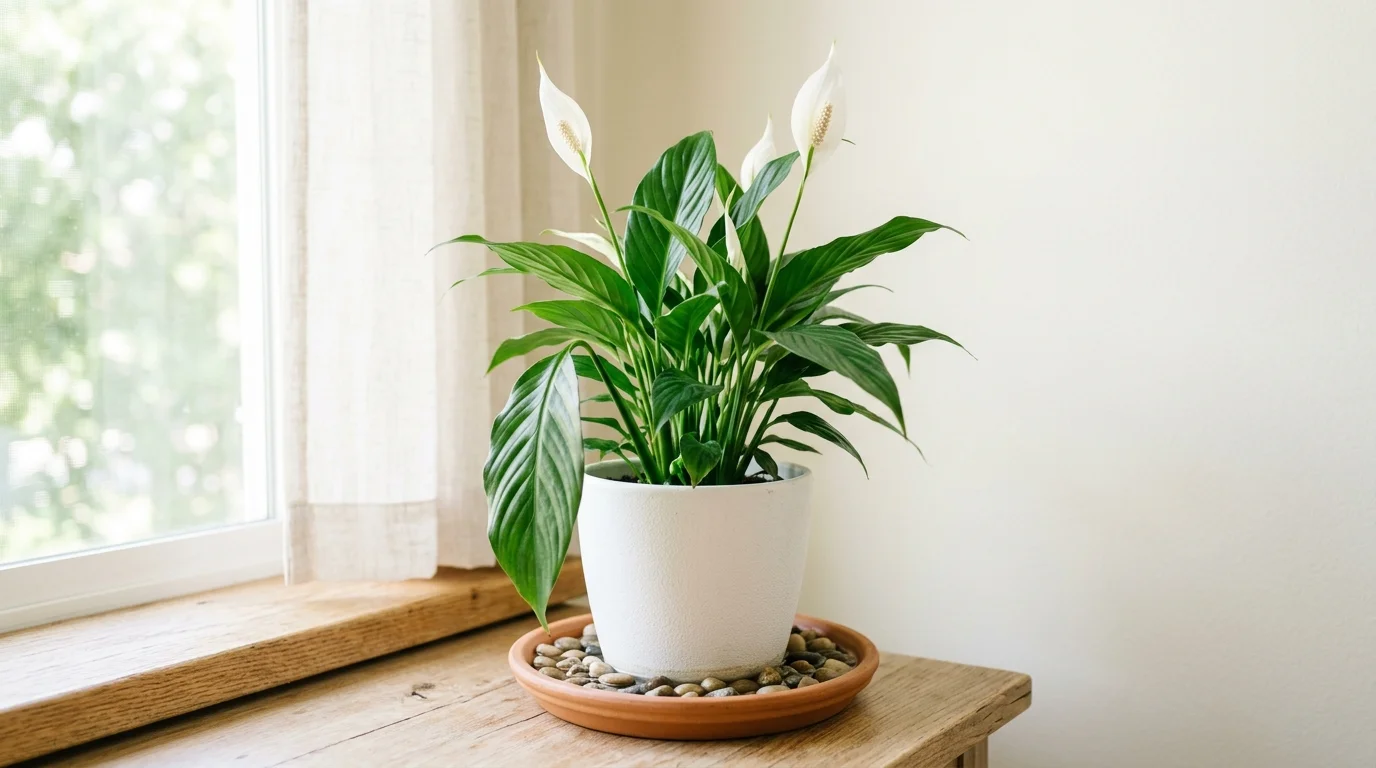
A drooping peace lily looks alarming, and it usually is not the end. Clemson says a peace lily wilts when its mix dries out too far. The trap is that a peace lily with damaged roots wilts too, while its mix is still wet. Most of good peace lily care comes down to telling those two apart.
Peace lilies are Spathiphyllum, a genus of about 60 species in the arum family (Araceae), according to NC State Extension. They come from Mexico, tropical America, Malesia and the western Pacific. They are not true lilies. The white “flower” is a spathe, a modified leaf wrapped around a spike of tiny flowers called the spadix.
Peace lily care at a glance
| Factor | What the sources say |
|---|---|
| Light | Bright indirect light is best; tolerates low light; no direct sun (Clemson, NC State) |
| Water | Moist but not soggy; let it dry slightly between waterings (NC State, Clemson) |
| Mix | Well-drained mix high in organic matter (Clemson, NC State) |
| Temperature | 20–29 °C (68–85 °F) by day, about 5–6 °C (10 °F) cooler at night; avoid below 16 °C (60 °F) (Clemson, NC State) |
| Feeding | Balanced liquid feed at one-quarter strength every 6–8 weeks in spring and summer (Clemson) |
| Repotting | Keep slightly pot-bound; go up only 2.5–5 cm (1–2 in) (Clemson) |
| Propagation | Division, in spring (NC State, UF/IFAS) |
| Pets | Toxic to dogs and cats (ASPCA) |
Size
Clemson says most peace lilies grow 30 cm–1.2 m (1–4 ft) tall and wide; a few cultivars, such as ‘Sensation’, reach 1.8 m (6 ft). Dwarf cultivars such as ‘Little Angel’ stay much smaller. Check the label before you choose a spot.
Light: bright shade, never direct sun
Clemson says peace lilies tolerate low light but grow best in bright indirect light. NC State lists partial to deep shade. Both say to keep the plant out of direct sun. Clemson explains that the heat scorches the foliage.
UF/IFAS puts it simply: a well-lit area, but out of direct sunlight. If pale or dry brown patches appear soon after a move into sun, our peace lily sunburn guide covers the checks.
Watering: check the mix before you water
NC State says to keep the soil moist but not soggy and to let it dry between waterings. Clemson says to let it dry out slightly. Maryland Extension advises against watering on a schedule.
Use two checks together:
- Feel the mix. Maryland Extension suggests pushing a finger about 5 cm (2 in) into the mix. If it is dry at that depth, it probably needs water.
- Lift the pot. Maryland notes that a pot with dry mix weighs much less than one that still holds water. Learn both weights.
When it is time, water until it runs out of the drainage hole. Empty the saucer or cover pot. Clemson warns that a peace lily left sitting in a saucer of water will develop root rot. Clemson also says to use room-temperature water.
NC State says watering from below works very well for peace lilies. Stand the pot in water so the mix draws it up, then lift it out and drain it.
For the full method, including bottom watering and rewetting a dry root ball, see our houseplant watering guide.
Drooping: dry pot or wet pot?
Maryland Extension says peace lilies wilt when they need water, and can also wilt when overwatered. Clemson adds that a plant left to dry out too far wilts and its leaves and edges turn yellow. Check the mix before you reach for the watering can.
| What you find | Likely meaning | What to do |
|---|---|---|
| Light pot, dry mix, limp leaves | Thirst | Water thoroughly, let it drain, and watch the leaves firm up |
| Heavy pot, wet mix, limp leaves | Roots damaged by wet mix | Stop watering; check drainage and roots |
| Wilting soon after repotting | Root disturbance or a pot too large | Keep conditions steady; check how wet the new mix stays |
Maryland Extension describes root rot as wilting even when the mix holds enough water, with roots that are brown to black and soft. Clemson says root and stem diseases are the most common peace lily problem, usually linked to overwatering.
Our written guides go step by step: peace lily drooping, what a drooping peace lily needs to recover and transplant shock after repotting. For soft, dark roots, use the root rot guide.
Temperature and drafts
Clemson and NC State give the same range: 20–29 °C (68–85 °F) by day, with nights about 5–6 °C (10 °F) cooler. Clemson says to avoid temperatures below 16 °C (60 °F), as cold damage may occur.
NC State says temperatures of 4–16 °C (40–60 °F) slow growth considerably. Long periods below 4 °C (40 °F) can damage leaves, stems and roots. Clemson warns against spots where heating or air-conditioning vents blow directly on the plant.
Feeding: very little
Clemson says peace lilies need very little fertilizer. It recommends a balanced liquid houseplant fertilizer, such as 20-20-20, every six to eight weeks in spring and summer, mixed at one-quarter of the recommended strength. NC State also says one-quarter strength, and to flush the mix with plain water between feeds.
Both warn that overfeeding burns leaf tips and roots. Clemson adds that a magnesium deficiency can stunt the plant and yellow the tissue between green veins. Our fertilizer schedule covers timing and salt flushing in detail.
Brown tips and yellow leaves
Clemson says leaf edges turn brown from overfertilizing or from excessive drying. Maryland Extension lists brown tips, dropping lower leaves and wilting as signs of soluble salt buildup. It says to leach every four to six months by pouring plenty of water through the pot and letting it drain completely.
Yellow leaves have several causes. Maryland Extension links yellowing to overly wet mix, and Clemson links yellow leaf edges to a mix left too dry. Yellowing between green veins can mean a magnesium deficiency (Clemson).
See peace lily brown tips and peace lily yellow leaves for the checks in order.
Repotting, mix and division
Clemson says peace lilies like to be slightly pot-bound. Repot when roots grow through the drainage holes or circle on top of the mix. Choose a pot only 2.5–5 cm (1–2 in) wider. Clemson warns that a pot that is too large keeps the mix too wet and can lead to root rot.
NC State suggests repotting, when necessary, in February or March. Clemson says any time works, but plants recover faster during the growing season. Loosen the roots gently before setting the plant in its new pot. Use a well-drained mix high in organic matter (Clemson, NC State). Our potting mix guide explains how mixes hold water and air.
To make more plants, divide a crowded clump. NC State lists division as the recommended method, and UF/IFAS suggests doing it in spring. Give each piece its own roots and leaves.
Flowers
NC State says the white spathes turn pale green after about 10 days, then stay attractive for at least another month. That greening is normal ageing. Clemson says a lack of flowering usually means the plant is under a year old or is in too little light.
UF/IFAS research explains why shop plants are so often in bloom: growers can trigger flowering with a gibberellic acid spray. Our peace lily not blooming guide covers light, age and feeding for reblooming.
Pests and mould
Clemson says peace lilies have few insect pests, but fungus gnats, mealybugs, spider mites and scales can appear. Clemson advises examining the leaves often for signs of insects. For small flies around the pot, see fungus gnats on peace lily. For fuzzy growth on the surface, see peace lily moldy soil.
Air purification
Clemson calls the peace lily a top air-purifying houseplant. What the NASA study actually measured, and what it means in a ventilated home, is in our peace lily air purification article.
Pets and children
The ASPCA lists peace lily as toxic to dogs and cats. The cause is insoluble calcium oxalates. Signs include intense burning of the mouth, tongue and lips, drooling, vomiting and difficulty swallowing. NC State and Clemson also flag it for children. Keep it out of reach, or choose from our pet-safe plants guide.
More peace lily guides are on the peace lily hub.
References
- NC State Extension Gardener Plant Toolbox: Spathiphyllum (Peace Lily)
- Clemson Cooperative Extension HGIC 1512: Peace Lily
- UF/IFAS Gardening Solutions: Peace Lily
- UF/IFAS Extension EP320, R. J. Henny and J. Chen: Spathiphyllum Flowering—Keys to the Future
- University of Maryland Extension: Watering Indoor Plants
- University of Maryland Extension: Root Rots of Indoor Plants
- ASPCA Animal Poison Control Center: Peace Lily