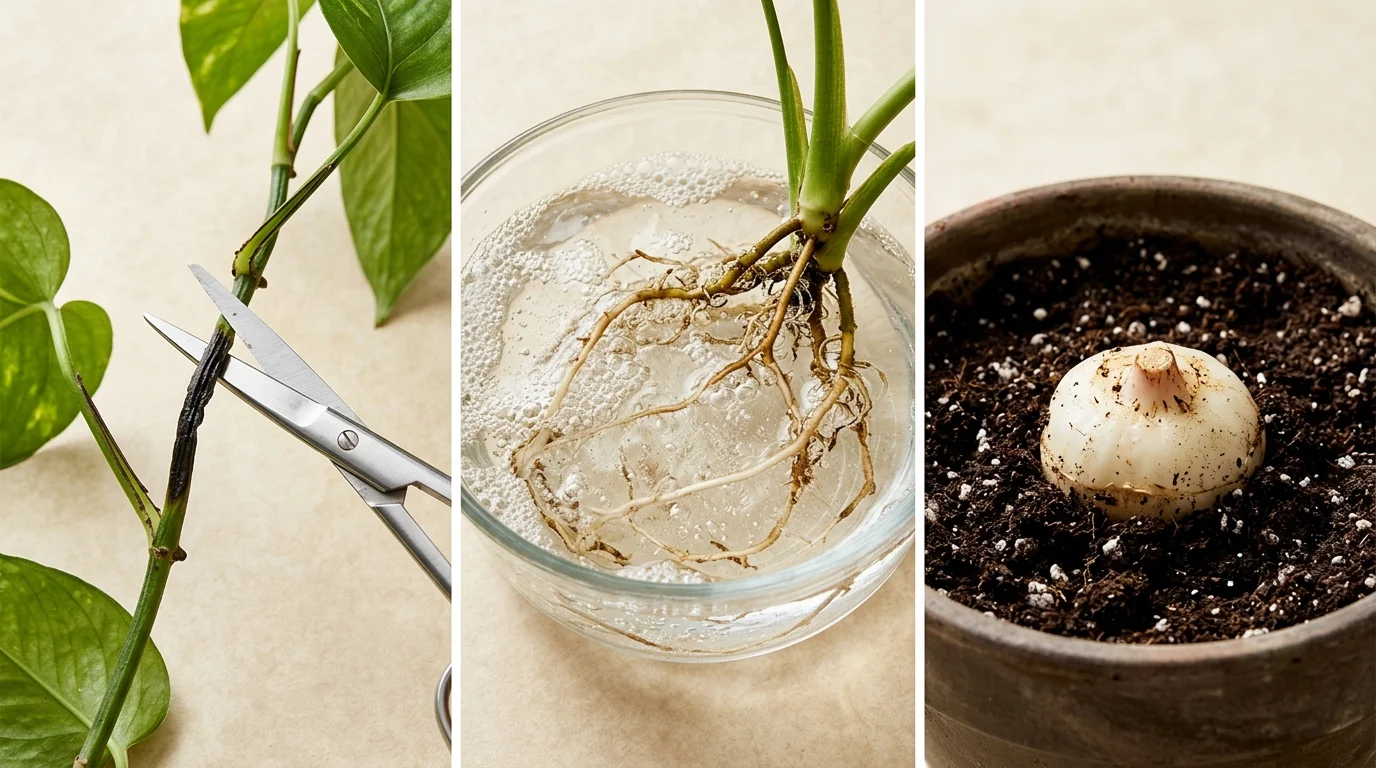
A sick houseplant is stressful, especially when one symptom could mean opposite things. Wilting can come from a bone-dry pot or a waterlogged one. Virginia Cooperative Extension makes this point in its diagnosis guide: many different causes can produce the same symptom, so the questions you ask matter more than the first guess.
The good news, from Clemson HGIC: most houseplant problems have environmental or cultural causes, and diseases are uncommon indoors. That means most fixes are changes to watering, light, pot or feeding.
Step 1: answer four questions before you treat anything
- What changed recently? A move, a repot, a new window, a heater, a holiday. Illinois Extension notes that newly bought plants often drop or yellow some leaves while they adjust, which should pass within a few weeks.
- Is the mix wet or dry right now? Push a finger about 5 cm (2 in) into the pot, as University of Maryland Extension suggests, or lift the pot to judge its weight.
- Which leaves are affected? Oldest, newest, or all at once. The pattern narrows the cause.
- Can you see anything on the leaves? Check the undersides and stems for insects, webbing, sticky residue or white fluff.
Step 2: check the roots
If the plant is wilting, yellowing or collapsing, slide it out of the pot. Maryland says healthy roots are light-coloured and firm. UW–Madison describes rotting roots as soft and brown, often with a bad smell. Clemson adds that infected roots may be brown to black.
Roots tell you whether you are dealing with a watering problem, a root problem or something above ground. Most branches of the flowchart below depend on this check.
Step 3: follow your symptom
Wilting or drooping
| What you find | Likely cause | What to do |
|---|---|---|
| Mix is dry, roots firm | Underwatering | Water thoroughly until it drains |
| Mix is wet, roots soft and brown | Overwatering and root rot (UW–Madison, Clemson) | Let the mix dry; see the root rot section below |
| Roots fill the pot, plant wilts soon after watering | Pot-bound (Clemson) | Repot into a slightly larger pot |
| White crust on soil or pot rim | Fertilizer or hard-water salts (Clemson) | Flush with plain water or repot in fresh mix |
Plant-specific guides: peace lily drooping, snake plant drooping, pothos drooping.
Yellow leaves
- Whole plant yellowing: Clemson says the most common cause is overwatering. Too little light, too little fertilizer, insects and mites can also do it. Check drainage and roots first.
- Old and new leaves yellowing and dropping together: the RHS lists this among signs of too much water.
- Lower leaves only, yellowing then browning: Clemson says this is generally nitrogen or iron deficiency, especially in pot-bound plants. It can also follow long periods of dryness.
- Only the lowest, oldest leaves, one at a time: can be normal ageing if new growth looks healthy. UF/IFAS lists age as the cause when Ficus lose lower leaves only.
Read more: why houseplant leaves turn yellow, pothos yellow leaves, monstera yellow leaves, peace lily yellow leaves.
Brown tips and edges
Clemson lists four causes: hot, dry air; improper watering; insect feeding; and salt accumulation. It also notes that some houseplants are sensitive to fluoride or chlorine in tap water. Maryland adds that over-fertilization, high soluble salts and lack of water can all scorch leaf margins.
What to check: a white or grey crust on the soil or pot rim (salts), the watering pattern, and whether the plant sits near a heater. The RHS lists brown, crispy leaf edges among signs of too little water.
Read more: spider plant brown tips, peace lily brown tips, dracaena fluoride toxicity, tap water for houseplants.
Spots, blisters and patches on leaves
| What you see | Likely cause (source) |
|---|---|
| Small brown spots with yellowish margins, sometimes target rings or tiny black dots | Fungal leaf spot (Clemson) |
| Water-soaked spots, sometimes with a yellow halo or sticky ooze | Bacterial leaf spot (Clemson) |
| Small blisters on leaf undersides that turn tan and corky | Edema: wet soil with low light, cool air or high humidity (UW–Madison, Clemson) |
| Bleached or whitened patches | Too much light or sunburn (Maryland) |
| White or straw-coloured patches after watering | Cold water spots (Clemson) |
Remove spotted leaves and keep water off the foliage for leaf spots (Clemson, Maryland). For edema, water less often in dull weather and improve light (UW–Madison). Read more: brown spots on houseplant leaves, edema in houseplants, pothos sunburn.
Leaves dropping
Clemson lists over- or under-watering, a pot that is too small, a sudden change of environment, chilling, and occasionally insects or disease. Leaf drop after a move should last only about three weeks. Read more: fiddle-leaf fig dropping leaves.
Black, mushy stems at the soil line
Clemson describes root and stem rot as a noticeable wilt, with stems sometimes girdled at or near soil level by a ring of brown or black tissue. Maryland lists stem cankers (discoloured areas on the stem) and cold injury, which can blacken leaves or shoots for up to a week after exposure. Protect plants from temperatures below 10 °C (50 °F).
Read more: pothos black stems, pothos bacterial infection, pothos root rot.
Insects, webbing, stippling or white fluff
Maryland’s diagnosis table lists:
- Fine stippling or webbing: spider mites on the leaf undersides.
- White cottony fluff in leaf axils: mealybugs.
- Raised brown or black bumps: scale insects.
- Tiny white insects that fly up when disturbed: whiteflies.
- Tiny black flies near the pot: fungus gnats. Let the potting mix dry between waterings.
Read more: spider mites on houseplants, mealybugs, scale insects, fungus gnats.
Pale, stretched or slow growth
Iowa State says too little light shows as leaf drop, failure to flower, and pale, spindly or slow growth. Too much light shows as bleached or damaged leaves. Maryland adds that excessive fertilizer can also cause spindly growth. Read more: pothos etiolation.
White powder, grey fuzz or mould on the soil
Maryland lists powdery mildew (white powder on leaves) and grey mould (fuzzy grey growth on old flowers or lower leaves). Improve air circulation and pick off affected parts. For growth on the soil surface, see mold on houseplant soil.
Step 4: if the roots are rotting
UW–Madison is frank that throwing out a plant with root rot is often the most cost-effective option. If you keep it:
- Reduce soil moisture. UW–Madison says this is the most important step. Give enough water to prevent drought stress, but no more.
- Cut out rotten roots and repot in sterile mix if only a few are affected (Clemson). Maryland suggests replanting the healthy sections or taking cuttings to root in sterile potting mix.
- Use a pot with drainage holes and no gravel layer, plus pasteurized commercial potting mix, not garden soil (UW–Madison).
- Do not reuse old mix or drainage water. Disinfect tools and clay pots with a 10% bleach solution or alcohol (UW–Madison).
UW–Madison does not recommend chemical fungicides for root rot on houseplants. Read more: houseplant root rot.
When to stop treating
Maryland says plants with viruses (mottled green and yellow foliage, stunting) or cyclamen mites should be discarded. It gives the same advice for severely damaged plants.
If you cannot tell what you are looking at, get a second opinion. UW–Madison notes that very few diseases can be diagnosed accurately by eye. Your local extension office or plant clinic can examine a sample.
References
- Clemson Cooperative Extension HGIC 2251: Houseplant Diseases & Disorders
- University of Maryland Extension: Diagnose Indoor Plant Problems
- University of Maryland Extension: Watering Indoor Plants
- UW–Madison Plant Disease Diagnostics Clinic, B. Hudelson and L. Jull: Root Rots on Houseplants
- UW–Madison Plant Disease Diagnostics Clinic, A. Joy and B. Hudelson: Edema
- Virginia Cooperative Extension, A. X. Niemiera: Diagnosing Plant Problems, 426-714
- Iowa State University Extension and Outreach: How to Care for Houseplants
- University of Illinois Extension: Houseplants: Get Started
- Royal Horticultural Society: How to help a poorly houseplant
- UF/IFAS Extension, J. Chen et al.: Cultural Guidelines for Commercial Production of Interiorscape Ficus (ENH879)