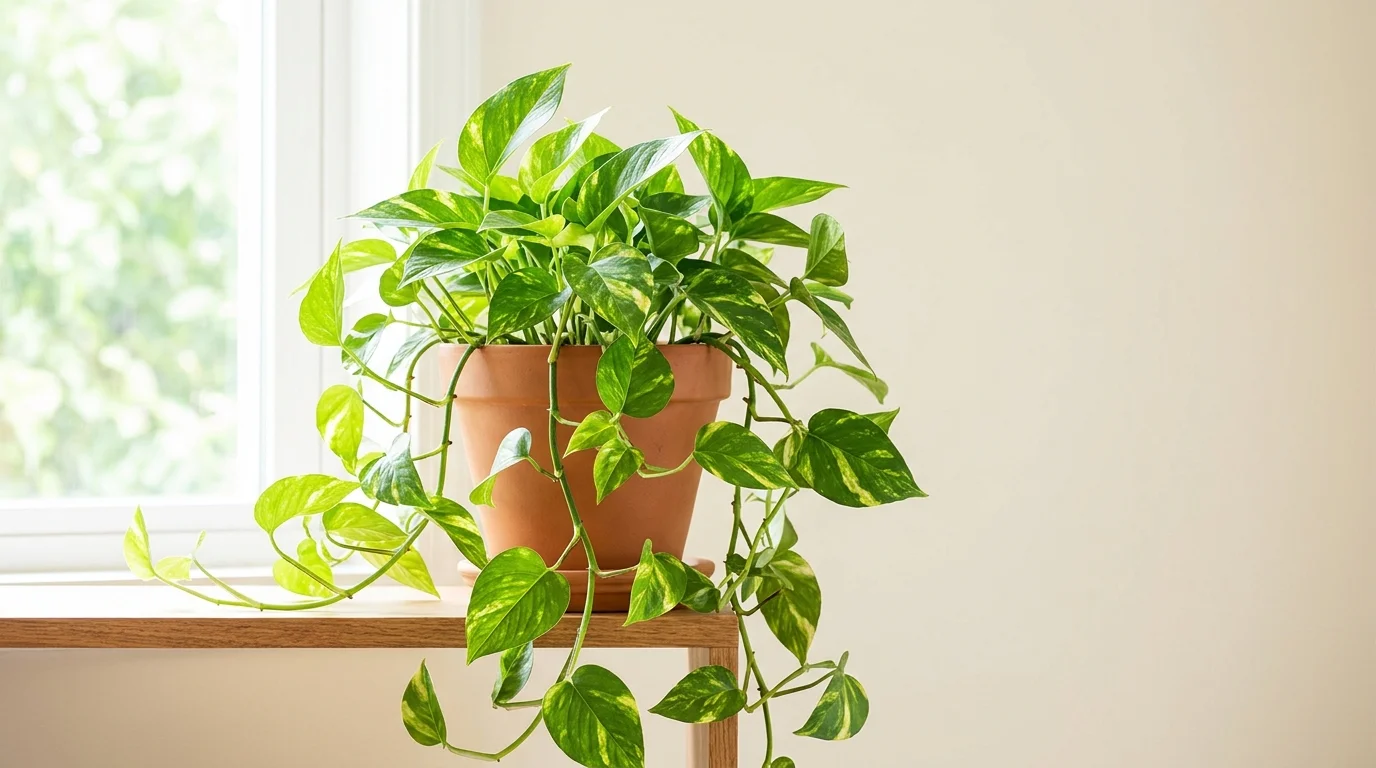
Pothos earns its reputation. Iowa State Extension calls it one of the easiest and most forgiving houseplants you can grow, and NC State rates it low-maintenance. It still has preferences. Getting the light right for your cultivar and letting the mix dry between waterings prevents most problems.
Pothos is Epipremnum aureum, also called devil’s ivy or golden pothos, in the arum family (Araceae). It was once sold as Scindapsus aureus (NC State). Indoors it keeps small, heart-shaped juvenile leaves. In the wild, the vines climb trees and the leaves grow far larger, split and with holes (UF/IFAS, Clemson).
This is our main pothos care guide. For the differences between ‘Golden’, ‘Marble Queen’, ‘Neon’, ‘Jade’ and the rest, see our pothos varieties guide.
Pothos care at a glance
| Factor | What the sources say |
|---|---|
| Light | Bright, indirect; survives long periods in low light (NC State). Variegated types need more light (Clemson, UF/IFAS) |
| Water | Let the mix dry between waterings, then water thoroughly (NC State, Clemson) |
| Temperature | 16–21 °C (60–70 °F) at night, 21–29 °C (70–85 °F) by day (Clemson). Keep away from vents and drafts |
| Humidity | Prefers 50–70%; tolerates the 30–60% typical of homes (Clemson) |
| Mix | Airy, well-draining (Clemson); well-aerated (UW–Madison) |
| Feeding | Every other month, except in winter (NC State, UW–Madison) |
| Repotting | Every year or two, when roots fill the pot (Clemson) |
| Propagation | Stem cuttings with at least one node, in water or mix (Clemson) |
| Pets | Toxic to dogs and cats (ASPCA) |
Light: match it to the cultivar
NC State says pothos prefers bright, indirect light and survives for long periods in low light. University of Illinois lists it as a medium-light plant; Missouri says it suits low and medium light. Iowa State puts it in low to moderate light.
UF/IFAS gives the clearest numbers for indoor plants. Pothos tolerates as little as 50 foot-candles, about 540 lux, but new leaves will be small and variegated cultivars lose colour. Around 150 foot-candles, roughly 1,600 lux, maintains colour and leaf size. On Illinois’s window guide, that is directly in front of a north window or a few feet from an east or west one.
How much light depends on the cultivar:
- Solid green ‘Jade’. NC State calls it great in low light.
- ‘Marble Queen’, ‘Snow Queen’, ‘Pearls and Jade’. Clemson says these need more light, or lots of bright indirect light, to keep their colouring.
- All types. UW–Madison says pothos does not tolerate much direct sunlight.
If new leaves come out smaller and greener than the old ones, the plant needs more light. See pothos losing variegation and, for scorch from too much sun, pothos sunburn.
Watering
Every source agrees on the pattern: let it dry, then water thoroughly.
- NC State: let the well-drained potting medium dry out between waterings.
- UW–Madison: water only when the soil surface is dry.
- Clemson: let the soil dry between waterings, then water thoroughly so it reaches all the roots.
- UF/IFAS: indoors, pothos does better if grown “a little on the dry side”.
Missouri Extension notes that pothos needs less uniform moisture than heartleaf philodendron. Check with a finger before watering, empty the saucer after, and expect a longer gap in winter. Clemson lists root rot from overwatering or poorly draining soil as a common problem. If the mix stays wet and leaves droop, see pothos overwatering and pothos root rot.
Temperature and humidity
Clemson recommends 16–21 °C (60–70 °F) at night and 21–29 °C (70–85 °F) by day. Keep pothos away from air-conditioning vents in summer, and cold sills and heating vents in winter. Hot and cold air can dry out the leaves.
Cold causes a specific symptom. UF/IFAS links scattered brown patches in the centre of the leaf to several hours at 1–4 °C (33–40 °F), or abrupt temperature changes. UW–Madison describes the same pattern.
Clemson gives pothos a preferred humidity of 50–70%, against 30–60% in an average home. It tolerates the lower range, and a humidifier helps if you want to raise it.
Pruning, climbing and fuller plants
NC State explains why long pothos vines look bare at the base. Over time, older leaves yellow and fall, concentrating leaves at the vine ends. Its advice is to prune stems back to keep the plant bushy. UW–Madison says plants can be cut back to 5 cm (2 in) above the soil if necessary. Iowa State suggests pinching tips to promote fullness. See leggy pothos for where to cut.
Give it something to climb for bigger leaves. NC State says pothos climbs by aerial roots. With a support and adequate light, it begins to produce large, mature leaves. Clemson suggests a moss pole or wooden rod. See pothos aerial roots and support and leaf size.
Propagation
Pothos roots readily from stem cuttings.
- Cut a stem section with at least one node, the joint where a leaf meets the stem (Clemson). UF/IFAS describes commercial cuttings of 2.5–4 cm (1–1½ in), each with a node and an attached leaf.
- Root it in water or potting mix (Clemson). UW–Madison says vines root in water or vermiculite within 3 to 4 weeks in warm conditions.
- Pot several rooted cuttings together for a fuller plant (UW–Madison).
A leaf without a node will not grow a new vine. Our pothos propagation guide has the full method.
Repotting and feeding
Clemson says to repot when roots show through the drainage holes or the plant becomes root-bound; most need it every year or two. Use an airy, well-draining mix. For newly bought plants, UF/IFAS advises waiting about four weeks before repotting or feeding, to avoid adding stress.
NC State and UW–Madison suggest feeding every other month, except in winter when growth slows. Clemson suggests every other month in spring and summer. UW–Madison warns that excess fertilizer can build up salts that blacken leaf margins.
Common problems
| What you see | Likely cause | What to check or do |
|---|---|---|
| A few older leaves yellowing at the base of vines | Normal ageing (NC State, UW–Madison) | Prune long bare vines |
| Many yellow leaves | Mix kept too dry or too wet (UF/IFAS); overwatering or low fertility (Clemson) | Check the mix before watering; see pothos yellow leaves |
| Brown patches in the centre of leaves | Cold, or an abrupt temperature change (UF/IFAS, UW–Madison) | Move away from cold glass and air conditioning |
| Blackened leaf tips or margins | Over- or underwatering, or salt from excess fertilizer (UW–Madison) | Flush the pot with plain water; feed less |
| Scorch and tip dieback | Low humidity or intense light (Clemson) | Move out of direct sun; see pothos brown tips |
| Small new leaves, fading variegation | Too little light (UF/IFAS, UW–Madison) | Move closer to a window |
| White cottony masses, bumps, fine webbing | Mealybugs, scale or spider mites (UW–Madison, Clemson) | See pothos mealybugs |
Is pothos safe for pets?
No. The ASPCA lists golden pothos as toxic to dogs and cats because of insoluble calcium oxalates. Listed signs include oral irritation, intense burning of the mouth, tongue and lips, excessive drooling, vomiting and difficulty swallowing. Clemson advises keeping pothos out of reach of children and pets. See is pothos toxic to pets for what to do if a pet chews one.
Still deciding between pothos and its look-alike? See pothos vs philodendron.
References
- NC State Extension Gardener Plant Toolbox: Epipremnum aureum
- Clemson Cooperative Extension HGIC 1568: How to Grow Pothos Indoors (Epipremnum spp.)
- UW–Madison Extension: Pothos, Epipremnum aureum
- UF/IFAS Extension, D. B. McConnell et al.: Cultural Guidelines for Commercial Production of Interiorscape Epipremnum (ENH894/EP151)
- Iowa State University Extension and Outreach, A. Steil: Easy low-maintenance houseplants
- University of Missouri Extension, D. H. Trinklein: Lighting Indoor Houseplants, G6515
- University of Illinois Extension: Houseplants: Lighting
- ASPCA Animal Poison Control Center: Golden Pothos