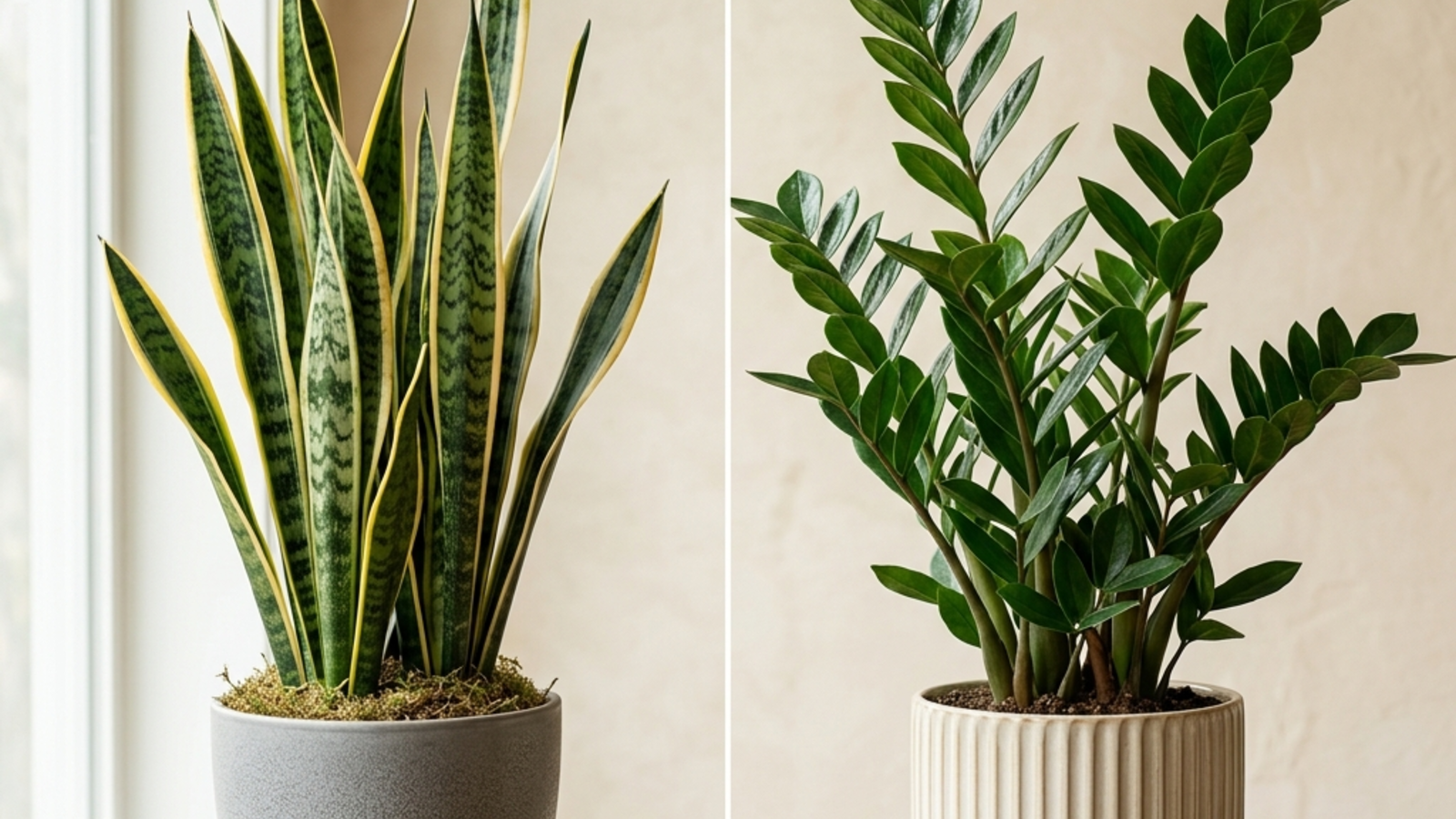
Snake plant and ZZ plant are the two plants most often recommended for a dim office or a forgetful owner. Both come from Africa, both store water, and both rot if kept wet. They are not related, though. Snake plant is Dracaena trifasciata (formerly Sansevieria trifasciata), in the asparagus family. ZZ plant is Zamioculcas zamiifolia, an aroid in the same family as philodendron and peace lily (NC State, Iowa State).
The differences that matter day to day are leaf shape, how much sun each accepts, how far to cut back winter watering, and how fast each grows.
How to tell them apart
Snake plant. NC State describes stiff, upright, succulent leaves in rosettes or clusters. They are flat, up to 1.2 m (4 ft) long and 5–10 cm (2–4 in) wide, with crossways bands in shades of green. Some cultivars have yellow edges or lengthwise stripes. Each leaf rises on its own from the base.
ZZ plant. NC State describes pinnately compound leaves: one thick stalk carrying glossy, oval leaflets 2.5–5 cm (1–2 in) long. Iowa State Extension notes the leaflets are so shiny they look polished. Each stalk is slightly swollen at the base and grows from an underground rhizome (Iowa State).
If you see single sword-shaped blades, it is a snake plant. If you see a row of leaflets on a stalk, it is a ZZ.
Side-by-side comparison
| Feature | Snake plant (Dracaena trifasciata) | ZZ plant (Zamioculcas zamiifolia) |
|---|---|---|
| Family (NC State) | Asparagaceae | Araceae (aroids) |
| Leaves | Single, stiff, sword-shaped, banded | Compound; glossy leaflets on a thick stalk |
| Water storage | Succulent leaves (RHS) | Fleshy underground rhizomes (NC State, UF/IFAS) |
| Size | Leaves up to 1.2 m (4 ft) (NC State) | 0.6–1.2 m (2–4 ft) tall and wide (NC State) |
| Growth rate (NC State) | Medium | Slow; Iowa State says it grows in spurts |
| Best light | Medium to bright (Missouri); some direct sun accepted (NC State, RHS) | Bright, indirect (NC State, Iowa State, UF/IFAS) |
| Low light | Tolerates very low light (NC State) | Tolerates very low light, even fluorescent only (NC State) |
| Direct sun | Sources differ (see below) | Scalds leaves (NC State); avoid afternoon sun (Iowa State) |
| Summer watering | Let the mix dry between waterings (NC State) | Thorough watering once dry; Iowa State says every 7–14 days usually suits |
| Winter watering | Every one to two months (NC State) | About once a month (NC State) |
| Cool tolerance | Tolerates around 10 °C (50 °F) (NC State) | Bring container plants indoors below 16 °C (60 °F) (NC State) |
| Propagation | Division or leaf cuttings (Iowa State) | Division or leaf cuttings (NC State, Iowa State) |
| Pets | Toxic: saponins (ASPCA) | Toxic: calcium oxalate, medium severity (NC State) |
Light: both tolerate shade, but they differ on sun
Both plants survive low light, which is why offices use them. NC State says ZZ plant will grow in very low light, even where there is only fluorescent light. Snake plant also tolerates very low light (NC State). University of Missouri Extension adds that snake plant makes its best growth in medium to bright light. Low-light tolerance is not the same as growth: expect few new leaves in a dim corner.
Direct sun is where they part ways:
- ZZ plant. NC State says scalding and browning can occur in direct sun. Iowa State warns that direct afternoon sun may damage the foliage. Keep ZZ in bright, indirect light.
- Snake plant. The sources do not agree. NC State suggests a spot with direct sun for 2 to 6 hours a day, and the RHS says sansevierias thrive in sun or light shade. Penn State Extension says to keep it out of direct sun, as it can burn. If you want to move a snake plant into a sunny window, do it gradually and watch for pale or scorched patches.
Watering: let both dry out
Overwatering is the main way to lose either plant. Clemson Extension singles out snake plant as prone to rotting from overwatering, and NC State says ZZ plant does not tolerate wet feet.
Snake plant. NC State advises letting the soil dry between waterings from spring to autumn, then watering only every one to two months in winter. Penn State says to water only when it is dry, and notes it can go a month or so without water.
ZZ plant. NC State suggests watering about once a month in winter. In summer, it suggests twice monthly, but only if the soil has dried out completely. Iowa State says a thorough watering every 7 to 14 days is usually fine, but only after the mix has dried. UF/IFAS warns not to let the roots sit in water.
Treat those intervals as starting points. Push a finger into the mix and water only when it is dry. Then water until it drains, and empty the saucer. Our ZZ watering guide explains why the rhizomes make a calendar unreliable.
Pots, soil and repotting
Both need a pot with drainage holes and a free-draining mix. Penn State suggests a cactus mix or one with perlite for snake plant. NC State says ZZ can be treated much like a cactus or other succulent.
Snake plant likes a snug pot. The RHS says to repot only once roots and leaves have filled the container or are making it buckle. Penn State warns a root-bound plant can break a clay pot. It also suggests a heavy pot for tall varieties, which can topple when the soil is dry.
Feeding and growth
Neither needs much feed. NC State suggests a balanced liquid houseplant fertilizer once or twice a year for ZZ. Iowa State suggests a dilute solution once or twice a month in spring and summer. For snake plant, Penn State suggests half-strength all-purpose fertilizer monthly in the growing season for a more robust plant.
Do not judge either by speed. ZZ is slow (NC State), and Iowa State says it tends to grow in spurts. A ZZ that has not grown for months is not necessarily unhappy.
Propagation
Both can be divided or grown from leaf cuttings (Iowa State). With snake plant, division keeps the leaf pattern. Iowa State notes that leaf cuttings may produce plain green leaves instead. Penn State says division is the easiest method. For ZZ, UF/IFAS describes it as easily propagated from leaf cuttings. See snake plant propagation for the steps.
Pet safety
Neither is safe for a pet that chews plants.
- Snake plant. The ASPCA lists it as toxic to dogs and cats. The toxic principle is saponins, with nausea, vomiting and diarrhea. NC State adds that the sap can irritate skin.
- ZZ plant. It does not appear in the ASPCA database. NC State lists medium toxicity to cats and dogs from calcium oxalate, with diarrhea and vomiting if leaves are eaten in quantity. UF/IFAS says all parts are toxic if ingested.
If pets are the deciding factor, consider cast iron plant or spider plant. The ASPCA lists both as non-toxic; see our pet-safe plants guide.
Which should you choose?
- Upright, narrow accent for a corner or tight space: snake plant.
- Bushy, glossy foliage for a desk or office: ZZ plant.
- Brightest spot you have includes some direct sun: snake plant, acclimated gradually.
- Only fluorescent office light: ZZ plant, which NC State says grows there.
- You often forget to water: either, but check the mix before you water after a long gap.
For full care of each plant, see our snake plant care guide and ZZ plant care guide. If a pot has stayed wet and the plant is wilting, use the snake plant root rot guide.
References
- NC State Extension Gardener Plant Toolbox: Dracaena trifasciata
- NC State Extension Gardener Plant Toolbox: Zamioculcas zamiifolia
- Iowa State University Extension and Outreach, R. Jauron: The ZZ Plant
- Iowa State University Extension and Outreach, A. Steil: Easy low-maintenance houseplants
- UF/IFAS Gardening Solutions: ZZ Plant
- Penn State Extension: Snake Plant: A Forgiving, Low-maintenance Houseplant
- Royal Horticultural Society: How to grow sansevierias
- University of Missouri Extension, D. H. Trinklein: Lighting Indoor Houseplants, G6515
- Clemson Cooperative Extension HGIC 1459: Indoor Plants – Watering
- ASPCA Animal Poison Control Center: Snake Plant