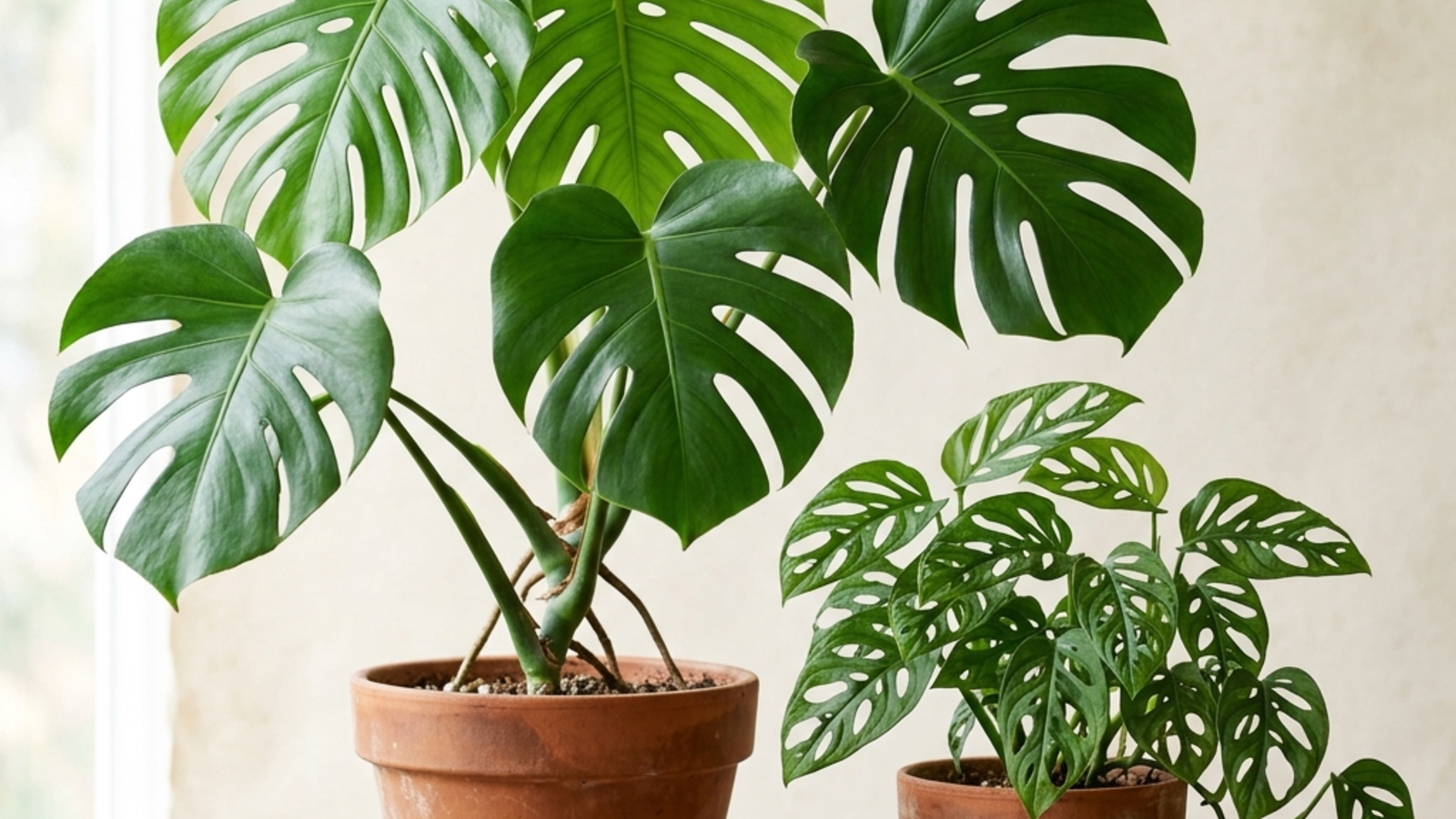
Both plants are sold as “Swiss cheese plant,” and young plants can look alike on a shop shelf. They grow into very different plants. Monstera deliciosa becomes a large, heavy floor plant. Monstera adansonii stays a smaller, denser vine that suits a shelf, a hanging basket or a short pole. Both are aroids from tropical America (NC State).
If you are buying one, the questions are space, light and pets. Care is close enough that the same habits work for both.
How to tell them apart
Monstera deliciosa. NC State describes very large, glossy, heart-shaped leaves, often 30 cm (1 ft) or more across. Mature leaves are perforated with holes, and some run out to the edge, so the leaf looks deeply lobed. Wisconsin Extension says leaves can reach 45 cm (18 in) wide on stalks around 30 cm (1 ft) long. NC State also notes a distinct joint where the leaf blade meets its stalk on mature leaves. Stems are thick.
Monstera adansonii. NC State describes medium to dark green, heart-shaped leaves with oval holes. Penn State says the leaves are much smaller than deliciosa’s, and the plant is denser and quite vigorous. NC State says leaves can reach 45 cm (18 in) across in the wild but are usually smaller on a houseplant; its profile lists a leaf width of about 15 cm (6 in).
The catch with young plants. Wisconsin Extension explains that young deliciosa leaves are small and have no lobes or holes. Holes only develop as the plant matures. A small deliciosa with plain leaves is normal, not a different plant. NC State also notes that deliciosa is often confused with Rhaphidophora tetrasperma, a different aroid vine.
Quick rule: big leaves with splits reaching the edge mean deliciosa. Small leaves with a pattern of oval holes inside the leaf, on a bushy vine, mean adansonii. Check the botanical name on the label too.
Side-by-side comparison
| Feature | Monstera deliciosa | Monstera adansonii |
|---|---|---|
| Common names | Swiss cheese plant, split-leaf philodendron (NC State) | Swiss cheese vine, five-hole plant, Adanson’s monstera (NC State) |
| Native range (NC State) | Mexico to Panama | Southern Mexico to tropical South America |
| Size indoors | Usually 1.8–2.4 m (6–8 ft) (NC State) | 0.9–2.4 m (3–8 ft) tall, 0.3–0.9 m (1–3 ft) wide (Penn State) |
| Leaves | Very large; lobed, with holes reaching the edge | Smaller; oval holes |
| Growth rate (NC State) | Rapid | Rapid |
| Light | Bright, not direct sun (Penn State, NC State) | Bright, indirect; direct sun scorches (NC State) |
| Temperature | 16–29 °C (60–85 °F); no growth below 10 °C (50 °F) (Penn State, Wisconsin) | Avoid drops below 10 °C (50 °F) (NC State) |
| Watering | Let the top quarter to third dry (NC State) | Moist, well-drained mix; water when dry (NC State, UF/IFAS) |
| Support | Sturdy pole to stop stems breaking (NC State) | Pole, trellis or hanging basket (NC State, UF/IFAS) |
| Propagation | Stem cuttings or layering (NC State) | Stem cuttings with a node (NC State, UF/IFAS) |
| Pets | Toxic: insoluble calcium oxalates (ASPCA) | Toxic: calcium oxalate crystals (NC State) |
Size and space: the deciding difference
Deliciosa needs floor space. NC State says it can reach 21 m (70 ft) in the wild but usually stays at 1.8–2.4 m (6–8 ft) indoors. Penn State calls it a floor plant for large spaces. Its stems are heavy, and NC State says it needs sturdy support to keep them from breaking.
Adansonii is a vine you can keep on a shelf. UF/IFAS suggests growing it in a hanging basket or up a pole wrapped in sphagnum moss. On a support, NC State and Penn State give a height of 0.9–2.4 m (3–8 ft) and a width of only 0.3–0.9 m (1–3 ft).
Light
Both want bright light without hot direct sun on the leaves.
- Deliciosa. Penn State says to place it near a sunny window with bright light, but not direct sun. It gets leggy in lower light. Wisconsin Extension adds that it can grow under fluorescent light, but will not develop leaf holes when light is inadequate. NC State says variegated cultivars need more light than green ones.
- Adansonii. NC State recommends bright, indirect light and warns that direct sun scorches the leaves. UF/IFAS suggests a spot near an east- or west-facing window.
If new deliciosa leaves are arriving without holes, light is the first thing to check. See Monstera with no fenestration and leggy Monstera growth.
Watering
Both rot if kept wet. Water thoroughly, let it drain, and check the mix before the next watering.
Deliciosa. NC State says to let the top quarter to third of the mix dry between waterings. Penn State says the top 2.5–5 cm (1–2 in). Wisconsin Extension notes that leaves “sweat” droplets when the mix is too moist, which is a cue to water less.
Adansonii. NC State recommends a moist, well-drained mix. UF/IFAS says to water when dry and not to leave water standing in the saucer, as root rot can follow. It suggests an orchid mix as an ideal free-draining base.
Our Monstera watering guide explains how to tell a thirsty plant from a wet root zone. If leaves yellow in wet mix, see Monstera root rot or adansonii yellow leaves.
Warmth, humidity and feeding
Both are tropical. Penn State gives 16–29 °C (60–85 °F) for deliciosa and suggests humidity above 50 percent. Wisconsin says deliciosa does not grow below 10 °C (50 °F) and frost kills it. NC State says to avoid cold drafts and drops below 10 °C (50 °F) for adansonii, and recommends high humidity for both.
Penn State suggests feeding deliciosa with a balanced houseplant fertilizer every two weeks in the growing season and monthly in winter.
Support and propagation
Both climb with aerial roots. Wisconsin Extension suggests a strong, moss-covered support for deliciosa and watering the moss so aerial roots can take up water. NC State recommends a stake, trellis or moss pole for adansonii.
Both are propagated from stem cuttings. NC State and Penn State add air layering for deliciosa. UF/IFAS says an adansonii cutting needs at least one node or existing roots. See adansonii propagation.
Pests
NC State lists spider mites, mealybugs, aphids, whiteflies and scale for adansonii, plus leaf spots if water splashes the foliage. Penn State lists scale, aphids, mealybugs, spider mites, thrips and fungus gnats for deliciosa. Check leaf undersides on both.
Pet safety
Neither is safe for a pet that chews leaves.
- Deliciosa. The ASPCA lists the Swiss cheese plant as toxic to dogs and cats. The toxic principle is insoluble calcium oxalates. Signs include oral irritation, drooling, vomiting and difficulty swallowing.
- Adansonii. It is not in the ASPCA database. NC State lists it as a problem for cats, dogs and children, from calcium oxalate crystals. It also says the sap irritates skin, so wear gloves when pruning.
Which should you choose?
- Large room and a bright window: deliciosa, as a floor plant with a sturdy pole.
- Shelf, hanging basket or small apartment: adansonii.
- You want the large, split leaves: deliciosa, given good light and time to mature.
- You want fast, dense trailing growth: adansonii.
- Pets that chew plants: neither; see our pet-safe plants guide.
For full care, see our Monstera deliciosa care guide and Monstera adansonii care guide. For more pairs, see the houseplant comparison guide.
References
- NC State Extension Gardener Plant Toolbox: Monstera deliciosa
- NC State Extension Gardener Plant Toolbox: Monstera adansonii
- Penn State Extension, S. Marquesen: Monstera as a Houseplant
- University of Wisconsin–Madison Extension: Monstera, Monstera deliciosa
- UF/IFAS Extension Charlotte County, R. Mitchell: Holey leaves – when holes in leaves are a good thing
- ASPCA Animal Poison Control Center: Swiss Cheese Plant