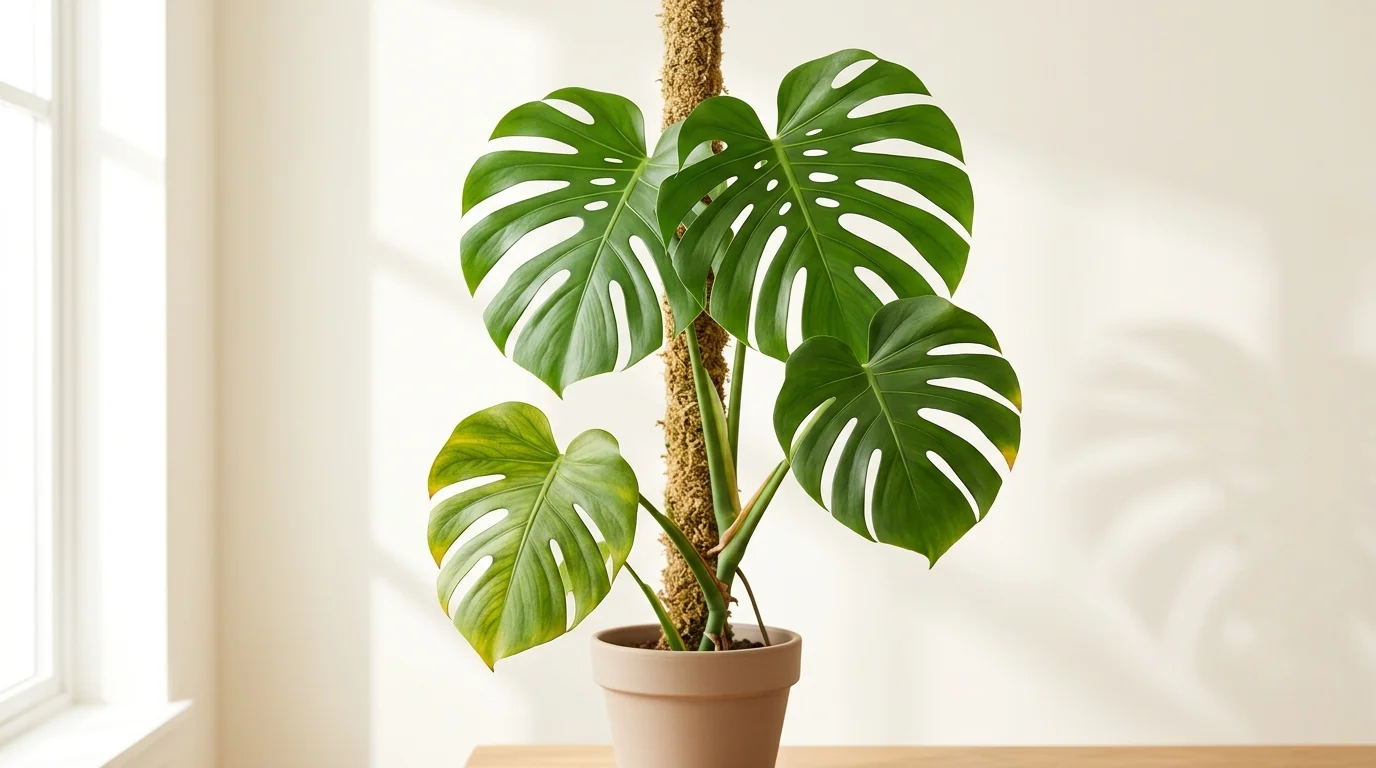
A Monstera deliciosa is forgiving about most things and unforgiving about two. A pot that stays wet rots the roots. Too little light gives you small, solid leaves on long stems. Get those two right and add a support, and this plant grows quickly indoors.
NC State Extension describes it as a woody climbing vine in the arum family (Araceae), native from Mexico to Panama. It can reach 21 m (70 ft) in the wild but usually stays at 1.8–2.4 m (6–8 ft) in a home. In the wild it starts on the ground, then climbs once it reaches a tree. Despite the old name “split-leaf philodendron”, it is not a philodendron. If you are not sure which monstera you have, see our Monstera deliciosa vs adansonii comparison.
Monstera care at a glance
| Factor | What the sources say |
|---|---|
| Light | Moderate brightness, not direct sun (NC State). Bright light in summer, direct sun in winter (Wisconsin) |
| Water | Soak, then let the top quarter to one-third dry (NC State). Less in winter |
| Mix | Well-draining, high in organic matter (UConn). Bark or perlite improves drainage (Penn State) |
| Temperature | 16–29 °C (60–85 °F) (NC State, Penn State). No growth below 10 °C (50 °F) (Wisconsin) |
| Humidity | High (NC State); preferably above 50% (Penn State) |
| Feeding | During active growth; easily burned by salts (UConn) |
| Support | Sturdy pole or moss stick to stop stems breaking (NC State, Penn State) |
| Propagation | Stem cuttings or layering (NC State) |
| Pets | Toxic to dogs and cats (ASPCA) |
Light: what decides leaf size and splits
NC State says the plant prefers moderate brightness but not direct sunlight. Penn State suggests a site near a sunny window that gives bright light but not direct sun, and warns that plants get leggy in lower light. University of Wisconsin Extension recommends bright light in summer and direct sun in winter.
The sources agree on one point that matters most: light drives the leaf you get. Wisconsin says the plant will not develop leaf perforations when light is inadequate. UConn cautions that the large leaves burn easily, so increase sun gradually. NC State notes that variegated cultivars such as ‘Albo Variegata’ and ‘Thai Constellation’ need more light than green plants.
If your new leaves come out small and solid on long gaps of stem, check light first. Our guides on leaves without holes, leggy growth and variegated monstera light cover the checks.
Watering
NC State says to water thoroughly, then let the top quarter to one-third of the mix dry before watering again. Penn State puts it as the top 2.5–5 cm (1–2 in), and UConn as the top 5–7.5 cm (2–3 in). All three are the same idea: soak, drain, and wait until the upper part of the pot has dried.
Wisconsin says plants kept drier grow more slowly, and to water less in winter. UConn warns the plant is susceptible to root diseases, especially in winter. Wisconsin also notes that an overwatered plant may “sweat” droplets from its leaves, a sign to cut back.
We cover how to check the mix, and how to tell a thirsty plant from one sitting in wet mix, in Monstera watering: thirst or wet mix?.
Mix, pot and repotting
UConn recommends a well-draining potting mix with high organic matter. Penn State suggests a soilless mix rich in organic matter, with bark, charcoal or perlite added for drainage. The RHS recommends a peat-free, loam-based potting compost. Our guide to why monstera roots need air explains why a dense, wet mix fails.
Repot only when the plant needs it. UConn says to repot when roots reach the bottom and sides of the pot, and to step up gradually in pot size. It adds that monsteras tolerate being pot-bound far better than being over-potted. NC State says spring is the time to prune or repot. Wisconsin notes that a fast-growing plant will need repotting more often to give the roots room. If a plant wilts after a move, see monstera transplant shock.
Support
This is a climber, and it needs something to climb. NC State says sturdy support prevents the stems from breaking. Penn State lists moss sticks, trellises, bamboo stakes and boards covered with sphagnum moss. Wisconsin recommends a bark or moss-covered support sunk into the pot, so the aerial roots can attach, and suggests watering the moss too.
UConn says moss poles mimic a natural climbing surface, and leaf size typically increases once the plant attaches. Tie the stem loosely and let the aerial roots grip on their own.
Humidity and temperature
NC State gives an average warm range of 16–29 °C (60–85 °F) and high humidity. It suggests a humidifier or a tray of wet pebbles in dry rooms. Penn State gives the same temperature range and suggests humidity preferably above 50%. It adds that monsteras hate cold draughts.
Wisconsin says the plant does not grow below 10 °C (50 °F) and that frost kills it. It links brown leaf edges to humidity that is too low. Wisconsin also notes the plant tolerates a wide range of conditions once acclimated. NC State recommends wiping dust off the leaves regularly.
Feeding
Feed while the plant is growing, and lightly. The RHS suggests a balanced liquid fertiliser monthly during active growth. Penn State suggests every two weeks in the growing season and monthly in winter. UConn warns that monstera is easily burned by high soil salts, though it can take regular feeding while actively growing. If growth is slow, check light and roots before feeding more; see monstera slow growth.
Propagation
NC State recommends layering or stem cuttings. Each method needs a piece of stem, not a lone leaf:
- Stem cuttings. UConn says to cut 7.5–12.5 cm (3–5 in) below a node, keeping as many aerial roots as possible. Wisconsin suggests cutting just below the aerial roots and potting the section.
- Cane sections. Wisconsin describes cutting the vine into 30 cm (1 ft) sections and pressing them halfway into rooting medium, then transplanting once they root.
- Air layering. Penn State lists air layering, along with stem cuttings, as the easiest methods.
NC State recommends pruning in spring, so stems you cut back then can become cuttings. The RHS also lists seed and root tip cuttings.
Problems and what to check
| What you see | Likely cause | Written guide |
|---|---|---|
| Yellow leaves | Wet mix, root damage, light change or normal aging | Monstera yellow leaves |
| Brown spots | Sun scorch, leaf spot, or root-zone trouble | Monstera brown spots |
| Wilting while the mix is wet | Roots short of oxygen or rotting | Root oxygen and root rot |
| New leaves solid, no splits | Juvenile plant or too little light | No fenestration |
| Long stems, small leaves | Too little light | Leggy growth |
| White fuzz on the mix | Saprophytic mold on damp mix | Moldy soil |
| Variegated plant turning green | Reversion | Reverting to green |
| Speckled leaves, fine webbing | Spider mites (RHS, Penn State) | Spider mite guide |
Penn State lists scale, aphids, mealybugs, spider mites, thrips and fungus gnats as pests to watch for. UConn names bacterial leaf spot, anthracnose and root and stem rot as the main diseases. It recommends avoiding overwatering and keeping air moving.
Is Monstera deliciosa safe for pets?
No. The ASPCA lists Monstera deliciosa, under the name cutleaf philodendron, as toxic to dogs and cats. Its insoluble calcium oxalates cause intense burning and irritation of the mouth, tongue and lips, drooling, vomiting and difficulty swallowing. NC State rates the poison severity as low and notes the sap can irritate skin. Wisconsin says all parts are poisonous except the ripe fruit, which NC State says the plant rarely produces indoors. Keep it where pets cannot chew it, and wear gloves when you cut it. For alternatives, see our pet-safe houseplants guide and the Monstera deliciosa hub.
References
- NC State Extension Gardener Plant Toolbox: Monstera deliciosa
- University of Wisconsin–Madison Extension, S. Mahr: Swiss-cheese plant, Monstera deliciosa
- Penn State Extension, S. Marquesen: Monstera as a Houseplant
- UConn Home & Garden Education Center: Monstera deliciosa
- Royal Horticultural Society: Monstera deliciosa
- ASPCA Animal Poison Control Center: Cutleaf Philodendron (Monstera deliciosa)