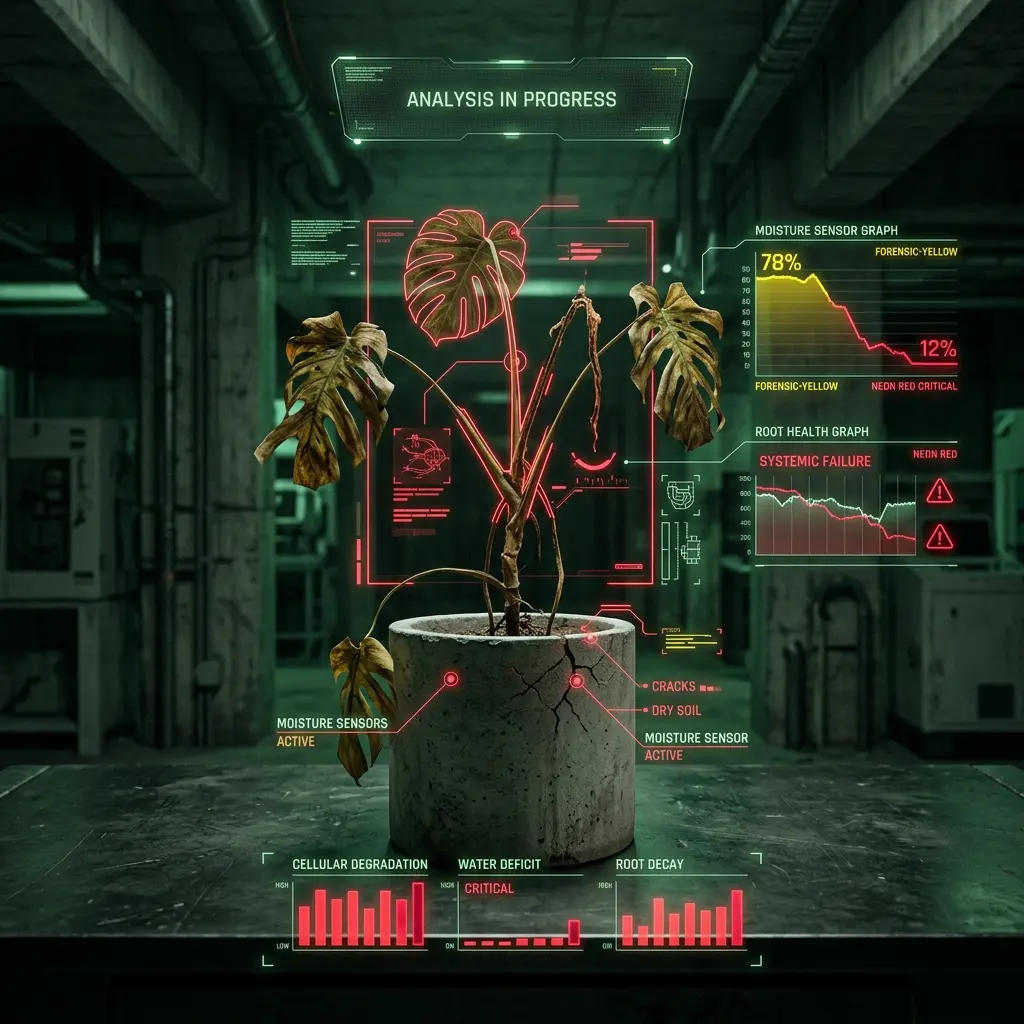
Most houseplant problems start with care, not disease or pests. UC IPM puts improper watering, wrong fertilizer amounts, poor sanitation, low light and low humidity at the top of its list of causes. The RHS says most problems can be fixed by adjusting the growing environment.
That is good news: the habits below are all things you can change today. Each fix comes from a named extension service or the RHS, and none needs a special product.
1. Watering on a schedule
Iowa State calls improper watering the number one reason people have problems with houseplants. Watering every Saturday, it says, gives some plants too much and others too little. Light, temperature, humidity, pot, mix, plant size and season all change how fast a pot dries.
Do instead: check on a schedule, water when needed. University of Maryland Extension suggests feeling the mix to about 5 cm (2 in) deep, or lifting the pot to judge its weight. Cacti and succulents need far less. See our watering guide.
2. Leaving the pot standing in water
Iowa State says roots that stay in water for long periods will rot. A decorative cachepot can hide a pool of water under the nursery pot.
Do instead: water until it runs out of the drainage hole, then empty the saucer or outer pot after 30 to 45 minutes (Iowa State). Maryland says never to let houseplants sit in water.
3. Using a pot without a drainage hole
Iowa State says every container must have a drainage hole. Without one, the soil stays wet and roots rot and die.
Do instead: if you love a pot with no hole, use it as a cachepot. Set a slightly smaller pot with a drainage hole inside it (Iowa State).
4. Adding a gravel layer “for drainage”
This one sounds sensible and is a long-running myth. Iowa State says a gravel layer does not make up for a missing drainage hole. Worse, it creates a wetter zone of soil next to the roots and promotes root rot. UW–Madison says rocks or gravel can inhibit drainage, and Maryland’s repotting guide says not to fill the pot base with gravel.
Do instead: fill the pot with potting mix all the way down. If the hole is large, Iowa State says a small screen or pot shard can stop mix falling out.
5. Moving into a much bigger pot
Iowa State says bigger is not always better. A pot that is too large holds wet mix around roots that cannot use it. Penn State lists overpotting among the habits that encourage disease.
Do instead: move up only one container size, maybe two (Iowa State). Repot when the plant is top-heavy, growth slows or the mix dries very fast. See our repotting signs guide.
6. Using garden soil or dense mix
Iowa State says unamended garden soil compacts and drains poorly in a container. UW–Madison adds that garden soils often carry root rot fungi. Maryland warns that products sold as “potting soil” can be too dense and may need perlite or vermiculite.
Do instead: use a pasteurized commercial potting mix (UW–Madison). Orchids and succulents benefit from specialized mixes (Iowa State). Our potting mix guide explains the ingredients.
7. Overestimating the light in a room
Iowa State says light drops quickly with distance from a window. Spots more than a few feet from even a bright window are often too dark for houseplants, and the areas beside a window are darker than they look. Curtains, films, overhangs and trees outside all cut light further.
Do instead: watch the plant. Iowa State lists pale, spindly or slow growth and leaf drop as signs of too little light. The RHS suggests moving many plants closer to a south- or west-facing window in winter. See our light chart.
8. Misting to raise humidity
Another common myth. Iowa State says misting does not raise humidity for more than a few minutes and can help spread disease. Illinois Extension says repeated misting is needed, and that too much misting can increase disease.
Do instead: group plants together, use a humidifier, or set pots on a pebble tray with the pot base above the water (Iowa State, Illinois). Our humidity guide covers how to measure first.
9. Feeding too much, or feeding a struggling plant
Illinois Extension says plants can be damaged by too much fertilizer, especially when dim light has slowed their growth, and that too much can burn roots. Iowa State explains that extra fertilizer pushes growth the light cannot support, giving spindly, weak stems.
Do instead: feed only while the plant is actively growing. Iowa State says to wait 2–4 weeks after repotting. Leach the pot with plain water every 4–6 months to clear salts (Illinois, Maryland). See our fertilizer schedule.
10. Parking plants by vents, doors and cold glass
Iowa State says big temperature swings cause yellowing, browning, wilting or leaf drop. Illinois warns that cold window panes can damage foliage. Both name heating and air conditioning vents and cold draughts as problems.
Do instead: aim for 18–24 °C (65–75 °F), which Iowa State and Illinois give as the comfortable range for most foliage plants. Do not trap plants between a curtain and a cold window at night (Iowa State).
11. Skipping quarantine, then spraying before you know the pest
Colorado State says scale, mealybug and whitefly problems almost always start from a recently bought or gifted plant. Then, when something appears, it is tempting to grab the nearest spray. UC IPM says to identify the pest correctly first, and to use only a product labeled for indoor use on your plant and that pest. Colorado State warns that dish detergents can injure plants.
Do instead: keep new plants apart for at least three weeks (Colorado State, Penn State); Clemson HGIC suggests six. Inspect them weekly, especially leaf undersides. If you find pests, wash them off with water first, then follow our houseplant pest guide.
A quick self-check
If your plant is already declining, run through these in order: roots and mix, watering, light, pests, temperature. Our guide to saving a dying houseplant walks through each check, and the plant doctor flowchart maps symptoms to causes. For a plant-specific example, see pothos overwatering or monstera yellow leaves.
References
- Iowa State University Extension and Outreach: How to Care for Houseplants
- University of Maryland Extension: Watering Indoor Plants
- University of Maryland Extension: Potting and Repotting Indoor Plants
- University of Illinois Extension: Houseplants: Care
- UW–Madison Plant Disease Diagnostics Clinic: Root Rots on Houseplants
- UC Statewide IPM Program: Pest Notes: Houseplant Problems
- Colorado State University Extension: Managing Houseplant Pests
- Penn State Extension: Pest and Disease Problems of Indoor Plants
- Royal Horticultural Society: How to help a poorly houseplant
- Clemson Cooperative Extension HGIC 2252: Common Houseplant Insects & Related Pests